
Yemen strikes and Trump’s oil claim meet a wide Brent-WTI gap
A wide Brent-WTI spread puts transport risk, not Yemeni production, at the centre of the oil-market question.
 Tomás FerreiraEnergy, shipping and chokepoints
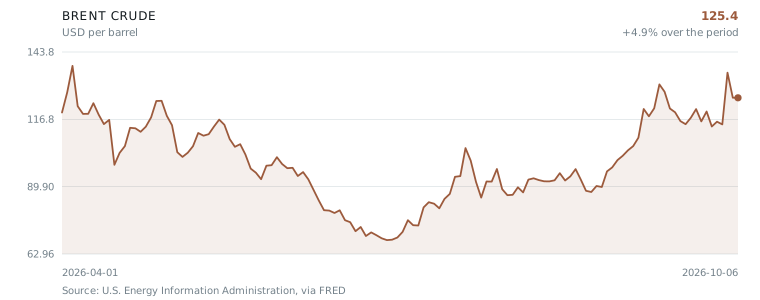
Brent crude was $125.44 and WTI was $96.24 on 6 October, leaving a wide spread of about $29. Yemen’s government launched air strikes on Houthi positions, according to local accounts, while a rights group accused the Houthis of killing five civilians. Trump said the Houthis are purposefully trying to drive up oil prices before the November vote.
On 6 October, Brent crude stood at $125.44 and WTI at $96.24. The gap between the two benchmarks was about $29, a wide split that forces traders to ask which market is telling the tighter story. Into that gap has dropped a new set of Yemeni headlines: air strikes on Houthi positions, civilian casualty accusations and a U.S. political charge that the Houthis are trying to move oil prices before the November vote.
The price numbers are hard. The political and military assertions are softer, and they need to be separated.
The route is the market channel
Yemen’s fighting does not need to remove large volumes of crude from the world to matter to a tanker market. The channel is movement, not production. If shipowners, insurers and cargo owners begin to treat waters near Yemen as more hazardous, the cost appears in war-risk premia, freight negotiations and the time charterers allow for delay. Those costs can build before any physical cargo is actually hit.
The mechanism runs through insurance and routing. Higher premia raise the cost of a voyage. Longer routes add days, tie up hulls and reduce the effective supply of ships. Even a small rise in perceived risk can move freight rates quickly, because tanker economics are sensitive to time, speed and turnaround.
That is why the market’s first question is not whether Yemen can supply less oil. It is whether shipping lanes near Yemen become harder, slower or more expensive to use. The market is not being told that Yemeni barrels are missing; it is being asked to reprice the route.
The market is not being told that Yemeni barrels are missing; it is being asked to reprice the route.
Trump’s accusation adds a political premium
Trump said the Houthis are purposefully trying to drive up oil prices before the November vote. That is a statement about intent, not a verified fact. It also turns a security issue into an election-season argument, which can change how traders read headlines.
Political accusations can matter to prices even when they are unproven, because they raise the chance of policy responses. If the political debate frames oil strength as foreign manipulation, the market may start to watch for sanctions, naval posture, enforcement or military action. Each of those can affect shipping risk, insurance underwriting or the willingness of vessel operators to transit exposed lanes.
The strongest market signal, however, remains the spread itself. Brent is the international, seaborne benchmark; WTI is more tied to inland supply. A $29 gap suggests that the market is already paying up for waterborne crude relative to landlocked crude. Whether that reflects logistics, regional demand, inventories or fear is the debate. Yemen headlines enter that debate as a possible amplifier, not as a standalone explanation.
Civilian toll and the next signal
The Yemeni government launched air strikes on Houthi positions, according to local accounts. A Yemeni rights group accused the Houthis of killing five civilians and injuring more than a dozen. Local accounts say hundreds of people have gone missing, and that new fighting is hindering families’ search for missing loved ones.
These details are not oil-market data. They are a reminder that the conflict has its own gravity. Civilian harm, displacement and missing-person cases can harden negotiations, prolong fighting and make de-escalation harder. For commodity desks, that means the risk is not a one-day spike after a headline. It is the possibility of repeated flare-ups that keep insurers, shipowners and cargo planners on edge.
The rights accusations and missing-person figures rest on local monitoring. That uncertainty matters. It means the conflict narrative is moving faster than the evidence base, which is exactly the environment in which risk premia can overshoot or undershoot.
The next test is whether freight desks and insurers change behaviour. If war-risk premia rise, if tankers seek longer routes, or if charterers demand higher compensation for exposed transits, the oil-risk layer becomes measurable. If not, the headlines remain political noise with a crude-price backdrop.
For now, the clearest fact is the price split: Brent at $125.44, WTI at $96.24, and a gap of about $29. The open question is whether Yemen adds a durable transport premium to that gap, or merely another volatile headline.
- 01Brent crude was $125.44 on 6 October.
- 02WTI crude was $96.24 on 6 October, leaving a spread of about $29.
- 03Trump said the Houthis are purposefully trying to drive up oil prices before the November vote.
- 04The Yemeni government launched air strikes on Houthi positions, according to local accounts.
- 05A Yemeni rights group accused the Houthis of killing five civilians and injuring more than a dozen.
Interpretation, not reporting. The facts above carry their tiers; this is one correspondent’s reading of them.
The oil market is being asked to price two different risks at once: physical disruption and political narrative. I would separate them. Brent at $125.44 and WTI at $96.24 already show a wide $29 gap, and that gap is the cleaner signal. It points to stress in waterborne crude relative to inland crude, which is where a Yemen risk premium would first appear. The air strikes, civilian casualty accusations and Trump’s assertion that the Houthis are trying to push prices up before the November vote may all intensify sentiment, but they do not yet prove that barrels are being blocked. I watch insurers and freight desks before politicians. If premia, routing changes or charter terms move, the risk is real. If they do not, the story remains mostly political. My mind would change quickly if underwriters began treating transits near Yemen as materially more dangerous, because that is the point where a headline becomes a cost.
— Tomás Ferreira
Every claim in this article, and what it rests on
We do not ask you to take our word for it. Each statement below carries its tier and its sources. Where sources disagree, you get both accounts and what would settle it.
Brent crude was 125.44 on 2026-10-06.
WTI crude was 96.24 on 2026-10-06.
The Yemeni government launched air strikes on Houthi positions.
A Yemeni rights group accused the Houthis of killing five civilians.
A Yemeni rights group accused the Houthis of injuring more than a dozen civilians.
Hundreds of people have gone missing in Yemen.
New fighting is hindering Yemeni families’ search for missing loved ones.
Trump said the Houthis are purposefully trying to drive up oil prices before the November vote.
The case against this story
Written by an adversarial reviewer, not the correspondent
The story's overall picture conflates Yemen's civil war with global oil markets through Trump's politically motivated assertion. Yemen is not a significant oil producer, and while Houthi attacks on Red Sea shipping could affect oil transport, the direct causal link to specific oil price levels is tenuous. Trump's claim that Houthis are 'purposefully' trying to drive up oil prices 'before the November vote' attributes strategic intent to influence US elections without evidence. The specific oil price figures show an unusual Brent-WTI spread of approximately $29, which is historically very rare and may indicate error. The Yemen conflict details come from lower-confidence sources, and the rights group's accusations against Houthis have not been independently verified. The framing serves to justify military action against Houthis and deflect blame for high oil prices from domestic factors to foreign actors.
Who benefits from this framing: Trump benefits from blaming Houthis for high oil prices before an election, deflecting from domestic energy policy criticism. The Yemeni government benefits from framing Houthis as aggressors who kill civilians, supporting their military campaign. Oil interests benefit from geopolitical tension that justifies higher prices. Saudi Arabia and coalition partners benefit from international support for their intervention in Yemen.
Report an error in this article
Subscriptions open at launch
Global Materials Review will be a paid publication. Reading is free while we build the archive — leave an address and we will write to you once, when subscriptions open.