
WTI outruns Brent as diesel squeeze stays unresolved
The price move points to U.S. crude buying, but the diesel forecast still needs physical proof.
 Tomás FerreiraEnergy, shipping and chokepoints

WTI rose from $96.24 on 6 October to $101.91 on 14 October, outpacing Brent's move from $125.44 to $126.55. The Brent-WTI gap narrowed from $29.20 to $24.64, while the diesel story remains a forward-looking market view. The key question is whether crude strength can become product supply.
On 14 October, WTI was $101.91 and Brent was $126.55. Eight days earlier, they stood at $96.24 and $125.44. The U.S. benchmark did the running: up $5.67, against a $1.11 gain in Brent. The Brent-WTI gap narrowed from $29.20 to $24.64, but it remains a wide gulf.
That matters because the market's bigger story is not crude in general. It is diesel in particular. The forecast being carried forward is that the diesel crunch will persist well into 2027, even as recent increases in crude flows out of the Strait of Hormuz are not solving it, and even as Russian diesel barrels are not expected to add new supply.
The spread is doing the talking
In a normal crude rally, both benchmarks move together and the story is about global demand or supply risk. This move is different. WTI's gain was more than five times Brent's in dollar terms. That points to something happening in the U.S. market first.
The explanation offered is that a U.S. crude inventory draw ignited fresh buying in crude oil. The timing fits the price tape: WTI moved sharply while Brent barely stretched. But a draw and a rally are not the same thing as proof of cause. Inventory data can trigger positioning, and positioning can exaggerate a physical signal. The tape shows the surge; it does not hand over the reason.
The tape shows the surge; it does not hand over the reason.
The spread is also too large to wave away. Brent above $125 and WTI near $102 implies a difference of nearly $25 a barrel even after the narrowing. That is too large to treat as a routine price difference. It is a question mark over where crude is wanted, where it is trapped, and what buyers are paying to get it.
Crude is not diesel
The second leg of the story is harder to test. Diesel is a refined product. More crude moving out of the Strait of Hormuz does not, by itself, put more diesel into the market. The crude has to reach a refinery, be run, and yield the fuel that trucks, farms and industry actually burn.
That is why the argument that Hormuz crude flows are not solving the diesel crunch is less mysterious than it first sounds. It is also why the forecast that tightness will persist well into 2027 needs more than a headline. Without naming the refinery constraint, the product balance remains an expectation rather than a physical certainty.
Russian barrels are part of that expectation. The market view is that Russian diesel is not expected to add new supply. If that holds, the relief many traders hoped for does not arrive as incremental barrels; it merely reshuffles existing flows. That is a subtle but important difference. A market can be short of diesel and still fail to receive new net supply, if every cargo arriving in one basin replaces a cargo that no longer goes somewhere else.
The detour question
For a physical market, the next question is spatial. If Russian diesel does not add net supply, and if extra Hormuz crude does not become usable fuel, where does the next barrel of diesel come from? The answer has to be found in refinery runs, product stocks or trade flows, not in crude prices alone.
The price move already tells us that buyers are paying up for U.S. crude more quickly than for Brent. What it does not yet tell us is whether that U.S. strength can turn into product relief. That is the missing link between the crude tape and the diesel forecast.
The open question into 2027 is simple: will refining convert the crude move into diesel, or will the market keep paying for a shortage that crude alone cannot fix?
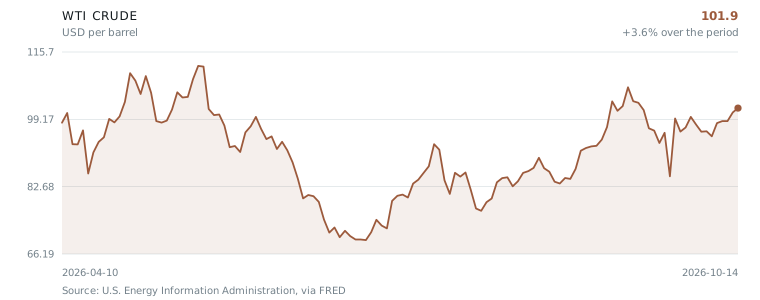
- 01WTI rose from $96.24 on 6 October to $101.91 on 14 October.
- 02Brent rose from $125.44 to $126.55 over the same period.
- 03The Brent-WTI spread narrowed from $29.20 to $24.64.
- 04The market view is that Russian diesel will not add new supply.
- 05The diesel-crunch forecast extends into 2027, but remains a view rather than a confirmed physical constraint.
Interpretation, not reporting. The facts above carry their tiers; this is one correspondent’s reading of them.
The price action says the market is paying for a U.S. crude scare, not for global diesel scarcity. WTI's rise from $96.24 to $101.91 was fast enough to pull the Brent-WTI gap from $29.20 to $24.64, yet Brent's own move was small. That leaves me suspicious of any simple diesel-shortage narrative. If the world were truly short diesel, Brent should be doing more of the work. Instead, the story leans on a U.S. inventory draw, a hoped-for Russian diesel flow that does not add net supply, and crude out of the Strait of Hormuz that still needs refining to become useful. Those are views, not physical proof. The level that would change my reading is the spread: if Brent starts rising faster than WTI while the diesel forecast remains intact, the product story becomes harder to dismiss. If WTI keeps leading, the cleaner explanation is a regional crude dislocation. Until then, I would treat the 2027 diesel crunch as a market expectation, not a settled logistics fact.
— Tomás Ferreira
Every claim in this article, and what it rests on
We do not ask you to take our word for it. Each statement below carries its tier and its sources. Where sources disagree, you get both accounts and what would settle it.
WTI crude was 96.24 on 2026-10-06 and 101.91 on 2026-10-14.
Brent crude was 125.44 on 2026-10-06 and 126.55 on 2026-10-14.
WTI crude price gains outpaced Brent crude price gains between 2026-10-06 and 2026-10-14.
The diesel crunch will persist well into 2027.
Recent increases in crude oil flows out of the Strait of Hormuz are not solving the diesel crunch.
Russian diesel barrels are not expected to add new supply.
A U.S. crude inventory draw ignited fresh buying in crude oil.
The case against this story
Written by an adversarial reviewer, not the correspondent
The story conflates crude oil dynamics with diesel dynamics. The claim that recent increases in crude oil flows out of the Strait of Hormuz are not solving the diesel crunch is nearly tautological — diesel is a refined product, and crude flows do not directly translate to diesel supply without refining capacity. The prediction that the diesel crunch will persist well into 2027 is speculative without specific refinery capacity constraints being named. The claim that a U.S. crude inventory draw ignited fresh buying is a causal inference without evidence of causation. Most strikingly, the WTI price ($96.24–$101.91) and Brent price ($125.44–$126.55) imply a spread of roughly $25–29 per barrel across both dates, which is extraordinarily wide and entirely unexplained by the story. This gap raises questions about either the accuracy of the price data or the completeness of the market explanation. A reader should ask: if WTI is surging while Brent barely moves, what specific U.S. market dislocation explains this, and why doesn't the story address it?
Who benefits from this framing: Oil producers and exporters benefit from a narrative of tight diesel supply and rising crude prices, which supports higher selling prices. Refiners benefit from the implication that diesel supply is constrained, as this supports crack spreads and refining margins. Long-only commodity funds and energy sector investors benefit from a bullish framing that could attract additional capital inflows. The story's framing — emphasizing supply tightness, rising prices, and an unexplained WTI surge — serves anyone positioned long in U.S. crude or diesel futures.
Report an error in this article
Subscriptions open at launch
Global Materials Review will be a paid publication. Reading is free while we build the archive — leave an address and we will write to you once, when subscriptions open.