
US nuclear-fuel push leans on one plant and four ministers
Washington's Central Asia outreach and Urenco's expansion are real, but the physical supply links remain thin.
 Tomás FerreiraEnergy, shipping and chokepoints
Washington's stated trade push toward Central Asia and Urenco's expansion of the only commercial-scale US uranium enrichment plant are being framed as supply-chain tailwinds. The physical links are thinner: the meeting excludes Uzbekistan, and the enrichment project still has 25% of construction to complete. Single-day commodity marks add backdrop, not trend.
Washington is courting four Central Asian foreign ministers while Urenco says it is pushing the only commercial-scale uranium enrichment plant in the United States toward completion. The two moves sit under one policy label, but they do not yet form one physical supply chain.
Four ministers, one missing state
On the diplomatic track, the announced agenda has Secretary of State Marco Rubio meeting the foreign ministers of Kazakhstan, the Kyrgyz Republic, Tajikistan and Turkmenistan. Washington's stated aim is a major trade push into Central Asia's energy and critical minerals. That is a wide phrase, and the meeting's guest list is narrower than the region: Uzbekistan, the fifth Central Asian state, is not on it.
The omission limits the meeting's regional coverage. A Central Asia minerals push that leaves out one of the five states cannot be treated as region-wide, and it cannot be read as a single corridor or supplier bloc.
The mechanism is potential rather than shipped cargo. Ministers can open licensing, transport and investment talks, but they do not move ore, concentrate or fuel by themselves. For procurement heads, the question is whether any follow-up produces contracts, rail or port capacity, and assay-verified material. Until then, the diplomacy is a meeting calendar, not a tonnage plan.
The physical chain is still narrow: one plant, four ministers and four price marks.
One plant, three-quarters built
The domestic leg is more tangible. Urenco says it is expanding the only commercial-scale uranium enrichment plant in the United States, and it puts the expansion at 75% complete. That means three-quarters of the project's build is done, but the remaining quarter still separates policy intent from operating capacity.
Because the plant is the only commercial-scale US enrichment site, concentration matters. A single facility carries more weight than it would in a multi-plant fleet, so the remaining construction phase is not a footnote.
Enrichment is not a spot market. Utilities buy fuel years ahead, and a new cascade only matters when it is commissioned, licensed and covered by long-term contracts. The expansion can reduce reliance on rival suppliers if it displaces foreign enrichment in future fuel loads. But the announced detail stops at construction progress; it does not give separative work units, start-up dates or contracted volumes.
The project is also domestic, not Central Asian. It does not by itself connect US fuel buyers to Kazakh, Kyrgyz, Tajik or Turkmen material. The link is policy direction, not shared infrastructure.
Prices without a trend
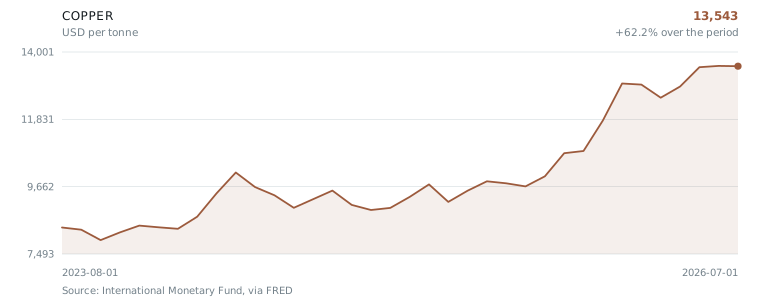
The commodity marks are snapshots, not curves. Copper was recorded at 13,542.820869565219 on 1 July, more than three months before the 14 October energy marks, and it is a single date quoted to 12 decimal places. Without a second observation, that number cannot show direction, volatility or even a weekly average.
The energy marks are closer to the present. Brent was 126.55 on 14 October, while WTI was 101.91 on the same day, leaving a spread of 24.64. Henry Hub gas was 3.22 on 14 October, a different curve and unit from crude, but useful as a reminder that energy input costs are not moving as one price.
The Brent-WTI gap is a simple comparison between two crude benchmarks; it does not say anything about uranium by itself. The Henry Hub figure, at 3.22, is not comparable barrel-for-barrel with oil, but it shows that not every energy input is priced at triple digits.
These figures can frame the macro backdrop, but they do not demonstrate a coordinated US resource strategy. The physical chain is still narrow: one plant, four ministers and four price marks. The next test is whether the diplomatic meeting turns into Central Asian supply agreements, and whether the remaining 25% of the Urenco build becomes bankable enrichment capacity.
- 01The announced agenda has Secretary of State Marco Rubio meeting the foreign ministers of Kazakhstan, the Kyrgyz Republic, Tajikistan and Turkmenistan.
- 02Washington describes its Central Asia outreach as a major trade push into energy and critical minerals.
- 03Urenco says the expansion at the only commercial-scale US uranium enrichment plant is 75% complete.
- 04Brent was 126.55 and WTI was 101.91 on 14 October; Henry Hub gas was 3.22.
- 05Copper was recorded at 13,542.820869565219 on 1 July.
Interpretation, not reporting. The facts above carry their tiers; this is one correspondent’s reading of them.
The real signal is hedging, not orchestration. Washington is reaching toward Central Asia while Urenco builds out the only commercial-scale US enrichment plant, but those are different tools operating on different clocks. I would not treat the Rubio meeting with four foreign ministers as a physical supply outcome; Uzbekistan is absent, and no cargo is specified. I would also keep the price marks in their box: Brent at 126.55, WTI at 101.91 and Henry Hub at 3.22 on 14 October are one-day energy snapshots, while the copper figure is a 1 July mark with excessive precision. If the remaining 25% of the enrichment build is completed, the only commercial-scale US plant can do more of the domestic fuel work. If the four-minister meeting leads to further US-Central Asia trade attention, that would still need physical proof. Until then, I see policy direction, not a rerouted supply chain.
— Tomás Ferreira
Every claim in this article, and what it rests on
We do not ask you to take our word for it. Each statement below carries its tier and its sources. Where sources disagree, you get both accounts and what would settle it.
The COPPER instrument value was 13,542.820869565219 on 2026-07-01.
The BRENT instrument value was 126.55 on 2026-10-14.
The WTI instrument value was 101.91 on 2026-10-14.
The HENRY_HUB_GAS instrument value was 3.22 on 2026-10-14.
The United States is targeting Central Asia's energy and critical minerals in a major trade push.
U.S. Secretary of State Marco Rubio will meet the foreign ministers of Kazakhstan, the Kyrgyz Republic, Tajikistan, and Turkmenistan.
Urenco is expanding the only commercial-scale uranium enrichment plant in the United States.
The Urenco expansion at the only commercial-scale U.S. uranium enrichment plant is 75% complete.
The case against this story
Written by an adversarial reviewer, not the correspondent
The story stitches together unrelated threads — Central Asian diplomacy, domestic Urenco nuclear expansion, and commodity price snapshots — into an implied narrative of coordinated US resource strategy, but the connections are asserted, not demonstrated. The Urenco expansion concerns domestic nuclear fuel supply inside the United States, not Central Asian resources. The commodity prices are single-date snapshots with no trend context, and the copper value's 12-decimal precision signals a data-quality problem that could undermine the other quoted prices. The diplomatic meeting is future-tense and excludes Uzbekistan, one of the five Central Asian states, raising questions about its scope and significance. The 'major trade push' characterization is an interpretation imposed on unconnected facts.
Who benefits from this framing: Russia and China benefit from a framing that casts the US as a resource-hungry power aggressively targeting Central Asian energy and minerals — it validates their narrative of US imperialism and justifies their own regional counter-moves. US defense contractors and energy companies benefit from a securitized framing that can justify government investment, subsidies, or an expanded military presence in Central Asia. Foreign policy hawks benefit from elevating Central Asia into a strategic battleground requiring greater US commitment. The narrative of a coordinated US 'trade push' serves anyone who wants to inflate the importance of US Central Asia policy, whether or not such coordination actually exists.
Report an error in this article
Subscriptions open at launch
Global Materials Review will be a paid publication. Reading is free while we build the archive — leave an address and we will write to you once, when subscriptions open.