
US buildout links AI power, Savannah terminal and shipbuilding
Power, port and maritime moves could pull steel, concrete, copper and shipyard work into the same US construction cycle.
 Tomás FerreiraEnergy, shipping and chokepoints
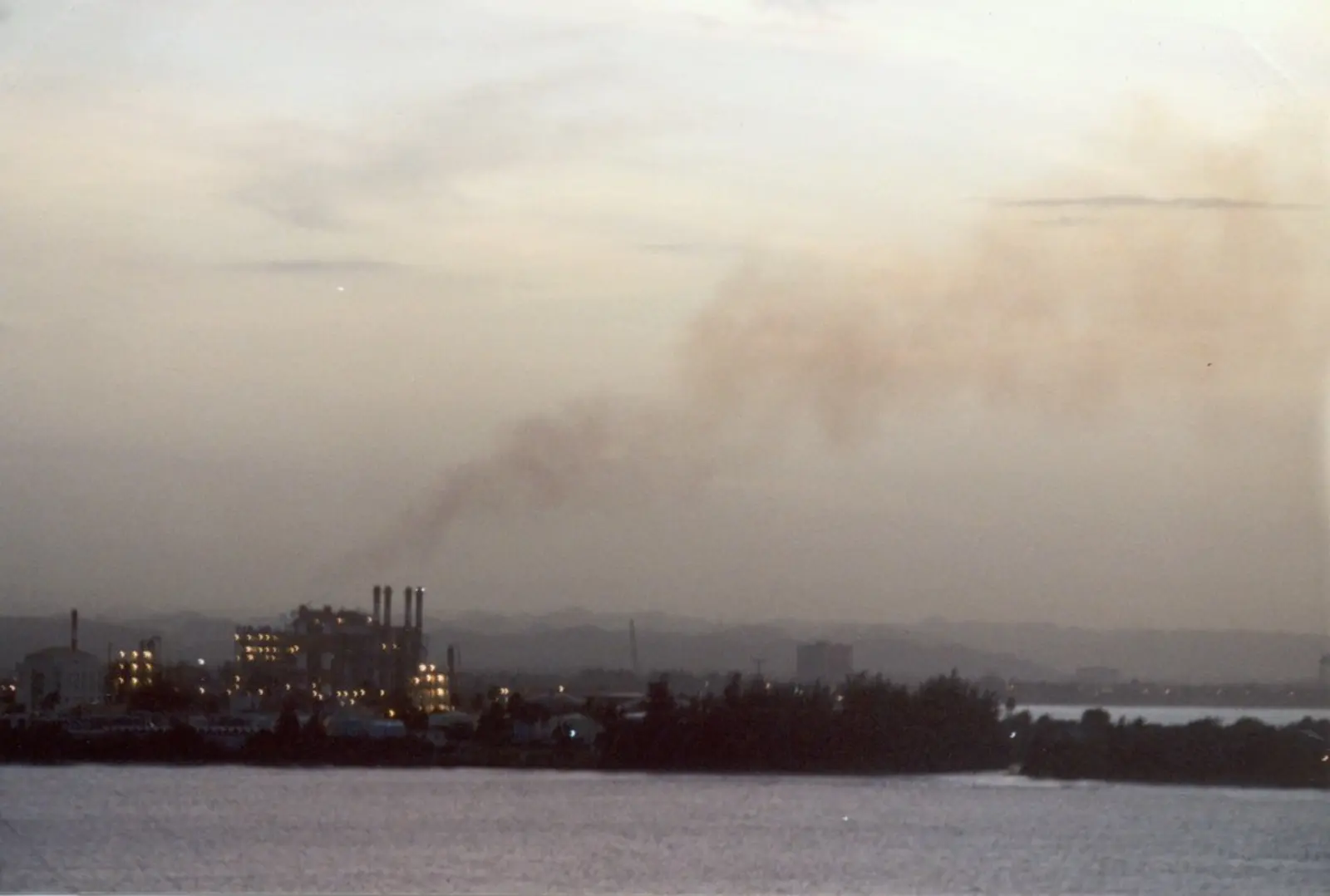
The U.S. Department of Energy announced a $100 billion private investment tied to a former uranium enrichment site in Western Kentucky, while Brookfield and NextEra are named as builders of a $100 billion AI hub on a Cold War nuclear site. Georgia Ports secured federal approval for a $2.3 billion Savannah container terminal that will add 3.5 million TEUs. JPMorganChase has appointed two senior leaders to expand support for U.S. shipbuilding as part of a $1.5 trillion industrial initiative.
One hundred billion dollars has been attached to a former uranium enrichment site in Western Kentucky by the U.S. Department of Energy. A second description of a $100 billion AI hub on a Cold War nuclear site names Brookfield and NextEra as builders. The physical question is whether one site can carry both labels.
One site, two $100bn labels
The DOE announcement frames the money as private investment tied to a former uranium enrichment site. The Brookfield and NextEra description frames a similarly sized AI hub on a Cold War nuclear site. Those may be the same project described from two angles, or two related projects. The descriptions do not settle that.
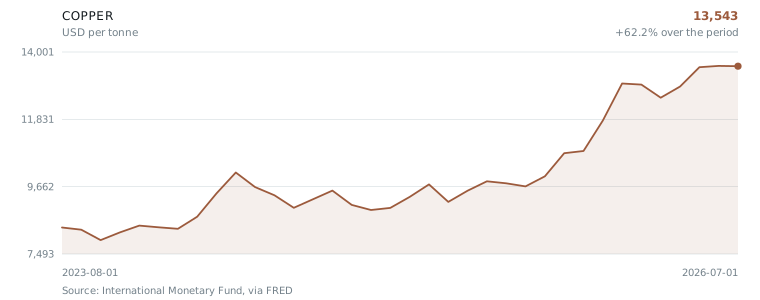
The commodity channel is clear enough. A nuclear-linked site with AI load needs civil works, power equipment, cooling, grid connections and heavy transport. If the two descriptions converge on one location, the demand for steel, concrete, copper and engineering labor is concentrated. If they diverge, the same materials are pulled into two sites instead of one.
That distinction matters for suppliers. A single $100 billion build can be planned around one construction sequence, one workforce and one set of contracts. Two separate $100 billion efforts would double the pressure on the same scarce inputs. The difference is not rhetorical; it shows up in delivery schedules, fabrication slots and freight.
Until then, the 3.5 million TEU figure is a planning addition, not cargo in hand.
Savannah puts a number on boxes
Georgia Ports secured federal approval for a $2.3 billion container terminal at the Port of Savannah. The approved terminal will add 3.5 million TEUs of capacity. Beside the $100 billion power-site figures, the terminal is a smaller commitment, but it is also more legible: a port project has berths, yard space, cranes, trucks and rail moves.
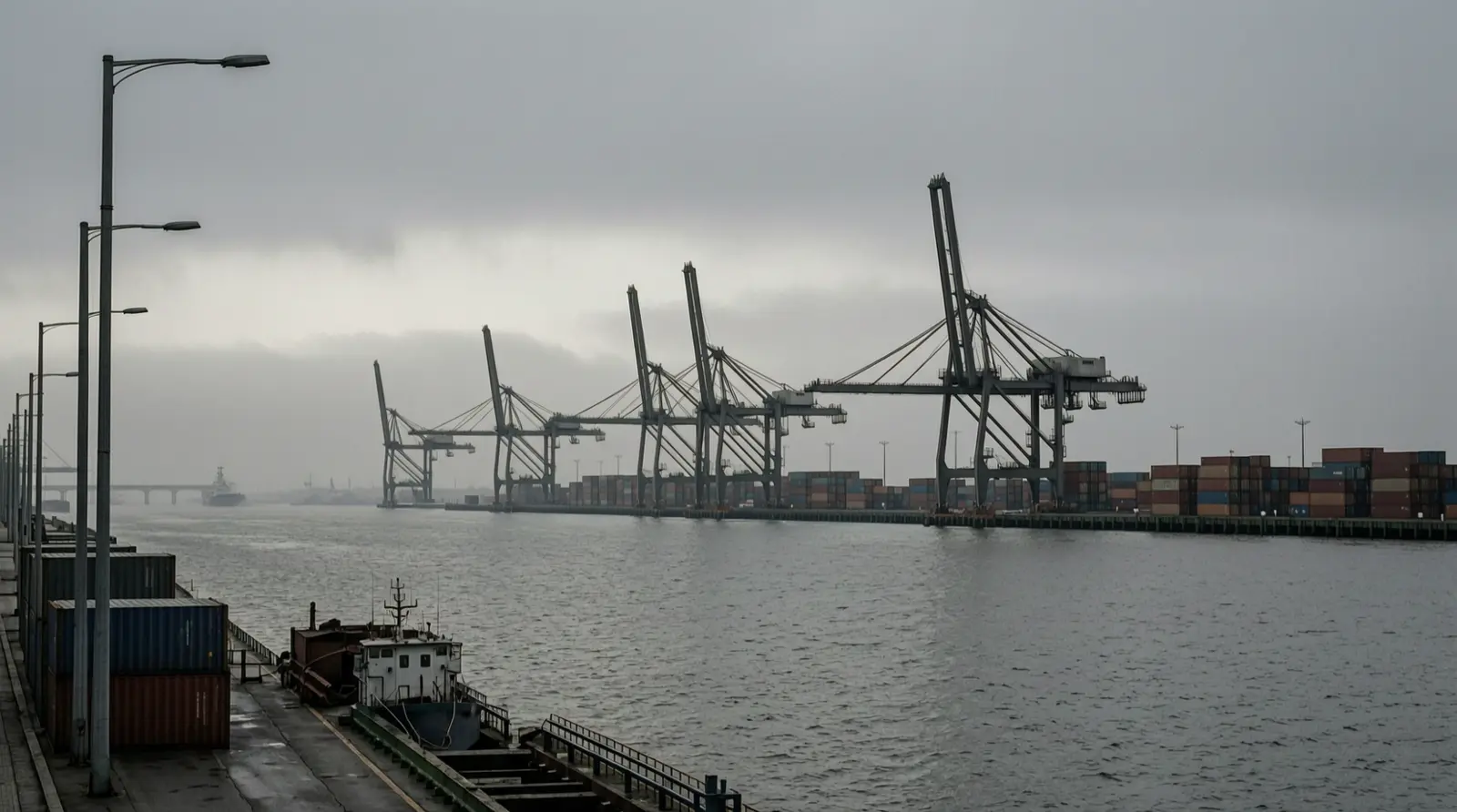
The capacity figure is the number traders and cargo owners will watch. An extra 3.5 million TEUs changes how containers move through the U.S. Southeast if it becomes operational. But approval is not completion. The terminal still needs construction, equipment and time before the first box moves through the new berth.
That gap is where the economics sit. Port capacity can ease bottlenecks only when the quay, equipment and landside connections are working. Until then, the 3.5 million TEU figure is a planning addition, not cargo in hand. The $2.3 billion cost is the entry price; the operating value depends on execution.
Shipbuilding gets a leadership test
JPMorganChase appointed two senior leaders to help expand support for U.S. shipbuilding and the maritime industry. The appointments are part of a $1.5 trillion industrial initiative. On paper, that initiative is 15 times larger than the $100 billion nuclear-site figure and far larger than the Savannah terminal.
Two appointments do not build ships. They can, however, direct balance-sheet attention toward yards, vessels and maritime customers. The missing detail is allocation: how much of the $1.5 trillion initiative is meant for shipbuilding, how much is for broader industry, and what form the support takes. The appointments do not answer those questions.
The linkage to the other projects is indirect but real. More power infrastructure and more port capacity can raise the need for vessels, barges and port equipment. Conversely, a stronger shipbuilding finance channel can make it easier to build and move heavy components. The announcements point to those connections without proving them.
The open question is whether the three threads become simultaneous construction. If they do, they will compete for the same labor, steel, concrete, copper and maritime equipment. If they do not, the story splits into a power project, a port expansion and a financial initiative. The next evidence will be contracts, not headlines.
- 01The U.S. Department of Energy announced a $100 billion private investment tied to a former uranium enrichment site in Western Kentucky.
- 02Brookfield and NextEra will build a $100 billion AI hub on a Cold War nuclear site.
- 03Georgia Ports secured federal approval for a $2.3 billion container terminal at the Port of Savannah, adding 3.5 million TEUs of capacity.
- 04JPMorganChase appointed two senior leaders to expand support for U.S. shipbuilding and the maritime industry.
- 05The shipbuilding appointments are part of a $1.5 trillion industrial initiative.
Interpretation, not reporting. The facts above carry their tiers; this is one correspondent’s reading of them.
The real test is whether these three threads can become physical work at the same time. I would treat the Department of Energy's $100 billion Kentucky announcement and the Brookfield and NextEra $100 billion AI hub as one question until the details separate them. If they are one site, the demand for steel, concrete, copper and power equipment is concentrated; if they are two, the pressure doubles. Savannah is easier to grasp: $2.3 billion for 3.5 million TEUs is a defined construction task, even if approval is not completion. The $1.5 trillion JPMorganChase initiative is the hardest to map. Two senior appointments can focus support, but they do not tell me how much of the initiative is destined for shipbuilding rather than the wider industrial field. My watch is simple: whether the Kentucky site, Savannah and the shipbuilding appointments move from announcement to physical work. If they move together, the mosaic becomes a buildout. If they move separately, the big numbers remain three different stories.
— Tomás Ferreira
Every claim in this article, and what it rests on
We do not ask you to take our word for it. Each statement below carries its tier and its sources. Where sources disagree, you get both accounts and what would settle it.
The U.S. Department of Energy announced a $100 billion private investment related to a former uranium enrichment site in Western Kentucky.
Brookfield and NextEra will build a $100 billion AI hub on a Cold War nuclear site.
Georgia Ports secured federal approval for a $2.3 billion container terminal at the Port of Savannah.
The approved Port of Savannah terminal will add 3.5 million TEUs of capacity.
JPMorganChase appointed two senior leaders to help expand support for U.S. shipbuilding and the maritime industry.
The JPMorganChase shipbuilding leadership appointments are part of a $1.5 trillion industrial initiative.
The case against this story
Written by an adversarial reviewer, not the correspondent
The story strings together three enormous investment figures — $100 billion, $2.3 billion, and $1.5 trillion — across energy, ports, and maritime sectors, creating an impression of coordinated industrial resurgence. But the two $100 billion claims may describe the same project with different levels of specificity, the $1.5 trillion figure is unprecedented in scale and may conflate JPMorgan's internal strategy with a broader industry total, and the 3.5 million TEU capacity figure is presented as settled when it likely reflects a planning estimate. Taken together, the story risks presenting a mosaic of separately sourced, individually uncertain claims as a single coherent narrative of massive national reinvestment. Each claim may be individually defensible at a lower confidence level, but the cumulative picture — billions and trillions flowing simultaneously into AI hubs, ports, and shipbuilding — is stronger than the underlying evidence for any single component.
Who benefits from this framing: Brookfield and NextEra benefit if their names are attached to a $100 billion project before they have publicly committed, boosting their stock and brand. JPMorganChase benefits from being seen as a anchor of a $1.5 trillion industrial initiative, enhancing its policy influence and deal pipeline. Politicians in Kentucky and Georgia benefit from claiming credit for transformative job-creating investments. Proponents of federal industrial policy and maritime reshoring benefit from a narrative that massive private capital is flowing into U.S. infrastructure, which can be used to justify further subsidies, permits, or deregulation. Readers who believe this framing may invest, vote, or advocate based on figures that have not been independently confirmed by the named parties.
Report an error in this article
Subscriptions open at launch
Global Materials Review will be a paid publication. Reading is free while we build the archive — leave an address and we will write to you once, when subscriptions open.