
US and UK split on shadow fleet as oil prices diverge
Divergent sanctions stances could alter who carries Russian crude and how fuel costs reach consumers.
 Tomás FerreiraEnergy, shipping and chokepoints

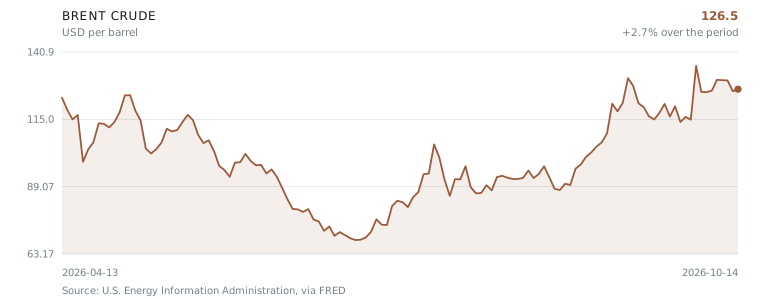
Brent crude was $125.44 on 6 October and WTI was $96.24, leaving a $29.20 gap between the two benchmarks. Washington is said to be weighing relief for shadow-fleet vessels, while Britain is reported to have widened sanctions on Russian oil companies, tankers and finance. The split could change tanker availability and the route of Russian crude without guaranteeing cheaper fuel.
On 6 October, Brent crude was $125.44 and WTI was $96.24. That left Brent $29.20 above WTI, roughly 30% higher. The gap is more than a number: it says the two benchmarks are not seeing the same market. A gap that wide invites scrutiny of the price data itself; if either figure is off, the link between policy and fuel costs becomes harder to judge.
Against that backdrop, two Western capitals are moving in opposite directions on the same set of assets. The Trump administration is said to be considering easing sanctions on shadow-fleet vessels. Britain, meanwhile, is reported to have expanded sanctions against Russia's oil industry.
A wide spread, two policy paths
The US deliberation, as described, is narrow but consequential. Shadow-fleet tankers are the marginal hulls in this trade. If Washington eases pressure on some of those hulls, it could change which ships are available to move sanctioned or hard-to-place crude.
The reported UK measures go the other way. Britain is said to have targeted two additional energy companies, a dozen shadow-fleet tankers and financial networks. That is a broad set of pressure points: the sellers, the ships and the money that settles the trades.
The split matters because tankers are not interchangeable; insurers, ports and buyers treat them differently. A tanker does not need to be physically blocked to be commercially unavailable. If underwriters, port agents or buyers pull back, the vessel can sit idle even when freight rates are high.
For a trader, the practical question is simple: if a sanctioned tanker cannot load, does the cargo move to another vessel, sit in storage, or find a different buyer? If the answer is storage, the barrel is still in the system but not in the market. If the answer is a longer voyage, freight and time become part of the price.
The split matters because tankers are not interchangeable; insurers, ports and buyers treat them differently.
Relief does not guarantee cheaper fuel
The reported view is that easing US sanctions on oil tankers may not lower fuel costs. The point is not that relief would automatically add supply; it is that it may fail to translate into cheaper product.
That distinction matters. Crude prices are set by barrels, but fuel costs also depend on refining margins, product inventories and the willingness of shippers to move cargoes through constrained routes. If the barrels that become easier to carry are already discounted, or if they flow to buyers who were already taking them, the effect on refined fuel can be muted.
A tanker made available by sanctions relief may still be refused by terminals or refiners if the crude it carries is restricted. The vessel is only one link; the cargo still needs a buyer, a port and a refinery that will take it.
The price spread itself is a warning. Brent at $125.44 and WTI at $96.24 suggests that the stress is not evenly distributed. A policy that adds tanker capacity in one place may not relieve the bottleneck priced into the other.
What the UK measures actually touch
Britain's reported sanctions are specific: two energy companies, a dozen tankers and financial networks. Each category works differently.
Companies can lose access to services, contracts or jurisdictions. Tankers can become harder to insure, charter or discharge. Financial networks can raise the cost and delay of settlement, pushing trades into slower, more circuitous channels.
But specificity is not the same as impact. The UK can name vessels and firms; the market then decides whether other jurisdictions, insurers and buyers follow. The incremental cost of a UK designation may be limited unless it changes behaviour elsewhere.
The same logic applies to the US deliberation. If Washington relaxes constraints on shadow-fleet vessels, the effect depends on whether those vessels were the binding constraint. If the constraint was refining, product distribution or demand, more tanker availability will not necessarily reach the pump.
The open question is whether the two policies meet in the physical market or simply cancel in rhetoric. The price gap says the market is already separating barrels by place and acceptability. The next signal will be freight, insurance and the movement of named hulls, not statements alone.
- 01Brent crude was $125.44 on 6 October.
- 02WTI was $96.24, leaving Brent $29.20 above the US benchmark.
- 03Washington is said to be considering easing sanctions on shadow-fleet vessels.
- 04Britain is reported to have targeted two energy companies, a dozen tankers and financial networks.
- 05Easing tanker sanctions may not lower fuel costs.
Interpretation, not reporting. The facts above carry their tiers; this is one correspondent’s reading of them.
The decisive variable is not whether one capital tightens and another loosens; it is whether the physical market accepts the barrels that become easier to move. Brent at $125.44 against WTI at $96.24 tells me the market is pricing location and acceptability, not just total supply. If Washington eases pressure on shadow-fleet vessels, I would watch freight and insurance before statements. If the affected hulls can load, discharge and clear compliance without a discount wide enough to offset the friction, relief could tighten the market for acceptable barrels. If not, the pump effect stays weak. The UK's dozen named tankers and two energy companies matter only if they change behaviour beyond British jurisdiction. I would be proved wrong if sanctions relief coincided with a visible fall in tanker rates or a narrowing of the Brent-WTI gap; for now, the spread says the stress is still regional.
— Tomás Ferreira
Every claim in this article, and what it rests on
We do not ask you to take our word for it. Each statement below carries its tier and its sources. Where sources disagree, you get both accounts and what would settle it.
Brent crude was $125.44 on 2026-10-06.
WTI crude was $96.24 on 2026-10-06.
The Trump administration is considering easing sanctions on shadow-fleet vessels.
Easing US sanctions on oil tankers may not lower fuel costs.
Britain has expanded sanctions against Russia's oil industry.
The UK sanctions target two additional energy companies.
The UK sanctions target a dozen shadow-fleet tankers.
The UK sanctions target financial networks.
The case against this story
Written by an adversarial reviewer, not the correspondent
The story's factual backbone rests on two oil-price figures that contradict each other: a $29.20 Brent-WTI spread is far outside historical norms and would require an extraordinary, easily identifiable supply dislocation to justify. If at least one price is wrong — and the spread strongly suggests one is — the narrative linking sanctions policy to current fuel costs is built on unreliable data. Separately, the claim that the Trump administration is 'considering' easing sanctions on shadow-fleet vessels is inherently unfalsifiable: internal deliberations are easily distorted by sources with agendas, and 'considering' can describe anything from a formal policy review to a single offhand conversation. The UK sanctions claims may be factually accurate but are presented with no evidence of actual economic impact, leaving the reader with an impression of decisive action that could be largely symbolic. The overall picture — Trump softening on Russia while the UK cracks down, against a backdrop of very high oil prices — is a dramatic narrative that collapses if the price data is wrong or the policy-deliberation claim is overstated.
Who benefits from this framing: Political opponents of Trump benefit from a framing that portrays his administration as easing pressure on Russia's shadow fleet. Sanctions advocates and foreign-policy hawks benefit from the claim that easing sanctions 'may not' lower fuel costs, since it undercuts the economic case for relaxation. UK foreign-policy interests benefit from the contrast between an expanding British sanctions regime and a potentially wavering American one, reinforcing Britain's image as the tougher transatlantic partner. Energy traders and producers benefit from narratives that sustain high oil-price expectations. And anyone invested in maintaining the current sanctions architecture benefits from a story that simultaneously questions the wisdom of easing sanctions and highlights allied resolve to tighten them.
Report an error in this article
Subscriptions open at launch
Global Materials Review will be a paid publication. Reading is free while we build the archive — leave an address and we will write to you once, when subscriptions open.