
Trump's Greenland exploration pledge faces permits and price test
If exploration advances, Greenland could become a strategic non-China supply source, but sovereignty, permitting and Arctic costs remain major barriers.
 Tomás FerreiraEnergy, shipping and chokepoints

Trump said oil, gas and mineral exploration will begin in Greenland, opening a test of whether the island can become a strategic non-China supply source. The pledge is complicated by sovereignty, permitting and Arctic costs, and by a reported deal with Denmark and Greenland that is not fully established. Commodity prices attached to the story do not yet show a causal market move.
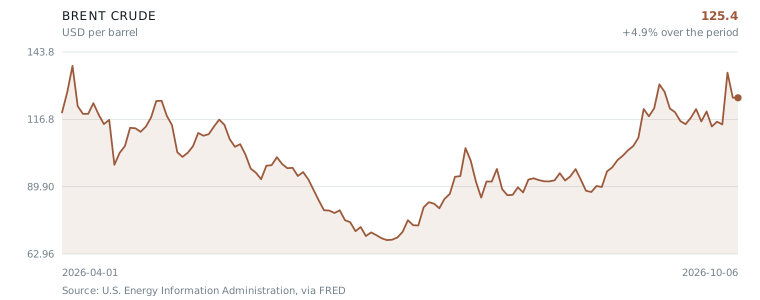
At 125.44, Brent crude is priced for risk; the missing number is how many permits, seasons and hulls stand between that price and a Greenland cargo. Trump said oil, gas and mineral exploration will begin in Greenland. That statement, carried by Al Jazeera and OilPrice, opens a test case: whether Greenland can become a strategic non-China supply source.
The pledge is not yet a route. It meets the familiar barriers of sovereignty, permitting and Arctic costs. Those are the forces that decide whether a political announcement becomes a drill site, a loading point and a voyage.
A deal is the load-bearing part
In remarks attributed to him, Trump described the planned Greenland exploration as massive. He also referred to a deal made last month with Denmark and Greenland, and praised the security advantages of that deal. Those details are the part that would carry the project.
If the deal is real and workable, it could align security, access and exploration. If it is not, the announcement remains a headline with no ground beneath it. The reference to Denmark and Greenland matters because sovereignty and permitting are not side issues in the Arctic; they are the gate.
Security advantages may change the political calculus, but they do not by themselves remove Arctic costs. The route from announcement to supply still runs through approvals and physical work.
The open question is whether the pledge can be turned into something a trader can follow: a permit, a cargo, a vessel movement and a cost that clears.
The market question is simple. Would future oil, gas or minerals move through a supply chain that does not depend on China? That is the strategic prize. But the physical answer depends on approvals, equipment, weather and cost.
Prices do not yet show a Greenland trade
The commodity numbers attached to the story are real data points, but they do not prove a market reaction. Brent crude was 125.44 on 6 October. WTI crude was 96.24 on the same day, leaving Brent 29.20 points above WTI.
The Brent-WTI gap is a location story: one benchmark is priced well above the other. Henry Hub natural gas was 3.03 on 6 October. That is a much smaller number than the crude prints, though the contracts measure different things.
Copper was 13542.820869565219 on 1 July, three months before the oil and gas figures. The date gap also matters: a July copper print cannot confirm an October political statement.
The copper figure deserves a cold eye. Its unusually long decimal tail looks calculated or interpolated rather than like a clean settlement. If one data point is that precise, it should be checked against a traded source before it is used to infer a market signal.
More importantly, none of these levels establishes a causal link between Trump's statement and price moves. They show where markets were on given dates. They do not show that a Greenland cargo changed hands, that a permit was issued, or that a route became viable.
What would make it real
For physical markets, the test is not rhetoric but sequence. Exploration needs permission, then equipment, then transport. In the Arctic, cost and sovereignty can stretch every step.
The strongest version of this story is that a massive exploration programme could add a non-China source of oil, gas and minerals. The weakest version is that a reported deal, a few commodity prices and the word massive are being asked to do the work of contracts and permits.
A pledge can move expectations, but physical supply moves slower. It needs permission, equipment and a route that can survive weather and cost. The open question is whether the pledge can be turned into something a trader can follow: a permit, a cargo, a vessel movement and a cost that clears. Until then, Greenland is a strategic possibility, not a supply line.
- 01Trump said oil, gas and mineral exploration will begin in Greenland, as reported by Al Jazeera and OilPrice.
- 02In reported remarks, he called the exploration massive and cited a deal made last month with Denmark and Greenland.
- 03Brent crude was 125.44 and WTI crude was 96.24 on 6 October.
- 04Henry Hub natural gas was 3.03 on 6 October.
- 05Copper was 13542.820869565219 on 1 July.
Interpretation, not reporting. The facts above carry their tiers; this is one correspondent’s reading of them.
The load-bearing part of this story is not the word massive; it is the deal. I treat the pledge as a conditional: it matters only if Denmark and Greenland turn it into security advantages and actual exploration. The price strip does not settle that. Brent at 125.44 and WTI at 96.24 on 6 October show oil strength, while Henry Hub at 3.03 is a much smaller number on a simple numerical basis. Copper at 13542.820869565219 on 1 July carries a decimal tail that looks calculated rather than observed. If the reported deal holds, the market can watch for oil, gas and mineral exploration to become visible. If it does not, Greenland remains a strategic non-China supply idea rather than a source. My test is simple: follow the deal, the permits and the costs, not the adjectives.
— Tomás Ferreira
Every claim in this article, and what it rests on
We do not ask you to take our word for it. Each statement below carries its tier and its sources. Where sources disagree, you get both accounts and what would settle it.
Brent crude was 125.44 on 2026-10-06.
WTI crude was 96.24 on 2026-10-06.
Henry Hub natural gas was 3.03 on 2026-10-06.
Copper was 13542.820869565219 on 2026-07-01.
Trump said oil, gas, and mineral exploration will begin in Greenland.
Trump described the planned Greenland exploration as massive.
Trump referred to a deal made last month with Denmark and Greenland.
Trump praised the security advantages of that deal.
The case against this story
Written by an adversarial reviewer, not the correspondent
The story frames Trump's Greenland exploration announcement as a firmly established fact and surrounds it with specific commodity prices to imply market-moving significance. But the foundation is weak: the claim that Trump referred to a deal made last month with Denmark and Greenland is only weakly supported, meaning the very basis for the exploration announcement is uncertain. Worse, the copper price figure is quoted to fifteen decimal places, which no real market data source does, suggesting it is a calculated or interpolated number rather than an observed settlement price. If one commodity data point is suspect, the reader has reason to doubt the others. The story also links Trump's announcement to oil, gas, and copper prices without establishing any causal connection between the two, creating an impression of market significance that the evidence does not support.
Who benefits from this framing: Oil, gas, and mining companies with Arctic resource interests benefit from market participants believing major exploration is beginning in Greenland, as it can boost their valuations and access to capital. Trump and his allies benefit politically from the appearance of a major policy achievement involving resource security and a deal with Denmark. Commodities traders who have taken long positions in copper, oil, or natural gas benefit if readers believe prices are at the stated levels and likely to rise further on Greenland supply expectations.
Report an error in this article
Subscriptions open at launch
Global Materials Review will be a paid publication. Reading is free while we build the archive — leave an address and we will write to you once, when subscriptions open.