
Trump-Putin diesel talk tests Russia sanctions
A reported 300,000-ton diesel arrangement could loosen sanctions pressure and complicate Kyiv's energy-ceasefire diplomacy.
 Tomás FerreiraEnergy, shipping and chokepoints
A reported diesel arrangement involving 300,000 tons of Russian fuel has moved from telephone diplomacy to market risk. Brent's premium over WTI was $29.20 on 2026-10-06, a wide gap that magnifies any shift in refined-product flows. The political reaction is larger than the tonnage, and the exact wording and scope remain disputed.
At 300,000 tons, the reported Russian diesel arrangement is too small to rebalance global fuel markets on its own. It is large enough to reopen a harder question: whether sanctions pressure on Moscow can be eased through a commercial channel while Ukraine still needs energy diplomacy.
On 2026-10-06, Brent crude was 125.44 and WTI crude was 96.24. That leaves Brent $29.20 above WTI, a wide gap between the two benchmarks. In physical markets, that kind of spread turns every political permission into a routing decision. A cargo that can move legally and insureably becomes more valuable than a cargo stuck in ambiguity.
The spread is not just a price curiosity. When Brent is far above WTI, crude and products can be pulled toward markets priced against Brent, while US-linked barrels may seek export outlets. Any political signal that changes access to Russian diesel therefore changes the competitive position of alternative suppliers.
A small cargo with a large political wake
The trigger is not clean. Trump announced that Russia would supply diesel to global markets, according to reports, but the exact nature of that announcement remains unsettled. It could be read as a new deal, an endorsement of existing trade, or a signal of sanctions relief. Those are different mechanisms, and they would hit the market through different channels.

Zelensky is reported to have called the Trump-Putin diesel deal a gift to Putin. The precise phrase is contested, and the difference between a direct quotation and a paraphrase matters in wartime diplomacy. Democrats criticized the deal as a complete betrayal of Ukraine and Europe, but whether that is a unified party position or a collection of individual statements is not clear.
The next signal will be a ship, not a quote.
The political volume is therefore much louder than the tonnage. A 300,000-ton cargo can be absorbed or diverted without changing the global diesel balance. A sanctions precedent cannot. If traders believe the arrangement opens a corridor for future Russian product, the risk premium will attach to the route, not to this single volume.
For freight markets, the issue is optionality. If insurers and port authorities treat the diesel as acceptable, vessels can be fixed quickly. If they do not, cargoes sit longer, transshipments multiply and the cost of moving fuel rises even if the headline volume is unchanged.
Diesel and crude are different routes
The story also crosses product lines. Putin said Russian oil supplies to the US would positively impact the global economy after his call with Trump. That is not the same commodity, nor the same destination, as a diesel supply arrangement for global markets.
Diesel is a refined product. It moves in product tankers, competes in regional deficits and depends on refinery runs. Crude supply to the US works through a different chain of terminals, pipelines and refinery economics. Stitching the two together makes the diplomacy look bigger than the physical flows.
Reports say Trump and Putin held telephone talks that discussed Ukraine and Iran. That places the diesel question inside a wider negotiation, where energy can become a bargaining chip rather than a standalone trade. For Kyiv, the risk is not only lost revenue. It is that an energy ceasefire becomes harder to sell if Russian fuel is seen to gain political acceptance.
The market will look for fixtures, not speeches
Physical traders will not settle this with statements. They will watch whether Russian diesel cargoes load, which routes they take, how insurance is placed and whether freight rates adjust. If a cargo can move with fewer compliance questions, its netback improves. If it cannot, the headline may leave no trace in the water.
The price tape adds urgency. With Brent at 125.44 and WTI at 96.24, a small change in sanctions treatment can shift margins quickly. Traders do not need a large cargo to reprice risk; they need a rule change.
The open question is whether 300,000 tons is a first tranche in a broader reset, or a symbolic volume designed to test reactions. The next signal will be a ship, not a quote.
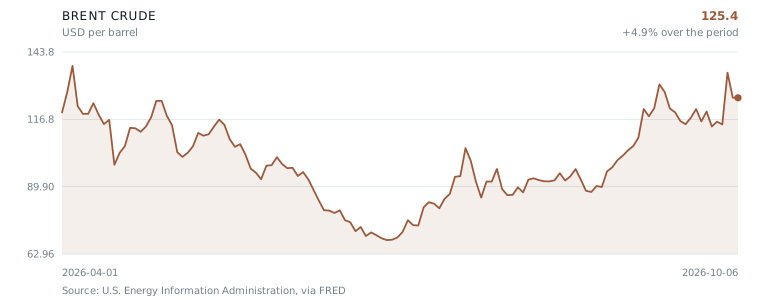
- 01Brent was 125.44 and WTI was 96.24 on 2026-10-06, a $29.20 spread.
- 02Reports put the discussed Russian diesel arrangement at 300,000 tons.
- 03Zelensky is reported to have called the deal a gift to Putin, but the exact phrase is contested.
- 04Democrats criticized the deal as a complete betrayal of Ukraine and Europe, though party-wide unity is unclear.
- 05Putin said Russian oil supplies to the US would positively impact the global economy after his call with Trump.
Interpretation, not reporting. The facts above carry their tiers; this is one correspondent’s reading of them.
I am less interested in the word deal than in the path of 300,000 tons of Russian diesel. If that volume moves under clearer political cover, the market will show it first in freight, insurance and route choices, not in speeches. The crude tape already raises the stakes: Brent at 125.44 against WTI at 96.24 is a $29.20 gap, so any politically sensitive barrel has a large incentive to find a way through. My test is simple. If Zelensky's reported gift to Putin line hardens into a diplomatic break and Democrats sustain the complete betrayal framing, the arrangement becomes a sanctions test. If the call stays limited to diesel and does not spill into Russian oil supplies to the US, the tonnage may remain symbolic. I would change my view if the 300,000 tons becomes a recurring schedule.
— Tomás Ferreira
Every claim in this article, and what it rests on
We do not ask you to take our word for it. Each statement below carries its tier and its sources. Where sources disagree, you get both accounts and what would settle it.
The Brent crude price was 125.44 on 2026-10-06.
The WTI crude price was 96.24 on 2026-10-06.
Trump announced that Russia would supply diesel to global markets.
Zelensky called the Trump-Putin diesel deal a gift to Putin.
Democrats criticized Trump's deal with Putin as a complete betrayal of Ukraine and Europe.
Trump and Putin held telephone talks that discussed Ukraine and Iran.
The reported Trump-Putin diesel deal involves 300,000 tons of Russian diesel.
Putin said Russian oil supplies to the US would positively impact the global economy after his call with Trump.
The case against this story
Written by an adversarial reviewer, not the correspondent
The story's internal coherence is undermined by a commodity mismatch: claims 3 and 4, and 21 describe a diesel deal, while claim 8 shifts to Russian oil supplies to the US — different products, different destinations, potentially different events stitched together. The 300,000-ton figure (claim 7) is disproportionately small relative to the intense geopolitical reactions described in claims 4 and 5, raising the question of whether the reactions are genuinely to this specific quantity or are being aggregated from broader frustrations. The Brent-WTI price spread implied by claims 1 and 2 (~$29) is historically unusual and warrants verification of at least one figure. No evidence block was actually provided despite the prompt stating evidence was retrieved, making independent verification of any claim impossible and leaving only internal consistency as a check — which reveals multiple seams.
Who benefits from this framing: Russian state interests benefit from the perception that a US president is facilitating Russian energy exports and legitimizing Putin's geopolitical role. Democratic political interests benefit from the narrative that Trump is betraying Ukraine and Europe. Anti-Trump media benefit from a sensational framing linking Trump to Putin against Western allies. The 'Trump-Putin deal' framing elevates what may be a limited or mischaracterized event into a geopolitical confrontation, serving anyone who profits from US political polarization or from the appearance of US-Russia alignment against European interests.
Report an error in this article
Subscriptions open at launch
Global Materials Review will be a paid publication. Reading is free while we build the archive — leave an address and we will write to you once, when subscriptions open.