
Shadow-fleet talk and fuel-oil scarcity split oil prices
Possible easing of shadow-fleet restrictions could change how restricted barrels move while fuel-oil tightness keeps shipowners and refiners bidding.
 Tomás FerreiraEnergy, shipping and chokepoints

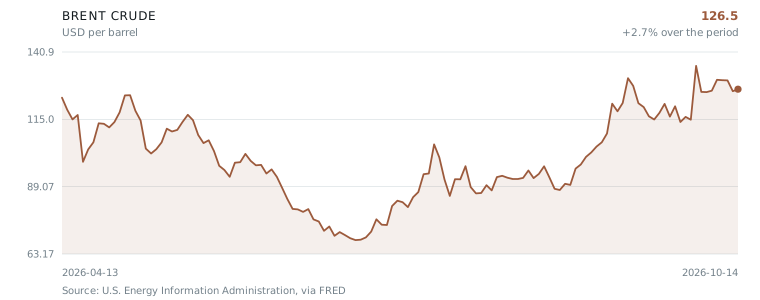
International oil-price movements were divergent, with Brent crude's price exceeding WTI's price by 24.64 on 14 October. Market sources say the United States is considering easing restrictions on the shadow fleet and describe fuel-oil supplies from the Middle East and Russia as collapsed. Traders say oil prices ended mixed as they weighed demand against continuing tanker strikes in the Strait of Hormuz.
Brent crude's price exceeded WTI's price by 24.64 on 14 October, while international oil-price movements were divergent. Traders say oil prices ended mixed as they weighed the demand outlook against shipping risks in the Strait of Hormuz. That leaves a market pulled in two directions: one price leg reflects Atlantic basin supply, the other carries more of the geopolitical and fuel-oil risk.
The spread itself is a clue. A wide Brent premium over WTI usually says the marginal barrel is not sitting comfortably in the US interior; it is being fought over at the water. It also gives refiners and traders a reason to watch any policy shift that could bring more restricted or hard-to-move barrels into the market. The number is not the whole story, but it marks where the pressure is building.
Easing would move barrels, not add them
Market sources say the United States is considering easing restrictions on the shadow fleet. That matters because the fleet is the plumbing for barrels that face restrictions. If restrictions ease, more hulls could move those barrels, and the discount on those barrels could narrow. If they stay, the same barrels remain trapped in a narrower pool of ships, with longer voyages and more friction.
This is where the market's split makes sense. An easing would not add new crude to the world; it would change which barrels can reach which buyers, and how easily. For a trader, that is a repricing of risk and logistics rather than a simple supply shock. The physical question is whether more ships become usable, or whether the same ships simply change flags and routes.
A wide Brent premium over WTI usually says the marginal barrel is not sitting comfortably in the US interior; it is being fought over at the water.
Fuel oil is the tight barrel
The stronger physical story is in fuel oil. Market sources say the global fuel-oil shortage is deepening and describe supplies from the Middle East and Russia as collapsed. Reports say shipping-industry demand for fuel oil remains firm.
That combination hits the market at its most inelastic point. Ships need bunker fuel to move, and some refiners and power users need fuel oil as feedstock or generation fuel. When supply falls and shipping demand stays firm, the shortage shows up quickly in margins and cargo bids rather than in a slow build of inventories.
For crude prices, this creates a second force. Fuel-oil tightness can support refining margins and make crude more valuable to certain buyers, even if demand expectations elsewhere are soft. It also explains why the market can look mixed: one part of the complex is pricing scarcity, while another is pricing hesitation.
Hormuz risk lives in hulls, not headlines
Reports say Iranian strikes on tankers in the Strait of Hormuz are continuing. That keeps the most sensitive chokepoint in oil on the table. The strait is not an abstraction; it is where Gulf barrels leave for the sea.
For physical traders, the question is not whether the risk exists but how it changes behaviour. Does a cargo sail now or wait? Does it load at night, take a longer route, or demand higher insurance? Each answer adds cost and time. Even if prices do not spike immediately, the market can still be tightening underneath.
That is the tension in the current tape. If fuel-oil supplies have truly collapsed and Hormuz risk remains live, the market should be paying up for prompt barrels. Yet traders say prices ended mixed, which suggests traders are still testing whether those risks will translate into sustained physical losses.
The open question is simple: will the next cargo move normally, or will one of these frictions — shadow-fleet policy, fuel-oil scarcity, or Hormuz risk — force a repricing?
- 01International oil-price movements were divergent.
- 02Brent crude's price exceeded WTI's price by 24.64 on 14 October.
- 03Market sources say the United States is considering easing restrictions on the shadow fleet.
- 04Market sources describe fuel-oil supplies from the Middle East and Russia as collapsed.
- 05Reports say Iranian strikes on tankers in the Strait of Hormuz are continuing.
Interpretation, not reporting. The facts above carry their tiers; this is one correspondent’s reading of them.
The spread is telling me the market is pricing logistics, not panic. Brent's 24.64 premium over WTI on 14 October is too wide to be casual; it points to seaborne barrels being more valuable than landlocked ones. If Washington eases shadow-fleet restrictions, I would expect discounts on restricted barrels to narrow and more hulls to chase the same cargoes. That would not create supply, but it would make supply more movable. Fuel oil is the harder edge. If Middle Eastern and Russian supplies have collapsed while shipping demand remains firm, refiners and bunker buyers are competing for a shrinking pool. I would watch whether fuel-oil tightness persists before assuming the mixed close is calm. Hormuz remains the wildcard: if tanker strikes continue and cargoes still sail, the market is absorbing risk rather than removing it. What would change my mind is a clear move in Brent-WTI back toward normal, or evidence that fuel-oil scarcity is easing.
— Tomás Ferreira
Every claim in this article, and what it rests on
We do not ask you to take our word for it. Each statement below carries its tier and its sources. Where sources disagree, you get both accounts and what would settle it.
International oil-price movements were divergent.
Brent crude's price exceeded WTI's price by 24.64 on 2026-10-14.
The United States was considering easing restrictions on the shadow fleet.
The global fuel-oil shortage was deepening.
Fuel-oil supplies from the Middle East and Russia had collapsed.
Shipping-industry demand for fuel oil remained robust.
Iranian strikes on tankers in the Strait of Hormuz were continuing.
Oil prices ended mixed as traders weighed the demand outlook and Hormuz shipping risks.
The case against this story
Written by an adversarial reviewer, not the correspondent
The story's fatal weakness is its internal contradiction. It stacks catastrophe on catastrophe—Middle East and Russian fuel-oil supplies 'had collapsed,' the global shortage was 'deepening,' shipping demand stayed 'robust,' and Iranian strikes on Hormuz tankers were 'continuing.' If all of that were simultaneously true, oil prices would not 'end mixed.' They would spike hard and uniformly. Collapsed supply from two major producing regions plus a disrupted chokepoint plus robust demand equals a one-directional price surge, not traders 'weighing' opposing factors to a mixed close. The story wants both a crisis dramatic enough to justify US policy shifts toward the shadow fleet and a market calm enough to show only divergent, not explosive, price action. Those two pictures cannot coexist; one is overstated or the other is understated.
Who benefits from this framing: Oil-market speculators positioned long on fuel oil gain from the shortage-and-collapse narrative that supports higher prices. Advocates for military action or escalation against Iran benefit from the framing of ongoing Iranian strikes on tankers in Hormuz. Shadow-fleet operators and sanctioned-oil exporters (principally Russia and Iran) benefit directly from the claim that the United States is considering easing restrictions on their vessels. Defence and energy-security interests benefit from the overall crisis framing that justifies increased naval presence in the Strait and emergency policy interventions.
Report an error in this article
Subscriptions open at launch
Global Materials Review will be a paid publication. Reading is free while we build the archive — leave an address and we will write to you once, when subscriptions open.