
Saudi drone interceptions and Taiz strikes test Gulf risk
If the reported interceptions and siege-breaking strikes spread, Gulf energy facilities and Red Sea transit face a wider risk premium.
 Tomás FerreiraEnergy, shipping and chokepoints

Saudi-led forces said they intercepted four drones over Saudi Arabia on 17 October and struck positions around Taiz the next day to break a Houthi siege. The coalition’s account, so far uncorroborated, puts the focus on Saudi airspace and Yemeni siege lines. Aid agencies warned of a humanitarian crisis as clashes caused casualties on both sides.
Four drones reported over Riyadh, Saudi Arabia’s Eastern Province and the kingdom’s southern region on 17 October, then airstrikes around Taiz on 18 October: the Saudi-led coalition says it is fighting on two axes at once, one in the air over Saudi territory and one on the siege lines around Taiz.
The military details are specific, but they come from one side. The coalition is reporting its own interceptions, describing its own strikes and supplying the humanitarian rationale for them. No independent confirmation has been provided, and the humanitarian warning attached to the fighting is broad rather than tied to a named agency or a measured flow of aid.
A one-sided account of a two-front flare-up
The coalition said it intercepted and destroyed four drones on 17 October. It placed them over Riyadh, the Eastern Province and the southern region, a spread that matters because it implies more than a single border incident. A drone in the south can be read as a continuation of the Yemen war. A drone over Riyadh or the Eastern Province points to deeper reach, even if the aircraft were small or unsuccessful.
The next day, Saudi-led forces said they struck multiple positions around Taiz. They framed the strikes as an effort to break a Houthi siege of the city. That wording changes the political meaning of the same bombs. An offensive air campaign becomes a relief operation; a strike on positions becomes a move to open roads. For a physical-market reader, the distinction matters less than the geography: Taiz is a major Yemeni city, and any intensification there can feed into Red Sea risk perceptions.
The coalition is reporting its own interceptions, describing its own strikes and supplying the humanitarian rationale for them.
The siege frame and the humanitarian overlay
The coalition’s description of the Taiz strikes as siege-breaking is the most consequential part of its account, because it sets up a justification for continued operations. If the city is presented as cut off, airpower can be cast as the fastest way to relieve it. But the same framing also raises the stakes: a siege is not just a military line, it is a choke point for food, fuel and medical supplies.
Aid agencies warned of a humanitarian crisis as fighting intensified across Yemen. The warning is generic, and that is the problem. A generic warning does not by itself tell a trader whether a new shock is beginning or whether an old emergency is simply being re-litigated. What would make it concrete are named agencies, specific corridors, and counts of trucks, fuel barges or treatment centres affected. None of that is in the account yet.
Clashes between Yemeni forces and Houthis caused casualties on both sides, according to an 18 October report. That detail suggests the fighting is not limited to air defence or standoff strikes. It points to contact on the ground, which tends to be slower to resolve and harder to separate from civilian movement.
Egypt’s vague role and the market’s threshold
As of the 17 October report, Egypt was weighing sending help. That phrase is doing a lot of work. It suggests regional concern without committing a ship, a squadron, a bridge or a fuel cargo. For markets, the difference between weighing and sending is the difference between a headline and a logistics chain.
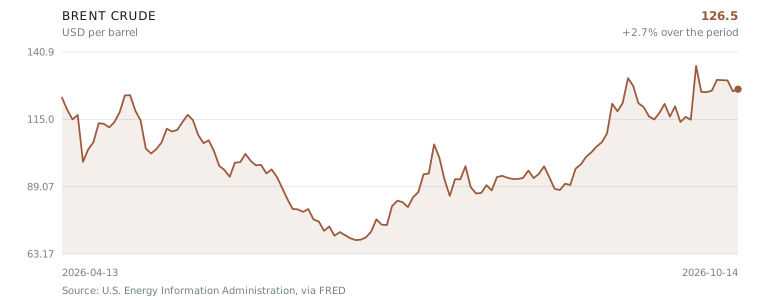
The commodity relevance runs through two channels. The first is Saudi airspace. Interceptions over Riyadh and the Eastern Province raise the possibility that critical infrastructure could be tested, even if the reported drones were destroyed. The second is Yemen itself, where strikes around Taiz and intensified clashes can feed into Red Sea risk perceptions. Shipping does not need a closed route to reprice; it needs only a higher probability of delay, rerouting or insurance friction.
The open question is whether this remains a pair of isolated reports or becomes a pattern. If the coalition continues to announce interceptions over deep Saudi territory while also describing siege-breaking strikes around Taiz, the market will have to treat the episode as a wider escalation rather than a local flare-up. The next tell will be physical: more drones, more strikes, more casualties, and eventually a named humanitarian route or a change in shipping behaviour.
- 01Saudi-led forces said they struck multiple positions around Taiz on 18 October.
- 02The coalition said it intercepted four drones over Riyadh, the Eastern Province and the south on 17 October.
- 03The Taiz strikes were described as intended to break a Houthi siege.
- 04Egypt was weighing sending help as of the 17 October report.
- 05Aid agencies warned of a humanitarian crisis as clashes caused casualties on both sides.
Interpretation, not reporting. The facts above carry their tiers; this is one correspondent’s reading of them.
The useful signal here is not the coalition’s description of its own strikes, but the geography of the reported interceptions. If four drones were truly tracked over Riyadh, the Eastern Province and the south in a single day, the conflict is no longer confined to a border zone. I would treat the Taiz strikes as the political wrapper: siege-breaking language makes airpower look defensive, even when the physical effect is more pressure on roads, civilians and supply lines. Egypt’s reported weighing of help adds diplomatic noise, not logistics. What would change my reading is a second, independent confirmation of either interceptions or a measurable disruption to shipping or aid flows. Until then, the market is left pricing possibility, not certainty: a wider Yemen flare-up is plausible, but the evidence is still one-sided.
— Tomás Ferreira
Every claim in this article, and what it rests on
We do not ask you to take our word for it. Each statement below carries its tier and its sources. Where sources disagree, you get both accounts and what would settle it.
Saudi-led forces said they struck multiple positions around Taiz on 18 October 2026.
Saudi-led forces said the strikes around Taiz were intended to break a Houthi siege of the city.
The Saudi-led coalition said it intercepted and destroyed four drones over Saudi Arabia on 17 October 2026.
The intercepted drones were over Riyadh, Saudi Arabia's Eastern Province, and the kingdom's southern region.
Egypt was weighing sending help as of the 17 October 2026 report.
Clashes between Yemeni forces and Houthis caused casualties on both sides, according to an 18 October 2026 report.
Aid agencies warned of a humanitarian crisis as fighting intensified across Yemen.
The case against this story
Written by an adversarial reviewer, not the correspondent
Every military claim in this story traces to a single source: the Saudi-led coalition. The coalition announces its own strikes, supplies the humanitarian justification for them, and reports its own successful drone interceptions — all without a single independent corroboration. The siege-breaking rationale is particularly convenient: it reframes offensive airpower as a rescue operation. The Egypt reference is so vague ('weighing sending help') that it lends the impression of regional backing without any concrete commitment. The humanitarian-crisis warning is generic enough to apply to any period in Yemen's conflict and names no agency. Strip away the coalition's self-reporting and the story has no independently verified military facts at all — only an atmosphere of escalation built on one belligerent's word.
Who benefits from this framing: The Saudi-led coalition benefits most. Its strikes are framed as siege-breaking rather than offensive, lending them a humanitarian gloss. Its self-reported interception success is presented without skepticism, projecting an image of defensive competence. The vague Egypt reference implies regional legitimacy for coalition operations without requiring Egypt to commit to anything. The Houthi perspective is entirely absent — they are cast as besiegers and drone-launchers but never quoted or given a chance to confirm or deny the claims made about them. A reader who accepts this framing walks away seeing Saudi military action as protective and regionally supported rather than as an unverified escalation by one side of a war.
Report an error in this article
Subscriptions open at launch
Global Materials Review will be a paid publication. Reading is free while we build the archive — leave an address and we will write to you once, when subscriptions open.