
Saudi blame on Iran and US bomb talk raise Gulf oil risk
Unverified strike claims and bomb talk are now interacting with crude prices, and physical traders need to know what is confirmed.
 Tomás FerreiraEnergy, shipping and chokepoints
Brent and WTI stood far apart on 6 October as Saudi Arabia accused Iran of encouraging Houthi attacks on Riyadh. An Al-Manar report claims precise Iranian strikes damaged Gulf infrastructure, while unspecified US media reported consideration of the GBU-43/B bomb against Iran. The market risk is that unverified escalation becomes a logistics problem before damage is proven.
On 6 October, Brent stood at 125.44 and WTI at 96.24. The spread between the two benchmarks was 29.20, a wide gap that puts the Gulf's risk and other supply sources in different price worlds. That gap is the market's quiet way of saying that a disruption in the Gulf would not be cured quickly by supply elsewhere.
The numbers alone do not prove an attack. They do show that traders are paying for geography. If a Gulf loading berth, processing plant or export meter were knocked out, the first effect would be fewer cargoes loading on schedule; the second would be longer routes and tighter prompt supply.
A strike claim without a paper trail
Al-Manar published an investigative report claiming that precise Iranian strikes damaged Gulf infrastructure. That is the claim moving through the market's conversation, but the damage itself is not established. The published report is the source, not a confirmed assessment, and the infrastructure remains unverified.
For a physical market, the difference matters. A rumour can move futures; a damaged separator, storage tank or export meter moves barrels. Until more evidence appears, the claim belongs in the category of escalation rhetoric rather than confirmed supply loss.
A rumour can move futures; a damaged separator, storage tank or export meter moves barrels.
The same caution applies to the direction of blame. Saudi Arabia accused Iran of encouraging Houthi attacks on Riyadh. Accusations from a state involved in the conflict are evidence of political positioning as well as security concerns. They raise risk because they can justify retaliation, but they do not by themselves identify the launcher, the target or the damage.
Bomb talk adds a heavier tail risk
US media reported that the US military was considering plans to use the GBU-43/B Massive Ordnance Air Blast Bomb against Iran. The claim comes from unspecified US media, which makes it hard to treat as an approved plan.
The weapon matters less for its blast radius than for the signal it carries. A MOAB is not a tool for a limited warning shot; talk of using it against Iran pushes the scenario set from proxy harassment toward direct strikes. That shift is what makes energy infrastructure more exposed, because direct US-Iran exchanges would make retaliation against Gulf assets more plausible than another round of deniable attacks.
The Yemen channel is already active. Fighting and attacks in Yemen intensified, according to reports. That matters because a missile or drone incident can change tanker scheduling even without a vessel being hit. The cost appears first in slower decisions, higher charges and longer routes.
What to watch next
The next confirming signal would likely be physical, not rhetorical. A change in loading schedules, a shutdown notice or a named official statement would carry more weight than another broadcast. In the absence of those, the market is trading a possibility: that the Saudi accusation, the Al-Manar strike claim and the MOAB talk converge into actual damage.
Brent at 125.44 and WTI at 96.24 show that the possibility is already priced to some degree. The open question is whether the physical evidence arrives. If it does not, the premium could fade; if it does, the spread may widen further and the conversation will move from rhetoric to barrels.
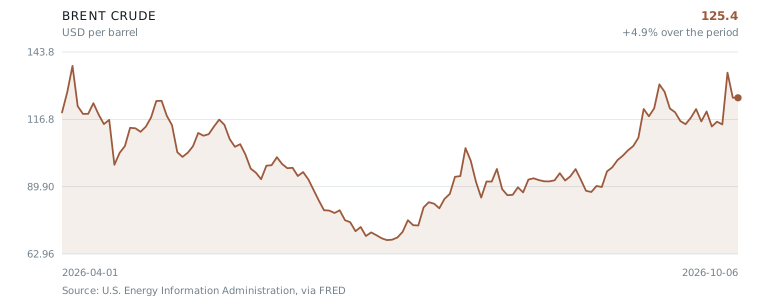
- 01Brent was 125.44 on 6 October.
- 02WTI was 96.24 on 6 October.
- 03Al-Manar claimed precise Iranian strikes damaged Gulf infrastructure.
- 04Saudi Arabia accused Iran of encouraging Houthi attacks on Riyadh.
- 05Unspecified US media reported consideration of using the GBU-43/B against Iran.
Interpretation, not reporting. The facts above carry their tiers; this is one correspondent’s reading of them.
The escalation premium looks real, but the evidentiary base is thin. I would treat Brent at 125.44 and WTI at 96.24 as a market paying for tail risk, not as confirmation that Gulf infrastructure has been damaged. Al-Manar's strike claim, Saudi Arabia's accusation against Iran over Houthi attacks on Riyadh, intensified Yemen fighting and unspecified US media talk of the GBU-43/B all point toward the same risk, yet none by itself proves lost barrels. The 29.20 spread between the benchmarks is the important physical signal: if Gulf supply is threatened, other crude cannot instantly fill the gap. What would change my mind is evidence that the Al-Manar claim is more than a broadcast, or that the US bomb talk becomes an official plan. Until then, the danger is that rhetoric starts to shape shipping and procurement decisions before any damage is verified. If no confirmation appears, the premium should decay. If it does, the market will be repricing barrels, not words.
— Tomás Ferreira
Every claim in this article, and what it rests on
We do not ask you to take our word for it. Each statement below carries its tier and its sources. Where sources disagree, you get both accounts and what would settle it.
The BRENT instrument value was 125.44 on 2026-10-06.
The WTI instrument value was 96.24 on 2026-10-06.
Al-Manar published an investigative report claiming precise Iranian strikes damaged Gulf infrastructure.
Saudi Arabia accused Iran of encouraging Houthi attacks on Riyadh.
Fighting and attacks in Yemen intensified.
US media reported that the US military was considering plans to use the GBU-43/B Massive Ordnance Air Blast Bomb against Iran.
The case against this story
Written by an adversarial reviewer, not the correspondent
The story paints a picture of imminent major war, but it rests on weak and interested sources. The claim that precise Iranian strikes damaged Gulf infrastructure comes from Al-Manar, which is Hezbollah's propaganda channel with every reason to inflate Iranian military prowess. The claim that the US military was considering using the MOAB bomb against Iran is attributed only to unspecified 'US media' with no outlet named or source identified. The oil price figures, while potentially factual, reinforce a crisis narrative that may be amplified by propaganda. Standard regional accusations and Yemen fighting are presented alongside these more dramatic claims, creating a guilt-by-association effect that makes the whole package seem more alarming than any individual claim warrants. A reader cannot distinguish genuine escalation from interested exaggeration on this evidentiary basis.
Who benefits from this framing: Iran and its allies, Hezbollah and the Houthis, benefit if readers believe Iranian strikes are effective and the US is being driven toward extreme measures. US military hawks benefit from escalation narratives that build public support for strikes against Iran. Oil speculators benefit from panic about energy supplies driving up prices. Saudi Arabia benefits from framing Iran as the sole aggressor. Al-Manar specifically benefits by having its propaganda laundered through a high-confidence presentation.
Report an error in this article
Subscriptions open at launch
Global Materials Review will be a paid publication. Reading is free while we build the archive — leave an address and we will write to you once, when subscriptions open.