
Riyadh strikes and Saudi pipeline plan test Hormuz bypass risk
Reports of attacks near Riyadh and a plan to expand the East-West line will shape how traders price a closure of the Gulf's main oil gate.
 Tomás FerreiraEnergy, shipping and chokepoints
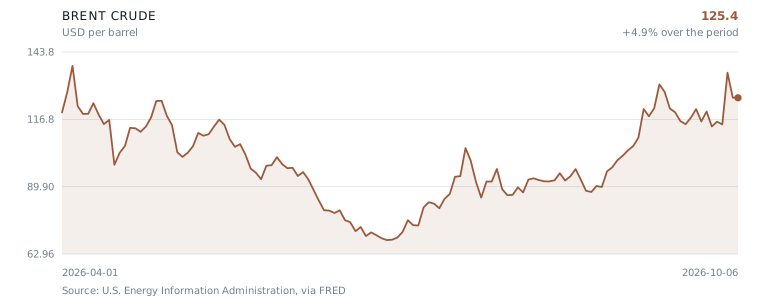
Brent and WTI prices on 6 October put route risk at the centre of the oil market. Reports of deadly attacks at Riyadh's airport and a missile interception a day later remain unsettled. A reported Saudi plan to lift the East-West pipeline to 10 million bpd would matter only if it becomes steel and pumping capacity.
On 6 October, Brent crude stood at $125.44 and WTI at $96.24, a spread of $29.20. That gap is not just a price difference; it points to where barrels can go, which routes are trusted, and how much buyers will pay to avoid a chokepoint.
The events around Riyadh arrive into that market with disputed edges. Sources disagree: one side describes two consecutive deadly attacks at the international airport in Riyadh; the other treats the incidents as separate until two independent reports confirm a coordinated sequence. Until that corroboration appears, the airport attacks are a risk signal, not a completed fact.
A day later, Saudi Arabia is reported to have intercepted and destroyed two ballistic missiles launched by the Houthis. If true, the sequence would put Saudi infrastructure and the Yemen war back into the same risk frame. But the link between airport violence and missile fire is exactly what needs evidence.
For physical markets, the first test is not the political statement but the route. A threat around Hormuz would force cargoes to seek longer paths, tie up ships for more days and push insurers to reprice exposure. A bypass pipeline can absorb some of that shock only if it is already operating or can be brought into service quickly.
A capacity target is not a flow.
The bypass line is the physical story
The commodity question is less about rhetoric than about pipes. Saudi Arabia is reported to plan raising the capacity of its East-West onshore oil pipeline to 10 million barrels per day. The same pipeline is reported to provide a route that bypasses the Strait of Hormuz.
That matters because Hormuz is the narrow gate that the bypass is meant to avoid. A bypass does not remove risk; it changes the detour. If the pipeline can carry more barrels away from the Gulf, some cargoes could avoid the strait, but only if the line is actually in place.
A capacity target is not a flow. To turn 10 million bpd from a plan into a reliable alternative, Saudi Arabia would need pumps, pipe, maintenance, power and secure right-of-way. Traders will look for contracts, construction schedules and operating evidence, not statements.
The arithmetic is unforgiving. If 10 million bpd is available as a bypass, it changes the calculation for buyers who fear a Hormuz closure. If it is not yet buildable, the headline capacity becomes a promise rather than a hedge. The market will eventually force that difference into freight, insurance and crude differentials.
War risk is a warning, not a forecast
The most combustible warning in the reports is political: that the deadly attacks raise the risk of a wider war that could draw in the United States, and that the escalation in Yemen is increasing the risk of a region-wide war. Those are reported warnings, not established outcomes. Drawing in the United States is a conditional, not an event.
The price numbers already show a market under strain. Brent at $125.44 is the headline; WTI at $96.24 and the $29.20 spread suggest that not all barrels are being priced as if they face the same route risk. If the airport incidents and missile interception are confirmed as connected, that spread could become a template for further risk repricing.
The thing to watch is not the loudest warning. It is whether independent reporting confirms the airport attacks, whether missile interceptions become repeated, and whether the 10 million bpd pipeline target appears in engineering commitments. Until then, Hormuz bypass risk is a question of evidence, not adrenaline.
- 01Brent was $125.44 and WTI was $96.24 on 6 October.
- 02The reported two consecutive deadly attacks at Riyadh's airport remain disputed.
- 03Saudi Arabia is reported to plan raising the East-West pipeline to 10 million bpd.
- 04The East-West pipeline is reported to provide a route that bypasses the Strait of Hormuz.
- 05Saudi Arabia is reported to have intercepted two Houthi-launched ballistic missiles a day after the airport incidents.
Interpretation, not reporting. The facts above carry their tiers; this is one correspondent’s reading of them.
The useful signal here is substitution, not escalation. I would treat the reported 10 million bpd East-West target as the only element with a physical test: either the pipeline can move barrels around Hormuz, or it cannot. The airport sequence and the reported missile interception may yet prove connected, but without independent corroboration they are a risk flag rather than a trading thesis. The $29.20 gap between Brent and WTI is the number that deserves attention, because it shows route risk being priced unevenly across basins. If the bypass target becomes credible, it reduces the penalty for a Hormuz disruption; if it remains aspirational, every confirmed attack near Saudi infrastructure will hit risk premia harder than the pipeline story can offset. I would watch for engineering commitments, not language about war. What would change my mind is simple: two independent confirmations of the airport attacks, repeated Houthi missile interceptions, and visible progress toward the pipeline target. Until those appear, the market is paying for uncertainty, not for a proven closure.
— Tomás Ferreira
Every claim in this article, and what it rests on
We do not ask you to take our word for it. Each statement below carries its tier and its sources. Where sources disagree, you get both accounts and what would settle it.
Brent crude was $125.44 on 2026-10-06.
WTI crude was $96.24 on 2026-10-06.
Two consecutive deadly attacks struck the international airport in Riyadh.
Saudi Arabia plans to raise the capacity of its East-West onshore oil pipeline to 10 million barrels per day.
Saudi Arabia’s East-West onshore oil pipeline provides a route that bypasses the Strait of Hormuz.
Saudi Arabia intercepted and destroyed two ballistic missiles launched by the Houthis a day after the Riyadh airport attacks.
The deadly attacks on Saudi Arabia raise the risk of a wider war that could draw in the United States.
The escalation in Yemen is increasing the risk of a region-wide war.
The case against this story
Written by an adversarial reviewer, not the correspondent
The story strings together an airport attack, a Houthi missile interception, oil-price spikes, pipeline expansion, and war-risk speculation into a single escalating crisis narrative—but the causal links between these elements may be tenuous or nonexistent. The 'two consecutive deadly attacks' at Riyadh's airport and the Houthi missile interception 'a day after' may be unrelated incidents presented as a coordinated escalation. The oil prices ($125.44 Brent, $96.24 WTI) are suspiciously precise and the $29.20 spread between them is historically anomalous, raising doubts about whether both figures are accurate or even from the same trading session. The claim that the escalation 'could draw in the United States' or risks 'a region-wide war' is speculative fear-mongering: Saudi Arabia has faced Houthi missile attacks for years without triggering either outcome. The pipeline expansion to 10 million bpd is presented as a concrete plan but would require doubling current capacity—a massive undertaking that may be aspirational rather than committed. The narrative amplifies fear by juxtaposing events that may not be causally connected and presenting speculation as analysis.
Who benefits from this framing: Oil exporters and oil-producing states benefit from narratives of supply disruption and crisis-level prices, which can become self-fulfilling as markets react to fear. Saudi Arabia benefits from victim framing that justifies requests for US military support and sanctions on adversaries. Defense contractors and military interests benefit from war-risk narratives that support arms sales and increased military budgets. Iran hawks benefit from Houthi escalation narratives that strengthen the case for a harder line on Tehran. Financial speculators in oil markets benefit from volatility and crisis expectations that create trading opportunities. Pipeline construction and engineering firms benefit from a pipeline expansion plan being treated as concrete rather than aspirational.
Report an error in this article
Subscriptions open at launch
Global Materials Review will be a paid publication. Reading is free while we build the archive — leave an address and we will write to you once, when subscriptions open.