
Reported Aramco strike and Yellow Line moves raise Gulf risk
A reported hit near Saudi oil administration and shifting military lines in Gaza and Lebanon are pushing physical energy markets toward a wider risk premium.
 Tomás FerreiraEnergy, shipping and chokepoints
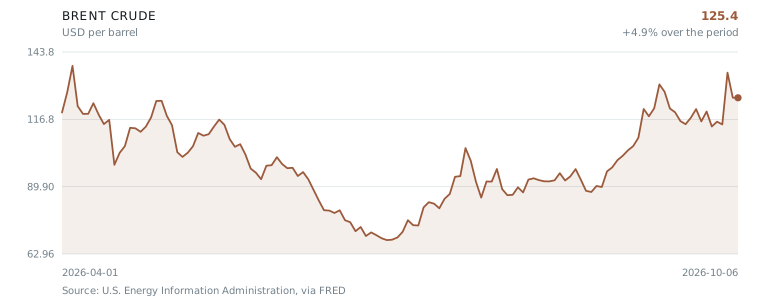
Brent traded at $125.44 on 6 October, with WTI at $96.24, leaving a wide $29.20 spread. Accounts say Saudi Aramco's administrative building in Dhahran was hit in attacks described as carried out by Iran-aligned Houthis. Israel's reported movement of Gaza's Yellow Line and the use of the same phrase for southern Lebanon add a second layer of geographic risk.
At $125.44 a barrel on 6 October, Brent is no longer pricing a routine Middle East risk premium. WTI stood at $96.24 on the same day, leaving a $29.20 gap between the two benchmarks. That is a large split, and it points to a fear concentrated around Gulf supply rather than a broad global shortage.
The physical trigger is close to the Gulf's administrative nerve. Accounts of the strikes say Saudi Aramco's administrative building in Dhahran, in eastern Saudi Arabia, was hit on Tuesday night and Wednesday morning. Accounts of the attacks describe them as carried out by Iran-aligned Houthis. The available accounts do not provide independent confirmation, but if the Houthi link stands it moves the conflict from proxy pressure to direct contact with Saudi oil management.
A reported strike near the Gulf's nerve center
Dhahran is not a remote pipeline valve. It sits inside the Eastern Province, where Saudi oil administration and export infrastructure are concentrated. A reported attack on an administrative building does not shut a field by itself, but it changes the risk map. It tells traders that the institutions running production and exports are within range.
In physical markets, the first response is not political language. It is the behaviour of cargoes, vessels and contracts. A reported hit on Saudi administrative capacity can raise insurance costs, delay approvals and make counterparties ask whether loading schedules are secure. Even if no barrel is lost, the paper market can price the possibility.
A $29.20 difference suggests the market is separating the Atlantic basin from the Gulf risk, rather than repricing every barrel equally.
The oil numbers already show stress. Brent at $125.44 is a price that reflects supply risk. WTI at $96.24 is high, but the spread is the tell. A $29.20 difference suggests the market is separating the Atlantic basin from the Gulf risk, rather than repricing every barrel equally.
A line that keeps moving
The second strand is harder to map. Accounts from Gaza say Israel moved Gaza's Yellow Line westward. In Shujayea, that movement left displaced families with nowhere to go. The same accounts say an Israeli air strike killed a Palestinian woman in Gaza City, and a girl was rescued from a burning apartment after an attack struck a building there.
The Yellow Line language is also being used for southern Lebanon, where Israel's line is said to be reshaping the area. That creates confusion. A line in Gaza that displaces families is not automatically the same instrument as a line altering southern Lebanon. Without a clear definition, the phrase risks becoming a catch-all for military advance rather than a specific boundary.
This matters because markets need geography. A corridor, buffer or advance line changes risk in different ways. If the Yellow Line is a ceasefire boundary, its movement is one thing. If it is an operational military limit, it is another. Traders and shipowners will not wait for the terminology to be cleaned up; they will price the visible direction of force.
The market's first read
The immediate question is whether these incidents remain separate shocks or merge into one Gulf-wide risk. A reported strike on Aramco's administrative building can be contained if it does not repeat against export terminals, processing plants or tank farms. The Gaza line can remain a humanitarian and political disaster without directly closing shipping lanes. Southern Lebanon can stay a border conflict without altering Mediterranean energy flows.
But the market does not need certainty to move. It needs enough evidence to imagine the next step. If the Houthi attribution is confirmed, the link between Yemen, Gaza and Saudi infrastructure becomes tighter. If the Yellow Line advances again, the idea of stable de-escalation zones weakens. If Brent holds near $125.44 while WTI lags, the price structure is saying the risk is regional and logistical.
The thing to watch is not the next statement but the next physical signal: whether cargoes are delayed, whether vessels take longer routes, and whether buyers start seeking alternatives. Those are measurable. The rhetoric is not.
- 01Brent crude was $125.44 and WTI was $96.24 on 6 October.
- 02Accounts say Saudi Aramco's administrative building in Dhahran was hit on Tuesday night and Wednesday morning.
- 03The attacks are described as carried out by Iran-aligned Houthis.
- 04Accounts from Gaza say Israel moved the Yellow Line westward, leaving displaced families in Shujayea with nowhere to go.
- 05The Yellow Line is also described as reshaping southern Lebanon.
Interpretation, not reporting. The facts above carry their tiers; this is one correspondent’s reading of them.
The market's job is to separate a local shock from a regional war. At $125.44 Brent and $96.24 WTI, the $29.20 gap says the risk is being placed near the Gulf, not across the world. That is plausible if the reported hit on Aramco's administrative building in Dhahran is confirmed and if Iran-aligned Houthis were responsible; it is less convincing if the attribution remains thin. The Yellow Line language is even more unstable. One line moving westward through Shujayea is a Gaza matter; the same phrase reshaping southern Lebanon is a different map. I would treat the physical market as the arbiter: if tanker routing, insurance and cargo tenders start to stretch, the escalation is real. If not, this is a bundle of separate conflicts being sold as one. What would change my view is simple: sustained movement in freight rather than a one-day price spike.
— Tomás Ferreira
Every claim in this article, and what it rests on
We do not ask you to take our word for it. Each statement below carries its tier and its sources. Where sources disagree, you get both accounts and what would settle it.
On 2026-10-06, Brent crude was 125.44 and WTI crude was 96.24.
Saudi Aramco’s administrative building in Dharan, eastern Saudi Arabia, was hit in attacks on Tuesday night and Wednesday morning.
The attacks on Saudi Aramco’s administrative building were carried out by Iran-aligned Houthis.
Israel moved Gaza’s Yellow Line westward.
The westward movement of Gaza’s Yellow Line left displaced families in Shujayea with nowhere to go.
An Israeli air strike killed a Palestinian woman in Gaza City.
A girl was rescued from a burning apartment after an Israeli attack struck a building in Gaza City.
Israel’s Yellow Line is reshaping southern Lebanon.
The case against this story
Written by an adversarial reviewer, not the correspondent
The story assembles a picture of comprehensive regional escalation: Houthis attacking Saudi oil infrastructure, Israel expanding territorial control simultaneously in Gaza and southern Lebanon, civilian casualties, and surging oil prices. The strongest case against this picture is the internal inconsistency around the 'Yellow Line'—it is described as being in Gaza (moved westward, displacing families in Shujayea) and also as reshaping southern Lebanon, with no explanation of whether these are the same or different lines or what the Yellow Line even refers to. If this concept is being conflated or misapplied across two separate conflict zones, it undermines the credibility of multiple claims at once. Additionally, the oil price data shows a Brent-WTI spread of approximately $29, far outside the typical $2–10 range, which if inaccurate would undermine the economic dimension of the escalation narrative. The Houthi attribution for the Saudi Aramco attack is also asserted without any indicated sourcing. Together, these issues suggest the story may be stitching together disparate fragments—some possibly inaccurate—into a narrative of all-encompassing regional crisis that may not withstand scrutiny.
Who benefits from this framing: If a reader accepts this framing of simultaneous multi-front regional crisis—Iran-aligned Houthis attacking Saudi oil, Israel expanding territorial lines in both Gaza and Lebanon at once, civilian casualties mounting, and oil prices surging—the primary beneficiaries are: advocates of military confrontation with Iran and its allied groups, who gain from a narrative of coordinated Iranian-backed aggression across multiple fronts; oil market speculators and energy traders who profit from supply-disruption panic; and defense and security interests who benefit from public acceptance of expanded military operations as proportional and necessary. The framing also serves any party seeking to justify escalation by portraying the region as already in comprehensive crisis, making additional military or political action seem like a response rather than an escalation.
Report an error in this article
Subscriptions open at launch
Global Materials Review will be a paid publication. Reading is free while we build the archive — leave an address and we will write to you once, when subscriptions open.