
Qatar’s old tankers meet a riskier Hormuz
Accounts of sinkings near the strait could raise LNG delivery, insurance and freight costs before any official report confirms them.
 Tomás FerreiraEnergy, shipping and chokepoints
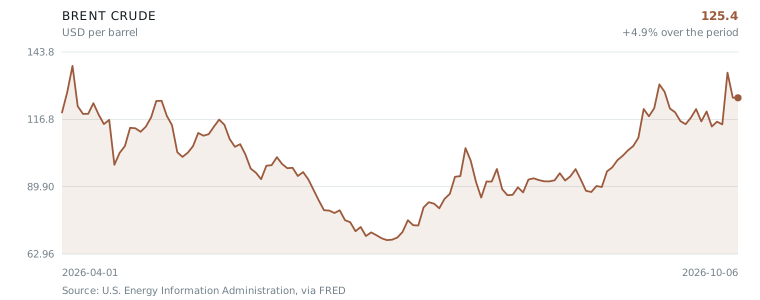
Brent was 125.44 and Henry Hub was 3.03 on 6 October, giving a hard price frame around a softer maritime narrative. Accounts describe sinkings near the Strait of Hormuz and a Qatari shift toward older tankers, but they remain accounts rather than confirmed events. The risk is that insurers and shipowners change terms before the facts are settled.
On 6 October, Brent crude was 125.44 and Henry Hub natural gas was 3.03. Those two marks frame the problem neatly. Brent is exposed to seaborne disruption; Henry Hub is not, so the pressure from Hormuz would show up first in freight, insurance and cargo delays rather than in the US gas benchmark.
The price marks are hard; the shipping incidents are not. In shipping circulation, a container ship and a dry bulk carrier are said to have sunk near the Strait of Hormuz. A separate account says a bulk carrier sank weeks after a deadly strike in the strait. In the same accounts, Iran is accused of escalating maritime attacks, while Qatar is described as rewriting its gas playbook with old tankers and new tactics.
Prices are firm, incidents are fuzzy
The market can verify a price quickly. It cannot verify a hull from a distance. If the sinkings are confirmed, the first channel is insurance. Underwriters would reassess war-risk premia, owners would alter routing or speed, and charterers would pay for the difference. That sequence can move freight before any official casualty report is complete.
Brent at 125.44 already carries a scarcity tone. Henry Hub at 3.03 does not. The comparison matters because a Hormuz disruption is not a uniform energy shock. It hits ships, crews, war-risk cover and delivery windows. For Qatar, the question is whether older tankers and changed operating habits can keep gas moving without pushing insurers further away.
The price marks are hard; the shipping incidents are not.
The second channel is time. A vessel slowed, rerouted or held for additional checks adds days to a voyage. In gas, those days can matter more than the headline price, because cargoes are tied to berths, boil-off limits and receiving-terminal slots. A small increase in transit time can become a missed window, and a missed window becomes a contract argument.
Qatar’s route risk is operational, not rhetorical
The description of Qatar leaning on old tankers and new tactics points to a practical problem. Ageing vessels can keep schedules when newer ships are scarce, but they also invite closer inspection, higher maintenance and more cautious port-state control. In a tense waterway, those frictions become days, not just costs.
The bulk-carrier and container-ship accounts widen the issue beyond energy. If true, the risk is not only to tankers carrying crude or LNG. It extends to general trade that uses the same approaches, the same pilots, the same anchorages and the same insurance desks. A container line does not need a direct hit to reroute; it needs a premium it refuses to pay.
There is also a fleet-effect. If underwriters treat the strait as more dangerous, they may demand convoy-like scheduling, longer notice, higher cover or different crew procedures. Each step is small alone. Together, they thin the number of ships willing to transit on normal terms, and that thinning is what turns risk into physical delay.
The detour question has no easy answer
The spatial question is simple: if Hormuz becomes slower or more expensive, where do the cargoes go? For Qatar, there is no pipe that fully replaces the sea lane. For regional bulk and container traffic, alternatives mean longer transits, later berths and thinner schedules. The market may not need a formal closure to change behaviour.
That is why the strongest signal may come from private contracts rather than official statements. War-risk renewals, freight fixtures and vessel-tracking gaps can move before ministries speak. The open question is whether insurers and owners start treating the strait as a higher-risk corridor on their own terms.
- 01Brent crude was 125.44 on 6 October.
- 02Henry Hub natural gas was 3.03 on 6 October.
- 03Shipping accounts say a container ship and a dry bulk carrier have sunk near the Strait of Hormuz.
- 04A separate account says a bulk carrier sank weeks after a deadly strike in the strait.
- 05Iran is accused of escalating maritime attacks, and Qatar is described as using old tankers and new tactics.
Interpretation, not reporting. The facts above carry their tiers; this is one correspondent’s reading of them.
The market is being asked to price a Hormuz shipping crisis before the hulls are counted. I would separate the two parts. Brent at 125.44 and Henry Hub at 3.03 on 6 October are concrete, and they point to a crude market already carrying disruption risk while the US gas marker stays quiet. The accounts of a container ship and a dry bulk carrier sinking, of a bulk carrier going down weeks after a deadly strike, and of Iran escalating maritime attacks are much softer unless insurers, owners or maritime authorities put them on the record. Qatar’s described move toward old tankers and new tactics is plausible as a logistics response, but it also raises the kind of operational risk that shows up in detention, inspection and cover, not in a headline. If war-risk terms tighten and freight fixtures move before any official confirmation, the market will have answered the question itself. If they do not, I would treat the crisis narrative as a warning light, not a confirmed casualty.
— Tomás Ferreira
Every claim in this article, and what it rests on
We do not ask you to take our word for it. Each statement below carries its tier and its sources. Where sources disagree, you get both accounts and what would settle it.
Brent crude was 125.44 on 2026-10-06.
Henry Hub natural gas was 3.03 on 2026-10-06.
A container ship and a dry bulk carrier have both sunk near the Strait of Hormuz.
A bulk carrier sank weeks after a deadly strike in the Strait of Hormuz.
Qatar has rewritten its gas playbook using old tankers and new tactics.
Iran has escalated maritime attacks in the Strait of Hormuz.
The case against this story
Written by an adversarial reviewer, not the correspondent
The story assembles a crisis narrative around the Strait of Hormuz—ships sinking, Iran escalating, Qatar reshaping gas strategy, and energy prices spiking—but the load-bearing factual claims are the weakest links. The two price points (Brent at 125.44, Henry Hub at 3.03) are presented as hard data yet carry no visible market-data citation. The maritime claims are all at the lowest confidence tier: 'a container ship and a dry bulk carrier have both sunk' and 'a bulk carrier sank weeks after a deadly strike' are not corroborated by any visible shipping incident report, Lloyd's List intelligence, IMB piracy report, or coast-guard statement. The claim that 'Iran has escalated maritime attacks' is a broad geopolitical assertion that requires evidence of specific Iranian actions and a baseline showing escalation—not just isolated incidents. The claim that 'Qatar has rewritten its gas playbook using old tankers and new tactics' is editorialised language that could mean almost anything and is not tied to any specific Qatari government statement, LNG contract data, or shipping-registry analysis. Without concrete sourcing for any of these claims, the entire picture could be a constructed narrative rather than a reported one.
Who benefits from this framing: If a reader accepts this framing, the beneficiaries include: energy traders and commodity speculators who profit from panic-driven price volatility; defence contractors and naval interests who benefit from narratives justifying increased military presence in the Gulf; energy producers (including LNG exporters and oil producers) who gain from higher prices driven by fear of supply disruption; geopolitical hawks who seek public support for confrontation with Iran; and options traders or short-sellers positioned to profit from market moves triggered by crisis narratives. Additionally, any party seeking to drive a wedge between Iran and Gulf states, or to justify sanctions or military action, benefits from a story that portrays the Strait of Hormuz as a zone of escalating Iranian aggression.
Report an error in this article
Subscriptions open at launch
Global Materials Review will be a paid publication. Reading is free while we build the archive — leave an address and we will write to you once, when subscriptions open.