
OPEC's 2027 demand call meets a $29 crude split
High Brent, low near-term demand growth and expected moderation in US CPI are pulling oil investors in opposite directions.
 Tomás FerreiraEnergy, shipping and chokepoints

Brent crude was $125.44 and WTI was $96.24 on 6 October, leaving a $29.20 gap between the two benchmarks. OPEC expects global oil demand growth of just 200,000 barrels per day this year, then 2.6 million barrels per day in 2027. Economists expect key US CPI metrics to have moderated in September, with the report due on Wednesday.
On 6 October, WTI crude was $96.24 and Brent crude was $125.44. Both prices are above $90.
The gap between the two benchmarks is the first thing a physical desk will notice. Brent minus WTI comes to $29.20, a split that changes the price signal for anyone comparing the two markets.
OPEC's near-term number adds to the tension. The organization says global oil demand growth this year is just 200,000 barrels per day.
A demand step, not a slope
The same forecast points to a much larger move ahead. OPEC expects global oil demand growth of 2.6 million barrels per day in 2027. That is thirteen times the 200,000 barrels per day it sees this year.
The arithmetic is stark. Moving from 200,000 barrels per day to 2.6 million barrels per day adds 2.4 million barrels per day to the expected growth rate. That is not a small revision; it changes the shape of the forecast.
For a market that thinks in barrels, the problem is the bridge. A rise of that size would need either a large change in consumption, a change in supply, or both. The figures on the table do not say which one does the work.
OPEC's numbers describe a step, not a slope.
The central question is whether the market should price the near-term demand figure or the later acceleration. The first points to a small growth year. The second points to a much larger demand increase. Both cannot be the dominant signal at the same time without another variable.
The price message is equally blunt. WTI above $96 and Brent above $125 put crude well above the $90 level that tends to draw attention from inflation desks. If demand growth is only 200,000 barrels per day this year, the strength in prices cannot be explained by that number alone.
That leaves the spread as the clearest internal signal. With demand growth at 200,000 barrels per day, the high prices stand out. The difference between WTI and Brent says the tension is not evenly distributed across the two price points.
The spread is not a footnote. It changes the price signal. If one benchmark is much higher than the other, the market is not saying the same thing in both places.
CPI gets the first test
The next macro signal arrives on Wednesday. Economists expect key U.S. CPI inflation metrics to have continued to moderate in September, and the U.S. Consumer Price Index report is due that day.
If the report confirms moderation, investors will have to reconcile easing inflation expectations with oil prices that remain high. If it does not, the question becomes whether strong crude prices are feeding through to the broader price level.
The CPI report will not answer the oil question by itself. But it will show whether the macro backdrop is friendly to high crude prices. If inflation metrics moderate while oil stays high, the market must decide whether oil is an exception or a warning.
The timing matters because oil is both a commodity and an input. A sustained move above $90 can change the inflation conversation even if other components are easing. The CPI report will not settle the gap between the demand figures and the price levels, but it will show how much room the macro backdrop gives it.
OPEC's numbers describe a step, not a slope. The market now has to decide whether the 2027 call is a forecast that prices should wait for, or a signal that the current price structure is already trying to anticipate.
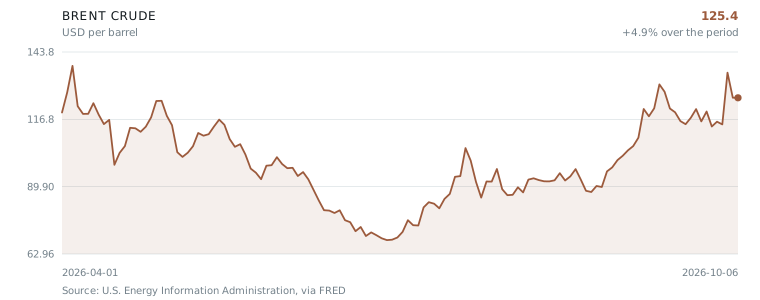
- 01WTI crude was $96.24 on 6 October.
- 02Brent crude was $125.44 on 6 October.
- 03The Brent-WTI spread was $29.20.
- 04OPEC sees 200,000 bpd demand growth this year and 2.6 million bpd in 2027.
- 05Economists expect September CPI metrics to have moderated; the report is due Wednesday.
Interpretation, not reporting. The facts above carry their tiers; this is one correspondent’s reading of them.
The market is being asked to hold two conflicting signals in one price: OPEC's 200,000 bpd growth this year and its 2.6 million bpd call for 2027. I do not see how both can be true without a supply-side explanation, and none appears in the numbers. If Brent stays near $125 while WTI lags at $96, the physical message is tightness in one market rather than broad global demand. But if Wednesday's CPI confirms moderation, the macro case for sustained oil above $90 becomes harder to sustain. My test is conditional: if OPEC's 2027 call is right, prices should begin to reflect that demand path. If they do not, I treat 2.6 million bpd as a forecast, not a floor. A wide spread can persist for a season; it cannot substitute for barrels.
— Tomás Ferreira
Every claim in this article, and what it rests on
We do not ask you to take our word for it. Each statement below carries its tier and its sources. Where sources disagree, you get both accounts and what would settle it.
WTI crude was $96.24 on 2026-10-06.
Brent crude was $125.44 on 2026-10-06.
OPEC forecasts global oil demand growth of 2.6 million barrels per day in 2027.
OPEC said global oil demand growth this year is just 200,000 barrels per day.
Economists predicted that key U.S. CPI inflation metrics continued to moderate in September.
The U.S. Consumer Price Index report is due to be released on Wednesday.
The case against this story
Written by an adversarial reviewer, not the correspondent
The story is internally contradictory. It says OPEC reports only 200,000 barrels per day of demand growth this year — an extraordinarily low figure for an organisation that typically forecasts 1–2 million bpd — yet simultaneously presents oil prices near $96 (WTI) and $125 (Brent), levels that normally reflect strong demand or acute supply disruption. No supply-side explanation is offered for how collapsing demand growth coexists with near-triple-digit or triple-digit prices. The WTI–Brent spread of roughly $29 is historically extreme and goes unexplained. Meanwhile OPEC supposedly forecasts 2.6 million bpd growth in 2027, a thirteen-fold acceleration from the 200,000 bpd attributed to this year, with no bridge between the two figures. The picture reads less like a coherent market analysis and more like a bullish oil narrative stitched together from inconsistent data points.
Who benefits from this framing: Oil producers, exporters, and long-positioned commodities investors benefit if readers accept triple-digit Brent as justified and believe a massive demand surge is imminent. The framing — weak current demand yet high prices, with explosive growth just around the corner — primes readers to expect even higher prices ahead, supporting continued fossil-fuel investment, weakening the case for energy transition, and giving cover to producers who want to sustain elevated price expectations despite soft near-term consumption.
Report an error in this article
Subscriptions open at launch
Global Materials Review will be a paid publication. Reading is free while we build the archive — leave an address and we will write to you once, when subscriptions open.