
Nord Stream trial opens, but Ukraine link remains unproven
A German court case may reshape gas-risk premiums, but attribution to Kyiv is not yet proven.
 Tomás FerreiraEnergy, shipping and chokepoints
The Nord Stream pipelines were sabotaged, and a German trial over that sabotage has reportedly begun. The more consequential allegation — involving a Ukrainian military officer — remains unsupported by public evidence. Price readings on 6 October provide atmosphere, not proof of a market reaction to the court.
A trial is reported, attribution is not settled
The Nord Stream pipelines were sabotaged. That much is physical fact: ruptured lines on the Baltic seabed, lost capacity and a permanent change in how Europe counts its gas routes. The legal phase has now reportedly begun in Germany, but the shape of the case is less certain than the headline.
Two elements need to be kept apart. One is the existence of a German trial over the sabotage. The other is the far heavier allegation that a Ukrainian military officer is on trial and that Ukraine itself is implicated. The first is circulating as a current event; the second remains an allegation, not an established finding.
This distinction matters because markets and ministries do not react to mystery in the same way they react to assigned responsibility. If public evidence eventually identifies a state or unit, sanctions politics, compensation fights and infrastructure-protection budgets could all shift. If it does not, the case may simply add another layer of suspicion without changing the physical balance of supply.
A trial alone does not reroute a cargo.
Price snapshots are not proof of a courtroom effect
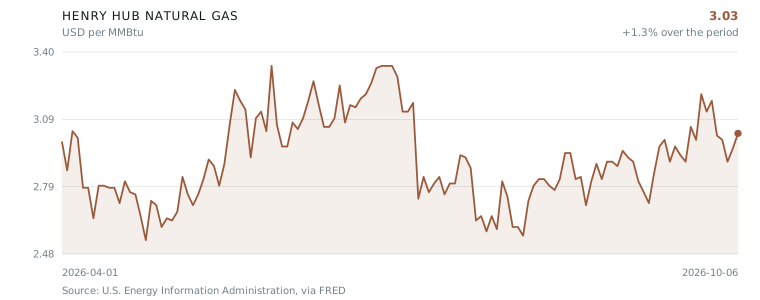
Energy prices were already elevated and volatile before any courtroom news. On 6 October, Brent was at 125.44, WTI at 96.24 and Henry Hub gas at 3.03. Brent's premium over WTI was therefore about 29.20, a wide spread that speaks to global oil tightness rather than to one legal proceeding. A single day's price cannot separate a legal shock from the ordinary noise of supply, weather and positioning.
Those numbers can be used as a backdrop, but they cannot be used as a verdict. No evidence yet links the 6 October readings to the trial. They may reflect supply disruptions, shipping constraints, seasonal storage, sanctions risk or any combination of forces that move barrels and molecules.
For a physical market, the mechanism would have to run through something concrete: a change in gas flows, a new insurance cost for Baltic infrastructure, a sanction that alters trade, or a security requirement that slows repairs. A trial can start that chain by producing evidence. A trial alone does not reroute a cargo. The timescale matters. Evidence can move sentiment in hours; insurance, rerouting and security spending move over weeks and months.
What would turn allegations into risk premiums
The market-moving question is not whether a courtroom is meeting, but what evidence emerges and whom it implicates. A case that assigns responsibility to a state actor would raise the probability of retaliatory measures, compensation disputes and tighter protection of subsea assets. That would be felt in insurance premia, project costs and the discount applied to routes perceived as vulnerable.
Europe's gas system is already different from the one that existed before the sabotage. Storage, LNG intake, pipeline rerouting and demand restraint have replaced some of the lost capacity. But the Baltic remains a corridor where politics, cables and pipelines sit close together. Any credible finding that a state directed attacks on energy infrastructure would increase the perceived risk of future incidents. The open question is whether underwriters, port states and pipeline operators change their behaviour before any verdict.
For now, the strongest statement is also the narrowest: the pipelines were sabotaged, and a German trial over that sabotage has reportedly begun. The more explosive attribution to a Ukrainian officer or to Ukraine itself rests on thinner support. Until public evidence closes that gap, traders should treat the legal story as a risk flag, not as a new supply fact.
- 01The Nord Stream pipelines were sabotaged.
- 02A German trial over the sabotage has reportedly begun.
- 03Allegations against a Ukrainian officer are not established.
- 04Brent was 125.44 and WTI was 96.24 on 6 October.
- 05Henry Hub gas was 3.03 on 6 October.
Interpretation, not reporting. The facts above carry their tiers; this is one correspondent’s reading of them.
The legal story is real enough to matter, but not yet proven enough to price as attribution. I would separate the pipeline damage from the courtroom narrative. The sabotage changed Europe's gas map; the trial may change who is blamed, but only if public evidence survives scrutiny. The Ukrainian-officer allegation is the part I would treat as unproven until corroborated. If that holds, the market impact should stay limited to risk rhetoric rather than flows. If independent evidence ties a state actor to the attack, then sanctions politics, insurance costs and infrastructure-security spending become the channels to watch. The price readings on 6 October do not settle that. Brent, WTI and Henry Hub can move for many reasons, and a single date cannot prove causation. What would change my mind is a clear evidentiary link from the German proceedings to a named chain of command. Until then, the case is a political and legal risk flag, not a new physical supply shock.
— Tomás Ferreira
Every claim in this article, and what it rests on
We do not ask you to take our word for it. Each statement below carries its tier and its sources. Where sources disagree, you get both accounts and what would settle it.
The Nord Stream pipelines were sabotaged.
The BRENT price reading was 125.44 on 2026-10-06.
The WTI price reading was 96.24 on 2026-10-06.
The HENRY_HUB_GAS price reading was 3.03 on 2026-10-06.
A German trial over the Nord Stream sabotage has begun.
The Nord Stream sabotage had remained unsolved for years before the trial.
A Ukrainian military officer is on trial in Germany over the Nord Stream sabotage.
The trial includes allegations against Ukraine.
The case against this story
Written by an adversarial reviewer, not the correspondent
The story's overall picture is that a German trial has begun, putting a Ukrainian military officer in the dock for the Nord Stream sabotage, confirming Ukrainian state involvement after years of mystery. But the two most specific and consequential claims—that a Ukrainian military officer is on trial and that the trial includes allegations against Ukraine—are only weakly supported, while the broader claim that a trial has begun is rated highly. This creates a credibility cascade: a reader accepts the trial as confirmed (high confidence), then carries that confidence into the Ukrainian-attribution claims that actually rest on much thinner evidence. The inclusion of specific oil and gas price readings on a single date further implies that markets are reacting to the trial, but no evidence links those prices to the legal proceedings—they could reflect any number of geopolitical or supply factors. The story thus uses a potentially real legal event as scaffolding to present speculative Ukrainian attribution as near-confirmed, while market data lends false atmospherics of real-world impact.
Who benefits from this framing: Russia benefits most from a framing that places a Ukrainian military officer on trial for the Nord Stream sabotage. If readers accept that narrative, blame for the pipeline attack shifts from Russia to Ukraine, undermining Western public and political support for Ukrainian military aid. It also validates longstanding Russian propaganda claims that Ukraine acts against European energy interests. Domestically, political factions in Europe and the United States that oppose continued aid to Ukraine benefit, as they can cite 'an ongoing trial' as evidence that Ukraine attacked critical European infrastructure. Energy traders or analysts who have taken positions on the expectation of reduced Russian gas flows could also benefit if the framing drives price sentiment.
Report an error in this article
Subscriptions open at launch
Global Materials Review will be a paid publication. Reading is free while we build the archive — leave an address and we will write to you once, when subscriptions open.