
Nord Stream trial and Kyiv talks test Europe's gas risk
A sabotage trial, high-level diplomacy and elevated energy prices converge ahead of winter.
 Tomás FerreiraEnergy, shipping and chokepoints
Oil prices on 14 October were elevated, with Brent at $126.55 and WTI at $101.91, while Henry Hub natural gas stood at $3.22. A Ukrainian army officer suspected in the Nord Stream sabotage stood trial, according to the account of the case, and is described as facing a German war-crime charge. Zelenskyy said Russia's war must end and that Kyiv-Washington communication is virtually nonstop despite a spat with Trump.
A wide oil spread, a modest gas print
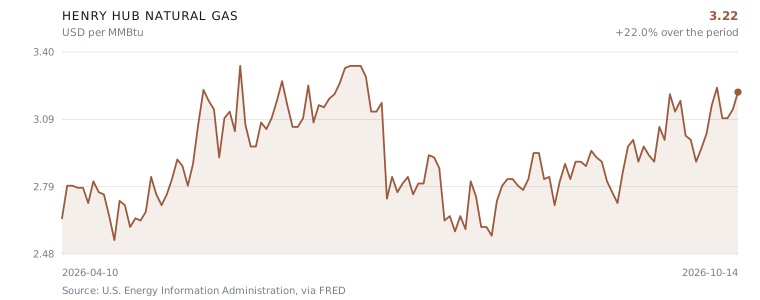
On 14 October, Brent crude stood at $126.55, West Texas Intermediate at $101.91, and Henry Hub natural gas at $3.22. Those are not one-market signals. Oil is pricing a shock; gas, at least in the US benchmark, is not.
For European gas buyers, the number that matters is not Henry Hub alone but the route, storage and insurance around physical molecules. The Nord Stream case, as described, starts with the 2022 sabotage of the Nord Stream gas pipelines. Any court proceeding that touches that sabotage reopens the question of who bears risk on subsea energy links.
Courtroom risk is infrastructure risk
A Ukrainian army officer suspected of being a protagonist in the sabotage stood trial, according to the account of the case. He faces a German war-crime charge, the same account says. That label is the heaviest part of the description. If it stands, the proceeding moves from a property-and-infrastructure case into a different legal register, with broader implications for how attacks on energy systems are prosecuted.
The market channel is indirect but real. Legal clarity can affect insurance, compliance and political risk around pipelines and subsea cables. It can also shape whether states treat energy infrastructure as a protected civilian object or as a legitimate target in hybrid conflict. For gas procurement, the question is not only whether a cargo is available, but whether the route, the compressor stations and the interconnectors are likely to remain intact through winter.
If either the legal label or the diplomatic channel proves thinner than it sounds, the winter risk premium will not wait for clarification.
When a pipeline route is lost, the replacement route tends to be longer and more exposed to weather and politics. The trial does not restore the lost route, but it can assign responsibility for the loss, which is the first step in pricing it.
Kyiv's line to Washington
Zelenskyy said Russia's war on Ukraine must be brought to an end. He also said communication between Washington and Kyiv is virtually nonstop despite a spat with Trump. The first statement is familiar; the second is the operational one. If contacts are continuous, the market reads a lower probability of sudden diplomatic collapse, though frequency is not the same as agreement.
The phrase virtually nonstop does not say whether talks concern battlefield terms, security guarantees, sanctions or energy infrastructure. For traders, the difference matters. A settlement that leaves pipeline risk unresolved does not remove the physical premium; it merely changes who is assumed to carry it.
Winter math with a legal overlay
The price set on 14 October gives a snapshot of that tension. Brent at $126.55 versus WTI at $101.91 is a spread of $24.64, wide enough to signal transport, quality or regional risk rather than a single global shortage. Henry Hub at $3.22 sits far below the oil signal, reminding buyers that gas can remain looser in one basin even when crude markets are tight.
Europe's winter exposure is not just a price question. It is a question of alternative routes: Norwegian pipe gas, LNG arrivals, storage withdrawals and demand response. The case describes the pipelines as sabotaged in 2022, and that event now sits inside Europe's route calculus. The trial adds a legal test of accountability for that loss, while Kyiv's talks with Washington test whether the political frame can hold through the heating season.
The open question is whether the court process and the diplomacy work on the same clock. Courts move by evidence and procedure; gas markets move by weather, storage and ship schedules. If either the legal label or the diplomatic channel proves thinner than it sounds, the winter risk premium will not wait for clarification.
- 01Brent was $126.55 and WTI was $101.91 on 14 October.
- 02Henry Hub natural gas was $3.22 on 14 October.
- 03Zelenskyy said Russia's war must end and Kyiv-Washington communication is virtually nonstop.
- 04A Ukrainian army officer suspected in the Nord Stream sabotage stood trial and is described as facing a German war-crime charge.
- 05The Nord Stream gas pipelines are described as sabotaged in 2022.
Interpretation, not reporting. The facts above carry their tiers; this is one correspondent’s reading of them.
The legal label is the hinge. If a German war-crime charge is truly the instrument, the Nord Stream case stops being only a criminal proceeding and becomes a test of how far law reaches into attacks on energy infrastructure. I would treat the price table as a warning about geography rather than a single energy crisis: Brent at $126.55 against WTI at $101.91 is a wide spread, while Henry Hub at $3.22 says that particular gas benchmark is not pricing the same shock. Zelenskyy's line that Washington-Kyiv communication is virtually nonstop matters only if it turns into a durable framework; frequency is not settlement. My watch is simple: if the court process clarifies responsibility for the 2022 sabotage, political risk around subsea infrastructure could become easier to price. If the charge or the diplomacy blurs, winter procurement will keep paying for ambiguity.
— Tomás Ferreira
Every claim in this article, and what it rests on
We do not ask you to take our word for it. Each statement below carries its tier and its sources. Where sources disagree, you get both accounts and what would settle it.
The Henry Hub natural-gas price was 3.22 on 14 October 2026.
The Brent price was 126.55 on 14 October 2026.
The WTI price was 101.91 on 14 October 2026.
Ukrainian President Zelenskyy said Russia’s war on Ukraine must be brought to an end.
Zelenskyy said communication between Washington and Kyiv is virtually nonstop despite a spat with Trump.
A Ukrainian army officer suspected of being a protagonist in the sabotage of Nord Stream gas pipelines stood trial.
The Nord Stream sabotage suspect faces a German war-crime charge.
The Nord Stream gas pipelines were sabotaged in 2022.
The case against this story
Written by an adversarial reviewer, not the correspondent
The story's hardest data points are mutually contradictory. A Brent price of $126.55 and a WTI price of $101.91 cannot both be accurate without a market dislocation so severe it would be the lead story on every financial front page—yet the narrative treats both as settled facts. If one figure is wrong, the entire energy-price pillar of the story collapses. Beyond the numbers, the claim that the Nord Stream sabotage suspect faces a German 'war-crime charge' is a very specific legal label; German prosecutors are far more likely to pursue charges under sabotage, terrorism, or explosives statutes than under war-crimes law, which typically applies to armed-conflict violations against persons, not infrastructure. Mislabeling the charge inflates the gravity of the proceeding and implies a legal equivalence with atrocities. The diplomatic claims are similarly soft: 'virtually nonstop' communication is a vague quantifier that could mean anything from hourly calls to a weekly email, and 'spat with Trump' editorialises what may be a routine disagreement into a dramatic rupture. The story bundles unremarkable statements (Zelenskyy wanting the war to end—something he has said continuously since 2022) with potentially erroneous price data and a questionable legal characterisation, producing a picture that looks coherent only because the reader is not given enough detail to see the seams.
Who benefits from this framing: Russia benefits directly from the framing that a Ukrainian army officer is on trial for sabotaging Nord Stream and faces war-crime-level charges: it reinforces Moscow's preferred narrative that Kyiv, not Russia, attacked the pipelines, and it lends moral weight to that accusation by invoking war-crimes language. Oil-producing states and energy companies benefit from any presentation of oil prices above $100 as established fact, because it anchors reader expectations at a level that justifies sustained high prices and weakens political pressure for intervention. Political actors in the United States who oppose aid to Ukraine benefit from the 'spat with Trump' framing, which portrays the US-Ukraine relationship as fractured and suggests that continued support is politically costly. And anyone who wants to link Ukrainian actions to global energy costs benefits from the juxtaposition of a Ukrainian sabotage trial with sky-high oil prices, even though the two price figures cited may not eve
Report an error in this article
Subscriptions open at launch
Global Materials Review will be a paid publication. Reading is free while we build the archive — leave an address and we will write to you once, when subscriptions open.