
Macron's address meets French school protests as unrest risk builds
Fuel, freight and labour exposure rise if French school protests spread into transport corridors.
 Tomás FerreiraEnergy, shipping and chokepoints
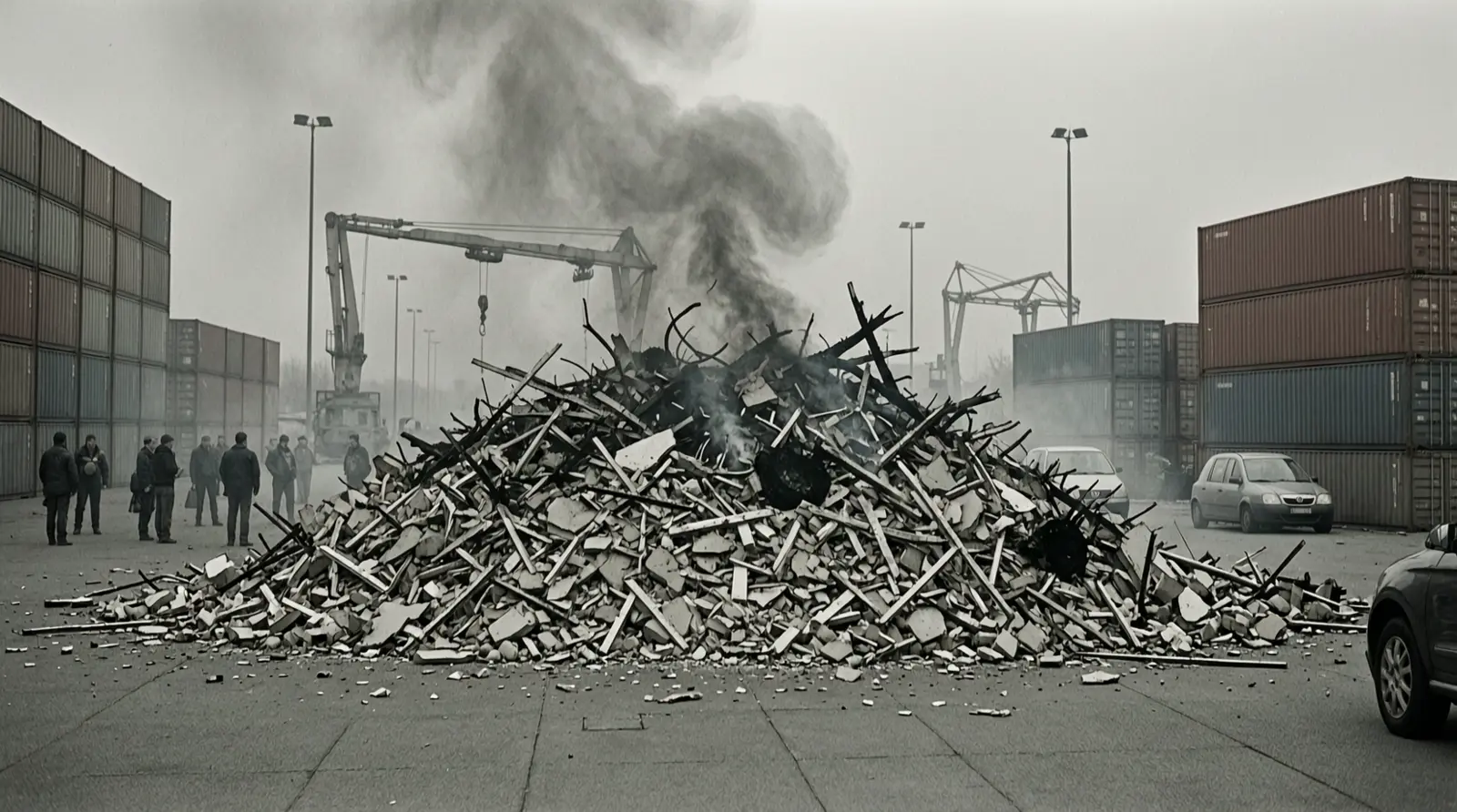
Emmanuel Macron is set to address the nation, according to reports, after protests over school conditions and high living costs turned disruptive. Arrest counts conflict, with one account at 1,200 and another at about 1,800, while elevated crude and food-price markers add pressure to transport and household budgets. The near-term risk for Europe is disruption to roads, depots and fuel demand rather than a single political shock.
Brent at $126.55 puts a price on every blocked road in France. The crude figure, dated 14 October, is the market backdrop to a political problem: Emmanuel Macron is to address the nation, according to reports, after protests over school conditions and high living costs turned disruptive.
Schools are nodes in the urban machine. They concentrate bus routes, parent commutes, cafeteria deliveries and after-school labour. When they become protest sites, the effect moves quickly from pavements to logistics: engines idle, deliveries miss windows, and staff cannot reach depots, shops or terminals.
The scale of the unrest is contested, and the difference between 1,200 and about 1,800 arrests is not a rounding error. One account says 1,200 arrests and 150 injured police officers. Another says about 1,800 arrests and hundreds injured. Official police or interior ministry figures would settle the count. Until then, operators must plan around the wider range.
The wider range matters because it changes the likely footprint of the unrest. A protest movement with 1,200 arrests may still be concentrated in a few cities. A movement with about 1,800 arrests and hundreds injured suggests broader geography and more sustained confrontations. For freight planners, the difference shows up in route choices: whether to avoid city centres, delay deliveries, or hold extra fuel.
Brent at $126.55 puts a price on every blocked road in France.
Two arrest counts, one unsettled picture
Reports describe protests across France spiralling into looting, fires and clashes. That wording matters to anyone moving goods through the country. Fire raises warehouse and street-level risk; looting raises premises risk; clashes raise route risk. For a dispatcher, the question is not whether the anger is legitimate but whether a truck can pass, park and unload.
The two arrest figures also imply different levels of police strain. One hundred and fifty injured officers is a serious policing event. Hundreds injured would be a larger one. The gap changes the likely response: more checkpoints, more road closures, and more friction at rail and motorway nodes.
High prices turn street trouble into freight trouble
The Global Food Index was 131.78 on 1 July. Brent was $126.55 on 14 October. The July food number and the October oil number do not measure the same market, but they press on the same household and transport budget. Food moves by road, and road moves by diesel. When crude is high, every detour, queue and restart costs more.
The same logic applies to labour. If demonstrations persist, shifts start late, warehouses run short of hands, and deliveries are rescheduled. Those are small losses individually. Repeated over several days, they show up in fuel stocks, overtime costs and missed contracts.
That is the channel from protest to physical demand. If schools close or streets are blocked, fuel consumption can fall in one place and rise in another: less commuting, more idling; fewer shop deliveries, more security runs. The net effect may be small at first. It becomes visible when high fuel prices meet repeated disruption.
The contagion question is about routes, not slogans
The most consequential extension is the report that youth-led demonstrations are spreading across Europe. If that holds, the risk is no longer confined to French cities. It reaches cross-border corridors: ports, rail terminals and motorway junctions. If it does not, the impact remains local and episodic.
The tactics matter as much as the geography. Youth-led protests can move quickly and target transport nodes rather than fixed institutions. That makes them harder to route around because the closure is not always predictable. A station, ring road or bridge can become the point of friction for a few hours, but that is enough to miss a sailing slot.
Freight does not vanish when a route closes. It queues, reroutes or waits. A motorway closure adds hours; a chokepoint closure can add days. The open question is whether official figures show a national movement or a set of local flare-ups, and whether fuel demand starts to bend.
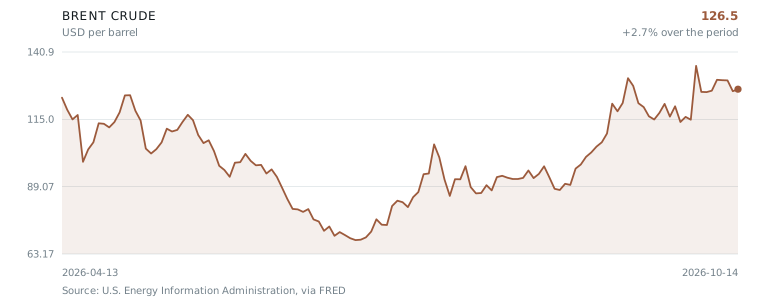
- 01Brent crude was $126.55 on 14 October.
- 02The Global Food Index was 131.78 on 1 July.
- 03One account reports 1,200 arrests and 150 injured police officers.
- 04Another account reports about 1,800 arrests and hundreds injured.
- 05Reports say Macron will address the nation after the protests.
Interpretation, not reporting. The facts above carry their tiers; this is one correspondent’s reading of them.
The useful way to read this unrest is as a transport and fuel-cost problem before it is a political one. I would treat the arrest figures as a range, not a fact: 1,200 and 150 injured officers on one account, about 1,800 and hundreds injured on another. That uncertainty matters more than the headline because it changes the likely police response and the probability of route closures. The macro backdrop is not soft either: Brent at $126.55 and a Global Food Index at 131.78 leave little room for households and logistics operators to absorb disruption. If reports of youth-led demonstrations spreading across Europe hold, the indicators to watch are transport nodes rather than speeches. If the unrest stays local, the impact should fade into higher local costs and missed delivery windows. My threshold is simple: official arrest figures and evidence of sustained fuel-demand change. Without them, this is a friction story, not a supply-shock story.
— Tomás Ferreira
Every claim in this article, and what it rests on
We do not ask you to take our word for it. Each statement below carries its tier and its sources. Where sources disagree, you get both accounts and what would settle it.
Brent crude was priced at $126.55 on 14 October 2026.
The Global Food Index was 131.78 on 1 July 2026.
The French protests involved 1,200 arrests and 150 injured police officers.
Macron is to address the nation after protests in France.
The protests in France are being driven by anger over school conditions and high living costs.
Protests across France spiralled into looting, fires and clashes.
About 1,800 people were arrested and hundreds were injured during nationwide demonstrations in France.
Youth-led demonstrations are spreading across Europe.
The case against this story
Written by an adversarial reviewer, not the correspondent
The story's overall picture of a France spiralling into chaos amid a European youth revolt rests on three weak pillars. First, the arrest figures are internally contradictory: one claim says 1,200 arrests and 150 injured officers, another says about 1,800 arrests and hundreds injured — the reader cannot know which is true, yet both are presented as reliable. Second, the two market data points (Brent at $126.55 and a 'Global Food Index' at 131.78) are placed at the highest confidence tier but lack any visible exchange or institutional source; if either number is wrong, the economic backdrop that frames the protests as cost-of-living-driven partially collapses. Third, the leap from French protests to 'youth-led demonstrations are spreading across Europe' is a broad generalisation offered at the lowest tier, yet it does heavy narrative lifting by implying a continent-wide contagion. A reader could just as easily see localised French unrest with inflated, conflicting casualty numbers and unverified economic data stitched into a crisis narrative.
Who benefits from this framing: Political opponents of Macron and the French government benefit from a framing that amplifies disorder and governmental failure. Populist and far-right movements across Europe benefit from the 'spreading youth demonstrations' narrative, which normalises the idea of continent-wide instability demanding authoritarian responses. Market speculators and energy-sector interests benefit from reader acceptance of a $126.55 oil price as fact, since anxiety about fuel costs supports higher pricing expectations. Finally, media outlets that thrive on crisis clickbait benefit from a story that pairs looting and fires with precise-sounding but unsourced economic data.
Report an error in this article
Subscriptions open at launch
Global Materials Review will be a paid publication. Reading is free while we build the archive — leave an address and we will write to you once, when subscriptions open.