
IMF war warning meets a split oil and gas tape
A reported IMF contraction in the Middle East collides with a calm gas price and a wide crude spread.
 Tomás FerreiraEnergy, shipping and chokepoints
The IMF is reported to say that war will shrink the Middle East and Central Asia economy in 2026 and that Iraq, Bahrain, Kuwait and Qatar face double-digit GDP declines. Brent at 125.44, WTI at 96.24 and Henry Hub at 3.03, however, show a divided energy tape rather than a broad crisis. AI investment is offered as a possible global offset, but its timing and scale remain the open question.
On 6 October, Brent stood at 125.44, WTI at 96.24 and Henry Hub natural gas at 3.03. The crude numbers are high and far apart: Brent carries a premium of about $29.20 over WTI. The gas number is quiet. That split is the first thing a physical-market reader should notice, because a broad energy crisis usually shows up in more than one fuel.
The IMF's reported warning is much less split. The fund says the Middle East and Central Asia economy will shrink in 2026 amid war, and it warns that the Middle East war could derail global economic growth. It also says the energy crisis sparked by the war remains the biggest risk to the global economy. Separately, it says investment in artificial intelligence provides grounds for optimism about economic growth.
A war premium in crude, not in gas
Brent at 125.44 is the price of a market that is still worried about supply. WTI at 96.24 does not confirm the same intensity. The gap matters because the two crude benchmarks can be pulled by different pools of supply, transport and demand. If the war risk is being priced, it is being priced more strongly in Brent.
Henry Hub at 3.03 weakens the crisis narrative further. Gas is not immune to Middle East risk, but a reading this low does not look like a market bracing for a broad energy shock. The IMF's reported language about an energy crisis and the tape in front of us are not telling the same story.
Crude may be carrying a geopolitical premium; the wider energy complex is not confirming it.
That does not make the warning false. It makes the market's current verdict narrow. Crude may be carrying a geopolitical premium; the wider energy complex is not confirming it.
Four producers, one severe map
The IMF is reported to have named Iraq, Bahrain, Kuwait and Qatar as facing double-digit GDP declines from the fallout of the US-Israel war on Iran. That phrasing is unusually blunt for a forecast. If accurate, the map points to a direct hit on sovereign revenue in four energy producers, not a mild regional slowdown.
The channel to commodities runs through state spending and domestic fuel demand. Double-digit contractions in that group would pressure budgets, import capacity and refining or power demand in a region that normally supplies the world rather than absorbs shocks. The credit risk is not abstract: it sits in the same countries whose production and export routes help set the physical oil balance.
Yet the oil market's own signal is partial. Brent is elevated, but WTI is much lower, and gas is calm. A true supply shock from those four producers would likely be harder to hide in the price spread.
AI capex is the counterweight
The other leg of the reported IMF message is optimism from artificial-intelligence investment. The mechanism is straightforward: large capital programmes can add demand and investment even while a war region contracts. In this telling, AI capex becomes a global offset, not a solution to the Middle East damage.
The problem is timing and scale. A regional contraction in 2026 is dated and specific. AI investment is broad, harder to verify in physical terms, and may not arrive in the same quarter or the same commodity markets. The IMF is reported to hold both ideas at once: a severe war-driven energy risk, and an investment-led reason for optimism.
The open question is which signal the physical market believes first. If Brent keeps its wide premium over WTI while gas stays quiet, the market is pricing a contained oil risk rather than a full energy crisis. If the IMF's reported damage is real, the next confirmation should come from demand, freight and sovereign stress, not from a single crude price.
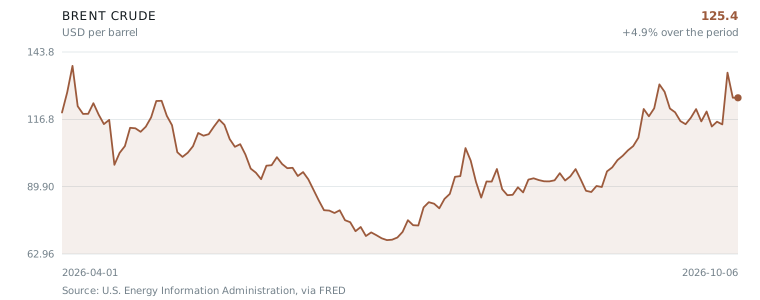
- 01Brent was 125.44 on 6 October.
- 02WTI was 96.24, leaving a spread of about $29.20.
- 03Henry Hub natural gas was 3.03.
- 04The IMF says the Middle East and Central Asia economy will shrink in 2026 amid war.
- 05The IMF says Iraq, Bahrain, Kuwait and Qatar face double-digit GDP declines.
Interpretation, not reporting. The facts above carry their tiers; this is one correspondent’s reading of them.
The price spread is doing more work than the reported IMF adjectives. Brent at 125.44 says the market still assigns a war premium to crude, but WTI at 96.24 and Henry Hub at 3.03 refuse to confirm a broad energy shock. That gap looks like a market pricing a regional oil risk, not a systemic fuel crisis. The IMF's reported language is severe: a shrinking Middle East and Central Asia economy in 2026, double-digit GDP declines for Iraq, Bahrain, Kuwait and Qatar, and an energy crisis called the biggest risk to global growth. If those hits land, sovereign balances and oil demand in four producers would weaken at the same time. But AI investment is offered as the offset, and I would need to see it in physical demand before treating it as a counterweight. My mind would change if Brent's premium stayed wide while gas rose with it. Until then, the tape looks split, not apocalyptic.
— Tomás Ferreira
Every claim in this article, and what it rests on
We do not ask you to take our word for it. Each statement below carries its tier and its sources. Where sources disagree, you get both accounts and what would settle it.
The BRENT price reading was 125.44 on 6 October 2026.
The WTI price reading was 96.24 on 6 October 2026.
The HENRY_HUB_GAS price reading was 3.03 on 6 October 2026.
The IMF says the Middle East and Central Asia economy will shrink in 2026 amid war.
The IMF says Iraq, Bahrain, Kuwait and Qatar face double-digit GDP declines from the fallout of the US-Israel war on Iran.
The IMF warns that the Middle East war could derail global economic growth.
The IMF says the energy crisis sparked by the Middle East war remains the biggest risk to the global economy.
The IMF says investment in artificial intelligence provides grounds for optimism about economic growth.
The case against this story
Written by an adversarial reviewer, not the correspondent
The strongest case against this story is its internal contradictions and absent sourcing. The story claims an energy crisis is the biggest risk to the global economy, yet Henry Hub natural gas sits at 3.03 — a low, normal price that flatly contradicts any energy-crisis narrative. The roughly $29 spread between BRENT and WTI is unusually wide and goes entirely unexplained. The story attributes very definitive predictions to the IMF — that economies 'will shrink' and that four named countries face 'double-digit GDP declines' — but the IMF consistently uses hedged, probabilistic language in its forecasts, not definitive declarations. The phrase 'US-Israel war on Iran' is not terminology the IMF would employ; the institution uses neutral, diplomatic language about conflicts. No IMF publication, press release, or report is cited for any of the attributed statements, so these could be loose paraphrases, exaggerations, or fabrications. Finally, the claim that AI investment provides grounds for optimism sits oddly alongside apocalyptic war predictions, suggesting a cherry-picked collage rather than a coherent IMF assessment.
Who benefits from this framing: If a reader believes this framing, energy companies and oil-producing states benefit from crisis narratives that justify higher oil prices and energy-security policies. Defence contractors and military-industrial interests benefit from conflict framing that supports increased defence spending. Political actors advocating for or against military intervention in the Middle East gain rhetorical ammunition. Financial speculators who positioned themselves before these claims circulated could profit from the market movements the claims might trigger. And the AI industry benefits from the inserted message that AI investment provides grounds for economic optimism — a convenient narrative for favourable regulation and investment flows that sits uncomfortably alongside the story's doom-mongering about war and collapse.
Report an error in this article
Subscriptions open at launch
Global Materials Review will be a paid publication. Reading is free while we build the archive — leave an address and we will write to you once, when subscriptions open.