
Houthi-Saudi flare puts Gulf shipping back on alert
Gulf condemnation and US-Israeli threats raise the risk that renewed Yemen attacks disrupt Red Sea and Gulf shipping and energy flows.
 Tomás FerreiraEnergy, shipping and chokepoints
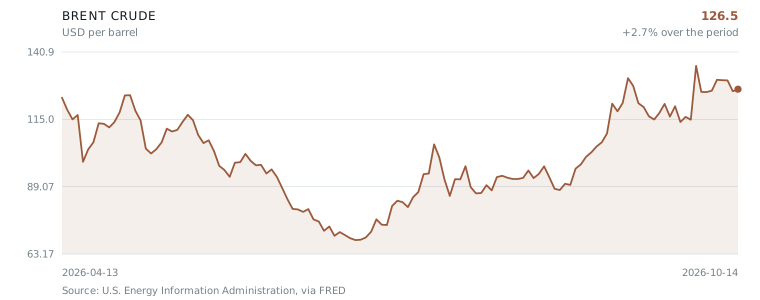
Brent crude was $126.55 and WTI crude $101.91 on 14 October, while reports of continued Houthi-Saudi attacks met Gulf condemnation and wider US-Israeli threats toward Iran. The physical market’s immediate question is whether the Yemen front stays local or becomes a shipping and energy risk. A reported displacement figure of more than 233,000 raises alarm, but the available reports do not date it or tie it to a specific route.
Brent crude at $126.55 and WTI at $101.91 on 14 October put a hard number under a fuzzy escalation. The price move is clearer than the battlefield: reports of continued Houthi-Saudi attacks, Gulf condemnation and US-Israeli threats toward Iran are arriving without a shared timeline.
Al Jazeera and Euronews report that attacks between the Houthis and Saudi Arabia continued. That is enough to put the Yemen front back on the shipping-risk map, but not enough to say how large the latest exchanges were, where they occurred, or whether they were cross-border strikes, border fighting or something else.
The difference matters because a border flare and a maritime flare hit different assets. A landward attack affects towns, roads and perhaps pipelines; a maritime threat changes insurance, routing and cargo schedules. The reports do not say which kind of risk is growing.
Condemnation is not a convoy
The Gulf Cooperation Council condemned Houthi attacks on Saudi Arabia, according to regional reports, and Gulf ministers are reported to have urged action against the Houthis. Those words matter because they move the issue from a Yemen file to a Gulf security file. But condemnation does not by itself change the military picture. It tells traders that Gulf governments see the attacks as political risk; it does not tell them whether escorts, ports or insurers will respond.
If Gulf ministers move from condemnation to operational pressure, the first signs would likely appear in port calls, naval tasking or insurance language, not in another communiqué. None of those steps is confirmed here.
The benchmarks are the cleanest facts in the story.
Oil is pricing a risk, not a confirmed outage
The benchmarks are the cleanest facts in the story. Brent traded at $126.55 on 14 October; WTI stood at $101.91. The spread between them — $24.64 — is a reminder that the market is not pricing one homogeneous pool of crude. Brent is the seaborne marker; WTI is the US marker. If the risk is Red Sea or Gulf transit, Brent is the first place that anxiety shows up.
The harder question is whether the oil move reflects Yemen attacks, Iran-Israel threats, supply decisions or all three. The available reports do not settle that. They only show that traders are being asked to hold several Middle East risks at once.
A premium can form on the expectation of disruption alone. Once freight desks start asking whether a voyage might be delayed, the price can move before any physical barrel is lost. The reverse is also true: if the attacks remain local, the premium can fade quickly.
Displacement is the local gauge
Fighting in Yemen is reported to have displaced more than 233,000 people across Yemen. The figure is large, but it is not dated or sourced in the available reports. It could describe a recent surge or a cumulative toll. For a commodity desk, that distinction matters: a fresh displacement wave points to active front lines and humanitarian strain; a cumulative number may mean the crisis is old but unresolved.
The number also raises the question of where people go. Displacement inside Yemen strains food, fuel and shelter budgets; it can also complicate aid corridors and local transport. Without a date, the figure cannot be used as a gauge of this week’s intensity.
Iranian Foreign Minister Abbas Araghchi said Israeli Prime Minister Benjamin Netanyahu seeks more war before elections. The United States and Israel have threatened confrontation with Iran amid Middle East escalation, according to reports. These statements widen the map. They do not prove that the Houthi-Saudi front is coordinated with Iran, nor that the oil price is responding to Iran rather than Yemen.
For a shipowner, the distinction is practical. A Houthi-Saudi exchange may mean higher risk near Yemen’s coast. A US-Israel-Iran confrontation could widen the set of targets and make underwriters rethink entire Gulf and Red Sea voyages. The statements suggest the second risk is being discussed; they do not show it has arrived.
The thing to watch is not another political statement. It is whether the next report names a ship, a port, a pipeline or a loading date.
- 01Brent crude was $126.55 and WTI crude $101.91 on 14 October.
- 02Al Jazeera and Euronews report that attacks between the Houthis and Saudi Arabia continued.
- 03The Gulf Cooperation Council condemned Houthi attacks on Saudi Arabia, and Gulf ministers urged action, according to regional reports.
- 04Fighting in Yemen is reported to have displaced more than 233,000 people.
- 05Iran’s foreign minister accused Benjamin Netanyahu of seeking more war before elections, while the United States and Israel threatened confrontation with Iran.
Interpretation, not reporting. The facts above carry their tiers; this is one correspondent’s reading of them.
The market is being asked to price three separate risks before it knows which one is real. I see the oil numbers as the only hard anchor: Brent at $126.55 and WTI at $101.91 on 14 October, with Brent carrying the seaborne risk. The reports of continued Houthi-Saudi attacks are enough to reopen the Yemen file, and the GCC condemnation plus Gulf ministers urging action show that Gulf governments are treating it as political risk. But the displacement figure is undated, the Iranian accusation is one official’s statement, and the US-Israeli threat toward Iran is vague. If the next week produces a named ship, a port disruption or a confirmed loading delay, the risk premium will have a physical address. If it produces only more statements, the premium may remain volatile but thin. I would watch Brent more than rhetoric, and I would treat any move in freight or insurance language as more telling than another ministerial line. What would change my mind is evidence that the Houthi-Saudi front and the Iran-Israel confrontation are operating through the same targets.
— Tomás Ferreira
Every claim in this article, and what it rests on
We do not ask you to take our word for it. Each statement below carries its tier and its sources. Where sources disagree, you get both accounts and what would settle it.
Brent crude was priced at $126.55 on 14 October 2026.
WTI crude was priced at $101.91 on 14 October 2026.
Attacks between the Houthis and Saudi Arabia continued.
The Gulf Cooperation Council condemned Houthi attacks on Saudi Arabia.
Gulf ministers urged action against the Houthis.
Fighting in Yemen displaced more than 233,000 people across Yemen.
Iranian Foreign Minister Abbas Araghchi said Israeli Prime Minister Benjamin Netanyahu seeks more war before elections.
The United States and Israel threatened confrontation with Iran amid Middle East escalation.
The case against this story
Written by an adversarial reviewer, not the correspondent
The story assembles a picture of regional escalation almost entirely from lower-confidence claims. The GCC condemnation of Houthi attacks, Gulf ministers urging action, the 233,000 displacement figure, the Iranian foreign minister's statement about Netanyahu seeking war before elections, and the US-Israel threat toward Iran are all lower-tier claims. The only high-tier claims are a vague assertion that 'attacks continued' and two oil-price figures that need market-data verification. The narrative implies these events are causally linked—Houthi attacks driving GCC alarm, Iran backing the Houthis, US-Israel threatening Iran, oil prices spiking—but none of the claims establishes any of these connections. A reader could equally see separate, parallel developments: a Yemen front deteriorating on its own, an Iran-Israel diplomatic spat, and oil prices moved by supply decisions unrelated to either. The displacement figure of 'more than 233,000' is precise but unsourced; it could reflect cumulative displacement over months or years rather than a recent surge tied to current fighting. The Iranian FM's claim about Netanyahu is one official's accusation, not verified Israeli intent. 'The United States and Israel threatened confrontation with Iran' is vague enough to cover anything from a diplomatic statement to military posturing, and without knowing who said what and when, it is nearly meaningless.
Who benefits from this framing: Oil traders and energy companies profit from fear-driven price spikes. Hawks in the United States, Israel, and Gulf states gain political cover for military action against Iran or the Houthis. Saudi Arabia and the GCC get international sympathy and justification for intervention in Yemen. Netanyahu's government benefits from framing Iran as the aggressor. Defense contractors benefit from escalation rhetoric and procurement urgency. Russia and other rival oil producers benefit from high prices driven by a Middle East fear premium.
Report an error in this article
Read everything for 14 days, free
All three titles in full, the full daily brief, and an alert when a claim about something you follow changes. No card, and it ends by itself.