
Hormuz offer and tanker report collide with thin proof
Crude prices are elevated, but the evidence behind the Hormuz crisis narrative is patchy.
 Tomás FerreiraEnergy, shipping and chokepoints
Crude prices are elevated, with Brent at 126.55 and WTI at 101.91 on 14 October. Al Jazeera has reported a tanker explosion in the Strait of Hormuz and repeated failure in Iran-US talks, but those reports have not been corroborated by additional sources. Iranian Foreign Minister Abbas Araqchi says a seven-day reopening proposal remains on the table, while a reported Baluch insurgency flare-up adds internal security pressure.
Prices are doing the talking
Brent crude stood at 126.55 on 14 October, with WTI at 101.91 and Henry Hub gas at 3.22. Brent's spread over WTI was about 24.64, a wide gap that often points to tight seaborne barrels. Henry Hub gas at 3.22 sits apart from that crude stress.
The spread is not itself evidence of a closed Strait. It is the market's way of paying for optionality: the chance that a reported incident becomes a confirmed one, and that a diplomatic failure turns into a shipping constraint.
The physical question is simple. If the Strait of Hormuz becomes more dangerous, where do cargoes go, and how long does the detour take? For Gulf exporters, alternatives to the Strait are limited. Any sustained impairment would force buyers to chase non-Gulf barrels, lengthen voyages and tie up tonnage. That is the channel through which a single incident can move freight, insurance and crude differentials at once.
Until then, the price is real and the trigger is not.
A tanker blast, one report away
Al Jazeera's Arabic service reported on 17 October that a tanker explosion occurred in the Strait of Hormuz. That is a serious allegation, but it remains a single reported account in the material available. No second source, ship-tracking confirmation or underwriting detail appears in the reporting.
In a normal information environment, a blast in the Strait of Hormuz would be confirmed quickly by vessel positions, insurers and port authorities. The absence of that confirmation matters. It does not prove the event did not happen. It does mean the risk premium is running ahead of proof. Ship operators and insurers do not need certainty to raise prices. They need a plausible probability of loss, and a route where alternatives are scarce.
The diplomacy around the incident is equally unsettled. Al Jazeera reported on 18 October that Iran-US negotiations keep failing. The phrase suggests repeated setbacks, but it is a characterisation from one outlet, not an agreed account of the talks. For traders, the practical point is that negotiations are not currently producing a de-escalation asset that underwriters can price.
Reopening, insurgency and the risk of overreach
On 18 October, Iranian Foreign Minister Abbas Araqchi said Iran's proposal to reopen the Strait of Hormuz within seven days remains on the table. The wording is awkward. A reopening offer implies the waterway is closed, restricted or at least treated as impaired. A tanker explosion report, by contrast, implies vessels are still moving. Both can be true only if traffic is already curtailed, or if one description is being stretched. A seven-day window also forces charterers to decide whether to wait, reroute or pay up for cover before the deadline. That decision can move freight before any physical cargo is lost.
A reported deadly flare-up of Baluch insurgency violence in Sistan-Baluchistan, along the Afghan and Pakistani border, adds another layer. It is not a Hormuz event, and it does not by itself threaten tanker flows. But it widens the picture of Iranian security pressure at a moment when the market is already paying for uncertainty.
The open question is whether the next few days produce hard evidence: a named vessel, a confirmed casualty, an insurance notice, or a visible change in traffic. Until then, the price is real and the trigger is not.
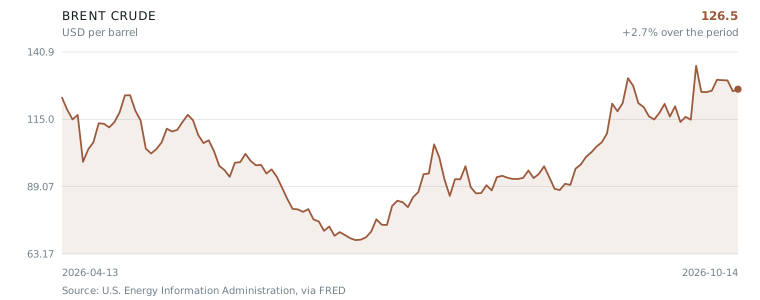
- 01Brent was 126.55, WTI was 101.91 and Henry Hub was 3.22 on 14 October.
- 02Al Jazeera's Arabic service reported a tanker explosion in the Strait of Hormuz on 17 October.
- 03Al Jazeera reported on 18 October that Iran-US negotiations keep failing.
- 04Iranian Foreign Minister Abbas Araqchi said a seven-day reopening proposal remains on the table.
- 05A deadly flare-up of Baluch insurgency violence was reported in Sistan-Baluchistan.
Interpretation, not reporting. The facts above carry their tiers; this is one correspondent’s reading of them.
The market is paying for optionality, not proof. I would separate the price signal from the incident feed. Brent at 126.55 and WTI at 101.91 show that traders are willing to pay for the possibility that Hormuz becomes impaired. But the triggering material is thin: one Al Jazeera report of a tanker explosion, another Al Jazeera report that Iran-US negotiations keep failing, and a seven-day reopening proposal from Abbas Araqchi. The Baluch insurgency flare-up adds political noise, not a direct shipping constraint. If a named vessel, an insurer notice or a visible traffic change appears, the premium can quickly become justified. If not, the spread may be charging for a closure that has not been demonstrated. I would watch the next few days for corroboration, not rhetoric. The market can price a chokepoint risk long before the evidence arrives; it can also unwind that price just as fast when the water stays open.
— Tomás Ferreira
Every claim in this article, and what it rests on
We do not ask you to take our word for it. Each statement below carries its tier and its sources. Where sources disagree, you get both accounts and what would settle it.
The Brent crude price was 126.55 on 14 October 2026.
The WTI crude price was 101.91 on 14 October 2026.
The Henry Hub natural gas price was 3.22 on 14 October 2026.
Al Jazeera's Arabic service reported on 17 October 2026 that a tanker explosion occurred in the Strait of Hormuz.
Al Jazeera reported on 18 October 2026 that Iran-US negotiations keep failing.
On 18 October 2026, Iranian Foreign Minister Abbas Araqchi said Iran's proposal to reopen the Strait of Hormuz within seven days remains on the table.
Iran's southeastern province of Sistan-Baluchistan, along the Afghan and Pakistani border, has witnessed a deadly flare-up of Baluch insurgency violence.
The case against this story
Written by an adversarial reviewer, not the correspondent
The story assembles a maximalist Iran-crisis narrative from selectively framed pieces. The claim that Iran-US negotiations 'keep failing' is not reporting—it is editorializing imposed on a source. Al Jazeera may have reported a specific setback, but 'keep failing' manufactures a pattern that serves the story's crisis arc. The tanker explosion rests on a single Arabic-language outlet with zero international corroboration, yet carries the highest confidence rating—a tanker explosion in the world's most important oil chokepoint would be confirmed within minutes by Reuters, AP, Lloyd's, and ship-tracking services. The claim that Iran proposes to 'reopen' the Strait within seven days implies Iran closed it, but the tanker explosion claim implies traffic is still flowing—these cannot both describe the same situation without one being overstated. The Baluch insurgency flare-up, acknowledged as low-confidence, is nonetheless deployed to deepen the picture of an Iran under multi-front pressure. The oil prices may be real, but their juxtaposition with unverified crisis claims lends false authority to the weak elements. A reader seeing $126 Brent next to a single-source tanker explosion and editorialized diplomacy failure will infer a comprehensive, well-sourced crisis when the actual evidentiary base is thin and internally inconsistent.
Who benefits from this framing: Oil speculators who have taken long positions benefit from panic premium in crude prices; the higher the perceived crisis, the higher their profit. Advocates of military action against Iran benefit from diplomacy being framed as perpetually failing—once negotiations are dismissed as hopeless, coercive options become the default. Iran's regional rivals benefit from a framing that depicts Iran as both aggressively controlling the Strait of Hormuz and internally collapsing from insurgency, since this justifies international isolation or military buildup. Defense contractors benefit from threat inflation that drives military procurement. Any actor that circulated this framing while holding energy or defense assets benefits if readers accept the crisis narrative and act on it—buying oil, selling equities, or supporting escalation.
Report an error in this article
Subscriptions open at launch
Global Materials Review will be a paid publication. Reading is free while we build the archive — leave an address and we will write to you once, when subscriptions open.