
Guyana's 1 million bpd milestone meets Falklands legal push
New Atlantic barrels are arriving just as a sovereignty dispute becomes a legal test for offshore development.
 Tomás FerreiraEnergy, shipping and chokepoints

Guyana is expected to cross 1 million barrels per day in crude exports for the first time in December 2026. Argentina says it has taken its dispute over Falklands oil to an international maritime tribunal and asked it to halt development of Sea Lion. Together, the two developments put legal risk alongside Atlantic supply growth.
A threshold timed for December
In December 2026, Guyana is expected to push crude exports past 1 million barrels per day for the first time, a threshold that marks a new scale for one of the world's newest oil exporters.
The milestone is a projection, not a cargo already loaded. It turns on a monthly rate being reached and sustained long enough to show up in export tallies. For buyers, that distinction matters: expected barrels can become physical barrels only if production, storage and lifting schedules align.
The market tends to treat such thresholds as signals of durability. If the rate is reached only for a month, it shows capacity can peak; if it holds, it shows a new supply base. That difference shapes how buyers plan for Atlantic cargoes and how sellers price risk.
That is where the second Atlantic story enters. Argentina says it has taken its dispute over Falklands oil to an international maritime tribunal, and it has asked the tribunal to halt development of Sea Lion.
A legal route across the same water
The two events are separate, but they sit in the same commercial geography. Guyana's rise adds new Atlantic crude at a moment when Argentina is using a legal channel to challenge offshore oil development linked to the Falklands. The tribunal request is framed as a legal remedy rather than a diplomatic statement.
For market participants, legal forums change the character of risk. A diplomatic dispute can be treated as rhetoric; a tribunal process creates a record, a timetable and a potential outcome that can be cited by insurers, lenders and charterers.
The question is whether the next million barrels per day from the Atlantic arrives with a clean commercial path, or with a legal challenge attached.
The shift is spatial as well as legal. Offshore projects tie reservoirs to vessels, ports and contracts that cross jurisdictions. A tribunal request does not move a ship by itself, but it can alter the paperwork that lets a project proceed.
If development can be challenged in tribunal proceedings, the question is no longer only whether barrels are in the ground. It becomes whether the route from reservoir to market carries legal exposure that follows the project across the Atlantic.
Sovereign risk attaches to new supply
Guyana's expected crossing of 1 million barrels per day is important because it changes the volume of new Atlantic supply available to refiners and traders. Argentina's tribunal push is important because it contests the legitimacy of offshore development in the same basin. Together, they show that Atlantic Basin supply growth is becoming legally contested.
The exposure is not necessarily a direct loss of Guyanese exports. The more immediate channel is perception: financing terms, contract risk, and the willingness of counterparties to hold long-dated positions in new offshore projects.
That is the point where sovereign risk becomes commercial. If legal challenges can follow offshore developments, companies and buyers must account for more than geology and freight. They must also account for the possibility that a state will use an international forum to contest the right to develop.
Sea Lion is the named pressure point. Argentina's requested remedy is direct: halt development. If that request gains traction, it would show that a tribunal process can be aimed at stopping a named offshore development. If it does not, the request still puts a legal marker on the map.
For crude flows, the calendar is the first test. December 2026 is close enough that Guyana's expected milestone will be judged by actual loadings. The tribunal effort will be judged by whether it moves from request to enforceable pressure. One is a volume threshold; the other is a legal threshold. Both now sit in the same Atlantic window.
For now, the two tracks run in parallel. Guyana's volume target is measured in barrels; Argentina's legal effort is measured in proceedings and remedies. The market will have to watch both, because one can be delayed by operational slippage and the other by procedural delay.
The question is whether the next million barrels per day from the Atlantic arrives with a clean commercial path, or with a legal challenge attached.
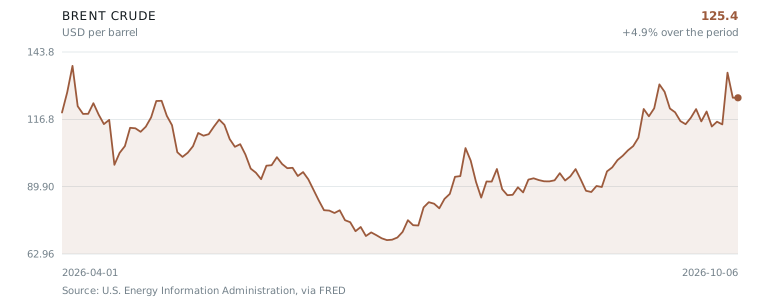
- 01Guyana is expected to surpass 1 million barrels per day in crude oil exports in December 2026.
- 02The projected level would be the first time Guyana's crude exports exceed that rate.
- 03Guyana is one of the world's newest oil exporters.
- 04Argentina says it has taken its dispute over Falklands oil to an international maritime tribunal.
- 05Argentina has asked the tribunal to halt development of Sea Lion.
Interpretation, not reporting. The facts above carry their tiers; this is one correspondent’s reading of them.
The bigger signal is not the 1 million barrels per day threshold itself, but the fact that new Atlantic supply is meeting a legal challenge at the same moment. I would treat Guyana's December 2026 projection as a commercial target, not a guaranteed loading. Offshore volumes become real only when they are produced, stored and lifted. Argentina's tribunal move matters because it turns the Falklands oil dispute into a remedy aimed at a named project: halt Sea Lion development. If that legal route gains traction, it adds a new layer of sovereign risk to Atlantic Basin growth. If it stalls, the request still reminds the market that political claims can follow offshore barrels. The watch item is simple: whether Guyana's exports actually sustain the million-barrel rate, and whether the tribunal request moves from argument to pressure on development.
— Tomás Ferreira
Every claim in this article, and what it rests on
We do not ask you to take our word for it. Each statement below carries its tier and its sources. Where sources disagree, you get both accounts and what would settle it.
Guyana is expected to surpass 1 million barrels per day in crude oil exports for the first time in December 2026.
The projected 1 million barrels per day level would be the first time Guyana's crude oil exports exceed that rate.
Guyana is one of the world's newest oil exporters.
Argentina has taken its dispute over Falklands oil to an international maritime tribunal.
Argentina asked the international maritime tribunal to halt development of Sea Lion.
The case against this story
Written by an adversarial reviewer, not the correspondent
The story pairs two narratives that may each be weaker than presented. The Guyana production milestone is a projection pinned to a specific month, but offshore FPSO ramp-ups are routinely delayed by weather, technical issues, and regulatory approvals—presenting December 2026 as the expected date without a named forecast source turns an industry guess into an apparent fact. The 'first time' language is a restatement that adds no independent information. The Argentina-Falklands claims assert formal legal proceedings at an international maritime tribunal, but without a docket number or filing reference, these could easily conflate Argentina's routine diplomatic protests or UN communications with an actual tribunal case. Diplomatic rhetoric about Falklands oil is common; formal maritime tribunal filings are rare and consequential. The story's specificity—named field, named remedy, named date, named threshold—exceeds what the evidence supplied can sustain, and a reader cannot tell whether they are reading a report of filed legal action or a summary of political posturing.
Who benefits from this framing: ExxonMobil and its Guyana partners (Hess, CNOOC) benefit from bullish production narratives that support their investment case and share prices. The Argentine government benefits domestically from appearing to take forceful legal action on Falklands sovereignty, reinforcing its long-standing territorial claim. Energy traders and investors benefit from production-milestone stories that could move crude markets. Conversely, Falklands oil developers such as Rockhopper Exploration could be harmed if Argentina's legal challenge is overstated, as exaggerated legal risk could affect project financing, partner confidence, and share value.
Report an error in this article
Subscriptions open at launch
Global Materials Review will be a paid publication. Reading is free while we build the archive — leave an address and we will write to you once, when subscriptions open.