
Gulf chemicals keep cost edge as tight oil story runs to 2027
Persistent Gulf feedstock advantages could keep Middle Eastern petrochemicals competitive even as conflict lifts freight, insurance and crude prices.
 Tomás FerreiraEnergy, shipping and chokepoints

Brent was $126.55 on 14 October 2026 and WTI was $101.91, a wide gap that puts feedstock differentials in focus. Sources describe the U.S. and Israel as engaged in a war with Iran, a brief June ceasefire and tight oil into 2027, but those elements are forward-looking and source-dependent. The practical question is whether Gulf petrochemicals keep their low-cost edge as war risk raises freight, insurance and crude.
On 14 October, Brent printed $126.55 and WTI $101.91, leaving a $24.64 gap between the two main crude benchmarks. That is the number a petrochemical buyer sees first, because it changes the value of every barrel, naphtha cargo and contracted feedstock stream behind it.
Sources describe the U.S. and Israel as engaged in a war with Iran, with a brief ceasefire in June and oil supply tight enough to keep prices high into 2027. Those are source descriptions, not settled facts. But they are enough to make procurement desks ask where the next margin will break.
The Gulf margin sits in the feedstock, not the freight
The view in circulation is that Middle East low-cost chemicals production will retain its long-term cost advantage over other regions despite the Iran war and a Hormuz crisis. The mechanism is simple. Integrated Gulf complexes often sit close to low-cost feedstock and export terminals, so their advantage is built into the ground, not just the freight rate.
When crude is high, naphtha-linked producers elsewhere feel the squeeze faster. A Gulf producer with contracted feedstock can still face higher insurance, higher bunker costs and longer voyage planning, but the core input cost does not move in the same way. That is why the market is watching the spread between Brent and WTI as closely as the absolute price.
For Middle Eastern chemicals, the advantage is not that the Gulf is immune to war risk; it is that the feedstock still moves even when insurance premia rise.
A wide crude spread is a warning, not a confirmation
Brent at $126.55 against WTI at $101.91 is not a normal, quiet relationship. It suggests stress in how barrels are priced, moved or replaced, and it forces buyers to ask whether the gap reflects physical tightness or a data problem. The answer matters for chemicals because feedstock contracts, freight hedges and regional margins all follow the benchmark.
For a Gulf exporter, a Brent-linked price can make cargoes look expensive against Atlantic basin alternatives, even if the physical route remains open. For a buyer, the question becomes whether to pay the benchmark or wait for arbitrage to close.
The more forward-looking part of the story is the view that oil prices stay high into 2027. It is a projection layered on a conflict that sources describe as including a brief ceasefire in June, which means intensity could shift quickly.
One energy research analyst is cited as saying international oil prices will jump in a super spike. That is a single-source call, not a market observation. A physical desk will treat it as a scenario, not a schedule.
Hormuz risk changes the route before it changes the cargo
If underwriters price a Hormuz crisis into war-risk premia, the first effect is not an empty map. It is higher insurance, stricter vessel vetting, slower fixings and more time spent arranging cover. The cargo may still move, but the cost of moving it changes before the volume does.
For Middle Eastern chemicals, the advantage is not that the Gulf is immune to war risk; it is that the feedstock still moves even when insurance premia rise. That edge can survive higher freight if loading windows hold and contract barrels continue to reach Asian and European buyers.
The open question is whether the physical system confirms the narrative. Watch tanker fixtures, war-risk quotes, Brent-WTI behavior and actual Gulf loadings. If those stay orderly, the Gulf cost story remains credible. If they fracture, the 2027 tightness thesis becomes a much harder sell. The next test is whether insurers, shipowners and terminals agree on the same risk.
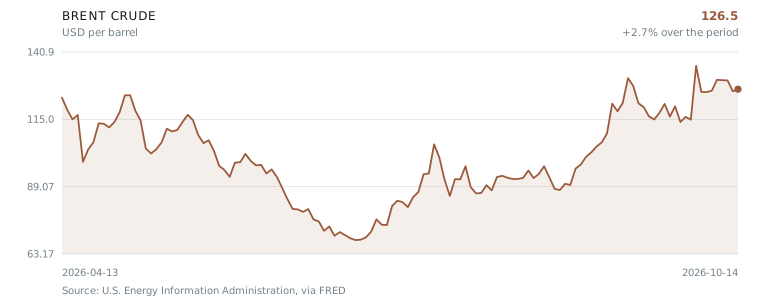
- 01Brent was $126.55 on 14 October 2026.
- 02WTI was $101.91 on the same day, a $24.64 gap.
- 03Sources describe a U.S.-Israel-Iran war and a brief ceasefire in June.
- 04Market commentary says tight oil supply could persist into 2027.
- 05One energy research analyst predicts a super spike in international oil prices.
Interpretation, not reporting. The facts above carry their tiers; this is one correspondent’s reading of them.
The spread is the tell. Brent at $126.55 against WTI at $101.91 is not just a high oil price; it is a physical-market alarm about where barrels can move and where they cannot. I would separate the observable from the projected. The two crude prints are dated facts. The war framing, the June ceasefire, the idea that supply stays tight into 2027 and the single analyst’s super-spike call are all source-dependent and forward-looking. If Gulf feedstock contracts hold and cargoes keep loading, Middle Eastern producers can absorb higher freight and insurance better than naphtha-exposed rivals. If Hormuz risk turns from premia into actual delays, that advantage thins quickly. The test is not rhetoric; it is fixtures, war-risk quotes and loading dates.
— Tomás Ferreira
Every claim in this article, and what it rests on
We do not ask you to take our word for it. Each statement below carries its tier and its sources. Where sources disagree, you get both accounts and what would settle it.
Brent crude was $126.55 on 14 October 2026.
WTI crude was $101.91 on 14 October 2026.
The U.S. and Israel were engaged in a war with Iran.
A brief ceasefire in the U.S.-Israeli-Iran conflict occurred in June.
Oil prices stayed high as war kept supply tight into 2027.
Middle East low-cost chemicals production is set to retain its long-term cost advantage over other regions despite the Iran war and Hormuz crisis.
An energy research analyst claimed international oil prices will jump in a super spike.
The case against this story
Written by an adversarial reviewer, not the correspondent
The story presents a coherent narrative of sustained war and tight oil supply, but several key elements are questionable. The Brent price of $126.55 versus WTI at $101.91 creates a spread of nearly $25, which is historically unprecedented (normal spread: $3-7) and suggests potential data problems or extreme market dislocation that needs explanation. The claim of 'war' between the U.S./Israel and Iran may overstate what could be limited military strikes, proxy conflicts, or heightened tensions. The assertion that oil prices stayed high 'into 2027' is a forward-looking prediction presented as established fact. The long-term chemicals production advantage claim is a multi-year projection that depends on numerous uncertain variables. The unnamed analyst's 'super spike' prediction is an appeal to authority without accountability. Together, these issues suggest the story may be constructing a crisis narrative that goes beyond what the evidence supports.
Who benefits from this framing: Oil producers and exporting nations benefit from narratives that sustain high price expectations. Defense contractors benefit from war narratives that support military spending and arms sales. Political hawks benefit from public support for military intervention in Iran. Russia benefits both as an oil exporter (higher prices) and strategically from U.S. distraction in the Middle East. Commodities speculators with long oil positions benefit from price spike narratives. Petrochemical producers in regions outside the Middle East benefit if their competitors are perceived as disadvantaged by conflict.
Report an error in this article
Subscriptions open at launch
Global Materials Review will be a paid publication. Reading is free while we build the archive — leave an address and we will write to you once, when subscriptions open.