
Diesel talk with Putin tests Europe’s Ukraine line
A reported call, a fuel transaction and a funding summit are being read as a split over how the war ends.
 Tomás FerreiraEnergy, shipping and chokepoints

Trump says he spoke with Putin, and a diesel transaction is being cast as a wedge. Europe’s funding summit and Kyiv’s response suggest capitals are preparing for pressure, not a settled deal. Brent at $125.44 on 6 October raises the cost of ambiguity.
The number that anchors this episode is not a treaty text but a price: Brent crude at $125.44 on 6 October. At that level, diesel is not just a transport fuel; it is a measure of refinery margins, war logistics and political tolerance for pain.
Trump announced that he had spoken with Putin. He also pushed a diesel deal and, in remarks that Kyiv and European capitals read as a direct challenge, called for President Zelenskyy to be replaced. Whether those pieces amount to a US-Russia arrangement over Ukraine is not established. What is established is that they have been fused into one political argument: that Washington may be moving toward a deal that Kyiv and Europe did not design. In Europe’s reading, Trump’s diesel deal opened a new rift with Europe over Ukraine.
A call, a cargo and a political test
The sequence matters. A presidential call is not a settlement, and a fuel transaction can be commercial without being strategic. Yet in wartime, markets and governments do not wait for the fine print. If Russian diesel is allowed back into Western conversations as a bargaining chip, the question becomes whether sanctions relief, waivers or shipping arrangements follow. That is why the diesel file has escaped the realms of trade and become a test of alignment.
Ukraine’s response to what it described as a Trump-Putin deal was quick. The substance was resistance: no settlement over Kyiv’s head, no substitution of Ukrainian consent by great-power bargaining. The language mattered less than the timing. When a government answers a rumoured arrangement before its terms are public, it is signalling that it fears momentum more than text.
A presidential call is not a settlement, and a fuel transaction can be commercial without being strategic.
Trump’s reported demand that Zelenskyy be replaced sharpens that fear. Even if the statement is more qualified than the headline, it strikes at the one thing Ukraine cannot concede: the legitimacy of its own leadership. For Europe, it also raises a practical problem. If Washington treats Ukrainian leadership as negotiable, European support must either fill the gap or expose its own limits.
Europe’s money as a counterweight
Europe’s answer, so far, is fiscal rather than rhetorical. Leaders devoted a summit to funding Ukraine. That is not automatically a rebuke to Washington; Ukraine needs money regardless of diplomatic noise. But the timing turns a budget meeting into a signal. If the United States leans toward accommodation with Moscow, Europe must show that it can sustain Kyiv’s state, army and reconstruction pipeline without relying on American political mood.
The summit also reveals the constraint. Funding commitments are easier to announce than to convert into shells, air defence and diesel for generators. Europe can pledge money, but the physical instruments of endurance — energy, logistics, ammunition capacity — take time to build. A high oil price makes that harder: it imports inflation into Europe while giving Russia more revenue per barrel, unless discounts and sanctions bite.
This is where the diesel story bites hardest. Diesel is the fuel of armies, farms and freight. A deal that eases Russian diesel flows could lower pump prices in the short run while weakening the coalition’s leverage over Moscow. That trade-off is easy to state and hard to resolve.
What the market is pricing
Brent at $125.44 does not prove a secret deal. It does prove that the market is paying for risk. At that price, any shift in Russian energy policy, any loosening of enforcement, or any new political channel between Washington and Moscow gets immediate attention. Traders will watch freight, refinery runs and product spreads for evidence that diesel is really moving differently.
The open question is not whether Trump spoke to Putin. It is whether the diesel conversation becomes a template: energy relief in exchange for political concessions, with Ukraine’s sovereignty as the balancing item. Europe’s summit and Ukraine’s pushback suggest that template is not accepted. The next test will be whether money follows words, and whether any diesel cargo appears that sanctions lawyers, insurers and ports are willing to touch.
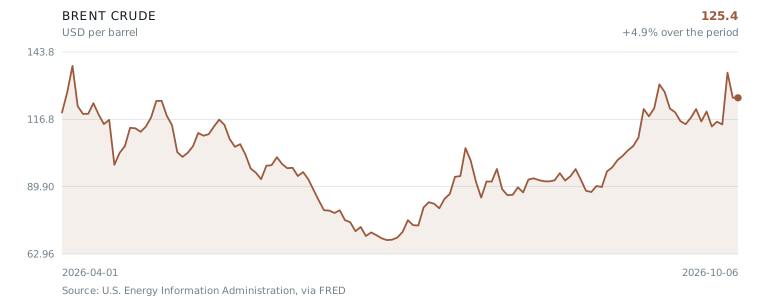
- 01Brent crude was $125.44 on 6 October.
- 02Trump announced he had spoken with Putin.
- 03Trump’s diesel deal is being framed as a new rift with Europe over Ukraine.
- 04Trump called for Zelenskyy to be replaced.
- 05Europe devoted a summit to funding Ukraine, and Ukraine issued a response to a Trump-Putin deal.
Interpretation, not reporting. The facts above carry their tiers; this is one correspondent’s reading of them.
I would not call this a deal yet. I see a pressure campaign: a presidential call, a diesel transaction and a leadership challenge bundled by opponents into a single threat. The real signal is Europe’s summit. If Kyiv’s backers respond with multi-year funding rather than one-season slogans, they are treating the risk as structural. If they do not, the diesel talk becomes more dangerous than it appears. My test is simple: watch for physical evidence — cargoes, insurance, port calls and refinery runs — before treating any US-Russia channel as a settlement architecture. Words move markets; diesel moves armies. Until a cargo actually shifts under new terms, the story is about leverage, not peace. That is the gap between rhetoric and enforceable terms.
— Tomás Ferreira
Every claim in this article, and what it rests on
We do not ask you to take our word for it. Each statement below carries its tier and its sources. Where sources disagree, you get both accounts and what would settle it.
Brent crude was $125.44 on 2026-10-06.
Trump announced that he had spoken with Putin.
Trump’s diesel deal opened a new rift with Europe over Ukraine.
Trump called for Zelenskyy to be replaced.
Europe devoted a summit to funding Ukraine.
Ukraine issued a response to a Trump-Putin deal.
The case against this story
Written by an adversarial reviewer, not the correspondent
The story constructs a narrative of a Trump-Putin deal over Ukraine's head, with a diesel deal causing a European rift, and ties this to a specific oil price. But the causal architecture is asserted, not demonstrated. Trump announcing he spoke with Putin does not constitute a deal. The diesel deal may be a routine commercial matter being framed as a geopolitical concession. The claim that Trump called for Zelenskyy to be replaced may overstate a more nuanced statement. And the Brent crude figure is presented at the highest confidence tier without apparent primary market data. The framing implies a coherent Trump-Putin axis against Ukraine and Europe that the individual claims, examined separately, do not fully support. Europe devoting a summit to Ukraine funding may be a routine diplomatic event rather than a response to a Trump-Putin arrangement.
Who benefits from this framing: Russia benefits from framing that normalizes the idea of Ukraine's fate being decided in U.S.-Russia bilateral dealings without Ukrainian input. Trump's domestic political opponents benefit from framing him as undermining Ukraine and European unity. Energy market speculators and fossil-fuel interests benefit from narratives linking political uncertainty to elevated oil prices, which can justify higher energy costs. European hawks benefit from framing that pressures governments toward harder lines on both Russia and the United States.
Report an error in this article
Subscriptions open at launch
Global Materials Review will be a paid publication. Reading is free while we build the archive — leave an address and we will write to you once, when subscriptions open.