
Diesel-deal talk and China's reported 4.5% test oil balance
A reported Russian diesel deal and stronger Chinese growth pull the near-term energy picture in opposite directions.
 Tomás FerreiraEnergy, shipping and chokepoints
Brent was $126.55 and West Texas Intermediate was $101.91 on 14 October, a $24.64 spread that shapes refinery margins. Crude prices are reported to have slipped as traders expected more diesel under a Russia-United States deal reported to have been agreed by the two presidents. Reported Chinese third-quarter growth of 4.5%, described as beating forecasts, pulls the demand side in the other direction.
On 14 October, Brent crude was $126.55 and West Texas Intermediate was $101.91. That gap of $24.64 is not a rounding error. It changes which barrels refiners can favor, which products they can make, and how much margin is left after freight.
At the same time, crude prices are reported to have slipped at the start of the week. Traders cited an expected increase in diesel supply under a Russia-United States diesel deal. The deal is reported to have been agreed by the presidents of Russia and the United States.
A wide spread changes the barrel choice
The price levels matter on their own. Brent and WTI are not the same physical market, so the gap alters the economics of running crude. When Brent trades $24.64 above WTI, cheaper WTI-linked barrels become more attractive, provided the refiner can take them.
For a refiner, the choice is not abstract. Cheaper crude can improve cracking margins if the plant can run it. But if product prices fall faster than crude, the margin disappears. That is why a reported diesel-supply agreement matters.
Diesel is the workhorse fuel for freight, farming, mining and shipping. If traders expect more diesel to reach the market, they will bid less for the crude needed to make it. The effect runs through cracks, then crude differentials, then physical cargoes.
The spread also determines whether cargoes can move economically between regions. When the gap widens, traders re-route barrels, charter vessels and test storage. That re-balancing can take weeks, because cargoes already on the water cannot be redirected without cost.
A diesel deal that needs proof
The reported deal is the central point of the near-term explanation. If it exists and is implemented, more Russian diesel could alter product balances. If it does not, the explanation for weaker crude prices loses force.
The assertion involves direct Russia-United States energy cooperation at presidential level. Until the terms, volumes and timing are visible, the market is trading a reported agreement rather than a confirmed flow. Confirmed flows would move freight and product prices first.
Freight and insurance would show the response before ministries do. Tanker positions, product cargoes and refinery runs offer a physical check on statements. For now, the reported presidential agreement should be treated as a condition, not a balance-sheet fact.
China's quarter pulls the other way
Reported third-quarter figures put China's economic growth at 4.5%. The numbers are described as beating forecasts and improving from the second quarter. If confirmed by the National Bureau of Statistics of China, they would support the demand side of the oil equation. A beat, if confirmed, would suggest fuel demand is not yet the weak leg of the trade.
China's growth matters because it moves more than GDP. Export-driven activity uses diesel for trucks and ports, bunker fuel for shipping, and feedstocks for petrochemicals. It also pulls copper through grids, wiring and industrial equipment.
The tension is simple. A reported diesel-supply increase points to softer product margins, while a stronger Chinese quarter points to firmer underlying demand. The near-term balance depends on which force arrives first: extra barrels on the water, or more factory output needing fuel.
The open question is whether the diesel deal can be verified in cargoes rather than headlines. If it cannot, the price slip may look like a positioning move. If it can, the $24.64 Brent-WTI gap may not stay comfortable for long. The next cargoes will say.
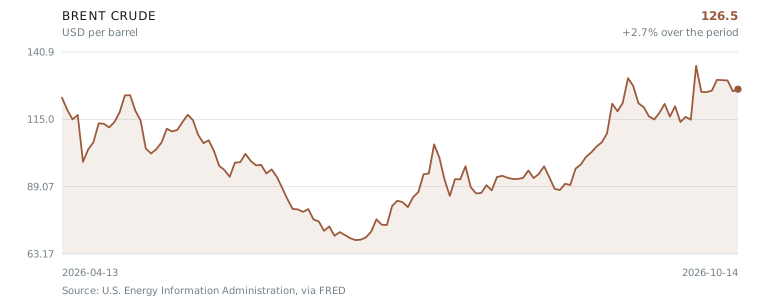
- 01Brent crude was $126.55 on 14 October.
- 02West Texas Intermediate was $101.91, leaving a $24.64 spread.
- 03Crude prices are reported to have slipped at the start of the week.
- 04Traders cited expected diesel supply under a reported Russia-United States deal.
- 05Reported figures put China's third-quarter growth at 4.5%.
Interpretation, not reporting. The facts above carry their tiers; this is one correspondent’s reading of them.
The market is pricing a reported diesel deal before the supply side has been proven. I would treat the presidential agreement as a condition, not a fact, because the crude-price slip depends on it. The $24.64 gap between Brent and WTI already changes the economics of crude selection. If traders are right about extra diesel, product margins should weaken first. If they are wrong, the early-week slip may simply reflect positioning around a wide spread. China's reported 4.5% third-quarter growth, described as beating forecasts and improving from the second quarter, pulls the other way. A stronger Chinese quarter supports demand for fuel and materials. The test is whether the diesel story survives contact with physical trade. That is the balance to watch.
— Tomás Ferreira
Every claim in this article, and what it rests on
We do not ask you to take our word for it. Each statement below carries its tier and its sources. Where sources disagree, you get both accounts and what would settle it.
Brent crude was $126.55 on 2026-10-14.
West Texas Intermediate crude was $101.91 on 2026-10-14.
China's economy grew 4.5% in the third quarter of 2026.
China's third-quarter GDP growth beat forecasts.
China's third-quarter GDP growth picked up from the second quarter.
Crude oil prices slipped at the start of the week.
Traders expected a boost in diesel fuel supply under the Russia-United States diesel deal.
The diesel deal was agreed by the presidents of Russia and the United States.
The case against this story
Written by an adversarial reviewer, not the correspondent
The story's causal chain rests on its weakest link: the claim that the presidents of Russia and the United States agreed a diesel deal. This is an extraordinary geopolitical assertion — implying a major breakthrough in Russia–US energy relations — yet it is presented at the same confidence level as routine market observations. If that deal does not exist or was not presidentially agreed, the entire narrative collapses: there is no expected supply boost, and the explanation for slipping crude prices evaporates. Separately, the Brent and WTI price points imply a spread of nearly $25, which is far beyond normal ranges and suggests at least one figure may be wrong. China's 4.5% GDP figure, the claim it beat forecasts, and the claim it picked up from the second quarter each require official confirmation from the National Bureau of Statistics of China, and none is independently corroborated within the story. The narrative is internally coherent but built on unverified extraordinary claims presented alongside mundane market observations, lending the whole an unwarranted air of reliability.
Who benefits from this framing: Parties seeking to normalise Russia–US energy trade or build the case for easing sanctions on Russian fuel exports benefit if readers accept that a presidential-level diesel deal exists. Oil traders or speculators positioned for diesel or crude price declines benefit if market participants act on the asserted supply-boost expectation. Entities with an interest in talking up China's economic recovery — including state media, bullish investors, or commodity exporters dependent on Chinese demand — benefit from the GDP framing being taken at face value.
Report an error in this article
Read everything for 14 days, free
All three titles in full, the full daily brief, and an alert when a claim about something you follow changes. No card, and it ends by itself.