
China's export surge and LNG deals meet $125 oil
A hot Chinese export print and long-dated LNG promises suggest demand, but $125 Brent raises the cost of believing it.
 Tomás FerreiraEnergy, shipping and chokepoints
China's September exports are reported up 36.3%, and long-dated LNG commitments tied to Qatar and Alaska are being read as signs of durable Asian energy demand. Brent at 125.44 on 6 October supports the price-risk argument, while Henry Hub at 3.03 points to a calmer gas market. The key test is whether announcements become contracted flows.
A 36.3% jump in Chinese exports and a $125.44 Brent price landed in the same week, but they do not tell the same story. The export figure points to factories, containers and bunker demand; the oil price points to risk premia, freight insurance and the cost of replacing lost barrels. One can be strong without the other being durable.
The export number is loud, the record is messy
The September trade release is being read as a 36.3% increase in China's exports. That is a big number for anyone watching fuel use, materials shipments and container bookings out of Asia. It also feeds directly into the energy ledger: more exports mean more factory runs, more inland trucking, more port calls and more fuel consumed before the cargo reaches water.
The same figure is being described as the biggest export leap since the pandemic. That label is less sturdy. Pandemic-era export growth was repeatedly distorted by low bases and abrupt shifts in demand, so a year-on-year percentage can flatter as much as it reveals. The useful question is not whether 36.3% is historically unique, but whether it reflects restocking, seasonal shipments or a broader recovery in Asian manufacturing.
For commodity markets, the channel runs through throughput. If September's strength persists, it should show up in higher port throughput, stronger product margins and more demand for refined fuels. If it is front-loaded, the effect fades within a quarter. Traders will know the difference when they see it in vessel fixtures rather than in a monthly percentage.
The two numbers do not confirm the same tightness.
LNG announcements move politics before steel
The energy side rests on announced LNG commitments, not yet on shipping schedules. A $3 billion LNG deal between China and Qatar is being cited, while President Trump says Taiwan has agreed to invest up to $4.4 billion in the Alaska LNG project and to buy 30% of its output over 20 years. Those are long-dated promises, and they matter because they attempt to convert future Asian gas demand into contracted cash flows.
But an announcement is not a cargo. A long-term LNG commitment needs liquefaction trains, storage tanks, loading jetties, credit support and vessels before it changes physical balances. Until there are signed offtake agreements, financing decisions and construction milestones, the market should treat these as political signals rather than supply. The Alaska account is especially sensitive because it comes from a single political source; unless Taipei or the developers confirm it, it remains a political signal.
Qatar is different. It is already named in a reported LNG deal with China, so the $3 billion figure reinforces a known commercial link rather than creating a new one. That matters for the Atlantic-to-Pacific arb: Qatari LNG can move east, but each diversion tightens the alternative basin. The question is not whether Asia wants gas; it is whether new contracts displace existing ones or add net demand.
Oil is pricing risk, gas is not
The price pair on 6 October is the cleanest signal. Brent crude at 125.44 is high enough to change refinery margins, product exports and the economics of long-haul freight. Henry Hub at 3.03, by contrast, is a much calmer North American gas signal. The two numbers do not confirm the same tightness.
A $125 Brent affects Asia through the invoice: higher crude import costs, wider product spreads and more pressure on utilities and refiners to secure cargoes earlier. It also changes routing. If oil is expensive, every extra day in transit becomes more costly, and buyers become more sensitive to chokepoint risk. That is where the demand signal and the price signal meet: strong exports can support fuel consumption, but high crude can compress demand by raising the cost of moving goods.
The open question is whether the physical market follows the paper. If Chinese export strength is real, it should appear in stronger product demand, higher freight rates and more energy imports over the coming months. If the LNG announcements are real, they should appear in project contracts and financing. Until then, the market has a loud export print, expensive oil and a stack of promises.
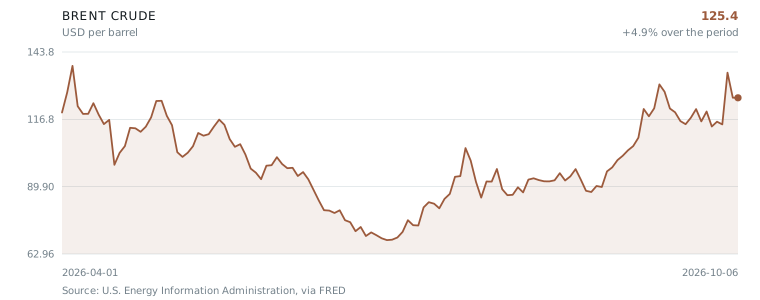
- 01Brent crude was priced at 125.44 on 6 October.
- 02Henry Hub natural gas was 3.03 on 6 October.
- 03China's September exports are reported to have grown 36.3%.
- 04A $3 billion China-Qatar LNG deal is being cited.
- 05President Trump says Taiwan may invest up to $4.4 billion in Alaska LNG and buy 30% of output over 20 years.
Interpretation, not reporting. The facts above carry their tiers; this is one correspondent’s reading of them.
The durable-demand story is plausible, but it is not yet physical. I see three separate signals: a 36.3% Chinese export print, a $125.44 Brent price and a set of LNG announcements tied to Qatar and Alaska. Only the first two are market observations; the Alaska numbers, including a $4.4 billion investment and 30% of output over 20 years, come from President Trump and remain political promises. The $3 billion Qatar deal is easier to place because it has a named counterparty and a stated amount. If the export strength shows up in freight and fuel demand through the quarter, and if the Alaska commitments turn into signed offtake agreements, the Asian-demand case becomes much stronger. If not, Brent is telling a risk story, not a demand story. The split between 125.44 oil and 3.03 Henry Hub gas is the cleanest warning.
— Tomás Ferreira
Every claim in this article, and what it rests on
We do not ask you to take our word for it. Each statement below carries its tier and its sources. Where sources disagree, you get both accounts and what would settle it.
The Henry Hub natural gas price was 3.03 on 2026-10-06.
Brent crude was priced at 125.44 on 2026-10-06.
China’s exports grew by 36.3% in September.
China’s September export growth was the biggest leap since the COVID-19 pandemic.
China has a $3 billion LNG deal with Qatar.
Taiwan agreed to invest up to $4.4 billion in the Alaska LNG project.
Taiwan committed to buying 30% of Alaska LNG project output over 20 years, according to President Trump.
The case against this story
Written by an adversarial reviewer, not the correspondent
The story's picture of surging Chinese economic power and a landmark US-Taiwan energy realignment rests on weak foundations. The claim that 36.3% export growth was 'the biggest leap since the COVID-19 pandemic' is contradicted by China's own customs history: in early 2021 China posted year-over-year export growth above 50% in multiple months due to base effects, so 36.3% cannot be the biggest leap since COVID even if the September figure is accurate. The Taiwan-Alaska LNG claims — a $4.4 billion investment and a 20-year commitment to buy 30% of output — are attributed to President Trump, a source with a well-documented record of overstating or fabricating deal specifics, and no independent confirmation from Taiwan's government, the project's developers, or any signed offtake agreement is cited. The commodity prices (Henry Hub at 3.03, Brent at 125.44) are presented as established facts without naming a market data source, and $125+ Brent would represent a significant price spike that demands specific verification. Taken together, the story assembles a dramatic narrative — China economically dominant, Taiwan pivoting to US energy, commodity prices confirming scarcity — from figures that are either internally contradicted, attributed to an unreliable single source, or unsourced.
Who benefits from this framing: Trade hawks and tariff advocates benefit from the narrative that China's exports surged by 36.3%, as it fuels arguments for tougher trade restrictions or decoupling. US energy exporters and Alaska LNG project backers benefit from the claim that Taiwan agreed to invest $4.4 billion and commit to 30% of output over 20 years, as it signals strong offtake demand for a long-delayed, capital-intensive project. President Trump personally benefits from the attribution of the Taiwan-Alaska LNG deal to him, allowing him to claim credit for a major energy and foreign-policy achievement. The overall framing — China economically dominant while Taiwan pivots toward US energy — serves those advocating for deeper US-Taiwan economic integration and a harder line against China.
Report an error in this article
Subscriptions open at launch
Global Materials Review will be a paid publication. Reading is free while we build the archive — leave an address and we will write to you once, when subscriptions open.