
China fuel exports jump as Russia reports tanker departure
A surge in Chinese refined exports, a Russian tanker claim and a Bali fuel drop point to uneven Asian distribution.
 Tomás FerreiraEnergy, shipping and chokepoints
China's September refined-product exports were reported at 7.16 million metric tons, up nearly 40% year-on-year. Moscow reported the departure of the first tanker carrying Russian oil. Fuel supply in Buleleng, Bali, was reported below 50%, while Brent and WTI were $24.64 apart on 14 October.
On 14 October, Brent crude was recorded at $126.55 and WTI at $101.91. The difference between the two prices was $24.64 a barrel. The price levels are recorded, but the figures do not explain the width of the spread. That is not a small gap: it is enough to change which cargoes can move, which refineries can compete and which routes pay.
The same set of signals now points from Asia. China's refined-product exports have jumped. Moscow reported the departure of a tanker carrying Russian oil. Fuel supply in part of Bali has fallen. None of these items, taken alone, settles the oil market. Together, they describe a market where crude prices are high and product distribution is uneven.
China's product flow is the heavy number
Mainland China's September refined oil product exports were reported at 7.16 million metric tons. The same figures show exports increased by nearly 40% year-on-year. That is the kind of change that alters regional balances, because refined products are the barrels that end up in trucks, ships, power plants and filling stations.
A surge of Chinese exports can add supply to nearby markets quickly. The timing matters: September cargoes are already moving or already delivered, not a promise for next quarter. The question for traders is whether this is a one-month spike or the start of a steadier flow.
A government can announce a departure; the sea either has a loaded tanker in it or it does not.
If the flow repeats, buyers in Asia may have more choices for spot cargoes. If it fades, the September number becomes a high-water mark rather than a trend. The figures do not say which it is. They only show the size of the move.
A tanker report needs a hull to follow
Moscow reported that the first tanker carrying Russian oil has departed. That is a statement about intent and capability, not yet a full shipping record. A departure becomes meaningful when it can be matched to a loading port, a vessel, a cargo size and, eventually, a discharge point.
For physical markets, the difference matters. A government can announce a departure; the sea either has a loaded tanker in it or it does not. The route also determines the economics. A cargo that travels farther uses more ship days, raises freight costs and shifts the timing of arrival.
The reported departure sits against a high Brent price. If the crude reaches a buyer, it adds to available supply. If it does not, the report is only words. The market does not yet know which it is.
Bali shows the downstream edge
In Buleleng, Bali, fuel supply was reported to have fallen below 50%. That is a local event, not a regional supply shock. But fuel systems often show stress first at the edge: a depot, a barge, a coastal terminal or a road delivery schedule.
A drop below 50% can force rationing, higher local transport costs or substitution by other fuels. The important point is not that one island is tight. It is that distribution risk can appear even when headline crude prices and export flows are moving in another direction.
The three signals do not point the same way. China's export jump can ease product availability in Asia. The Russian tanker report, if confirmed by a real voyage, could add crude supply. The Bali drop shows how quickly downstream inventories can thin. The $24.64 gap remains the price difference that cargoes must overcome.
The open question is whether the physical flows follow the headlines. A tanker needs a destination. Chinese exports need repeat cargoes. A local fuel shortage needs restocking. Until those show up, the market has numbers and claims, not a settled balance.
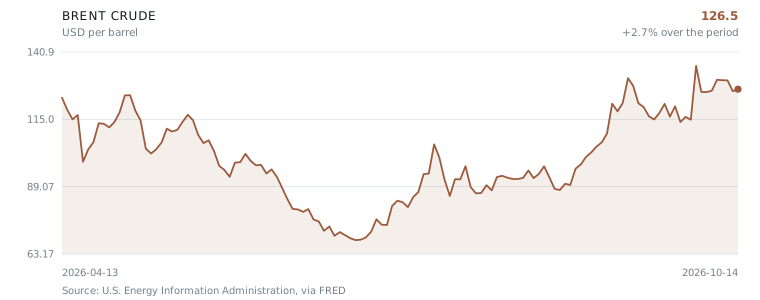
- 01Brent was recorded at $126.55 on 14 October; WTI at $101.91.
- 02The Brent-WTI spread was $24.64 a barrel.
- 03Mainland China's September refined-product exports were reported at 7.16 million metric tons, up nearly 40% year-on-year.
- 04Moscow reported the departure of the first tanker carrying Russian oil.
- 05Fuel supply in Buleleng, Bali, was reported to have fallen below 50%.
Interpretation, not reporting. The facts above carry their tiers; this is one correspondent’s reading of them.
The heavy signal is China's export jump, not the tanker headline. A reported 7.16 million metric tons of refined products leaving mainland China in one month can change Asian buying options quickly, even if crude prices remain elevated. I would treat Moscow's tanker departure as a placeholder until it becomes a trackable voyage: a departure is not a cargo until a port, a hull and a destination appear. The Bali fuel drop is too small to move the region, but it is the right kind of warning for distribution: inventories at the edge can fall before broader balances change. The $24.64 Brent-WTI gap tells me geography is still expensive. If China's export pace holds and the Russian tanker reaches a buyer, product and crude availability improve. If the September flow proves temporary, the market is left with high benchmarks and thin local cover. I would watch repeat cargoes before giving the headlines much weight.
— Tomás Ferreira
Every claim in this article, and what it rests on
We do not ask you to take our word for it. Each statement below carries its tier and its sources. Where sources disagree, you get both accounts and what would settle it.
Brent crude was recorded at 126.55 on 14 October 2026.
WTI crude was recorded at 101.91 on 14 October 2026.
Moscow reported that the first tanker carrying Russian oil has departed.
Mainland China's September refined oil product exports reached 7.16 million metric tons.
Mainland China's September refined oil product exports increased by nearly 40% year-on-year.
Fuel supply in Buleleng, Bali, was reported to have fallen below 50%.
The case against this story
Written by an adversarial reviewer, not the correspondent
The story assembles a patchwork of weakly sourced fragments to paint a picture of a tight, high-price oil market. Moscow's report that the first tanker carrying Russian oil has departed is a self-serving government claim with no independent verification — Russia has every incentive to demonstrate that its exports continue despite sanctions. Mainland China's September refined oil product exports reaching 7.16 million metric tons and rising nearly 40% year-on-year could reflect a temporary surge, quota front-loading, or strategic stockpile drawdown rather than a sustainable structural shift. The Bali fuel supply report is hyper-local — a single regency on a single island — and tells us nothing about regional or global supply conditions. The two crude price points (Brent at 126.55, WTI at 101.91) are presented without named sources, and the ~$24.65 Brent-WTI spread is unusually wide without any explanation. Each claim individually is thin; stitched together they create an impression of market strain that the underlying evidence does not robustly support.
Who benefits from this framing: Oil market bulls and energy commodity speculators benefit from a framing that emphasizes high crude prices, supply disruptions, and export surges — all signals that could justify long positions. Russian state and commercial interests benefit from the perception that Russian oil exports are flowing normally despite sanctions. Domestic energy producers and their political advocates benefit from narratives of tight supply and elevated prices, which support arguments for increased drilling, pipeline approvals, or strategic reserve releases. Financial analysts or funds already positioned long in crude or refined products benefit if readers accept the high-price, supply-constrained framing without scrutinizing the thin sourcing behind each individual claim.
Report an error in this article
Subscriptions open at launch
Global Materials Review will be a paid publication. Reading is free while we build the archive — leave an address and we will write to you once, when subscriptions open.