
Brent firm as strikes and Nord Stream trial test Europe
Firm oil and gas prices are colliding with reported strikes, a pipeline trial and an unverified policy sequence that could shape Europe's physical fuel risk.
 Tomás FerreiraEnergy, shipping and chokepoints
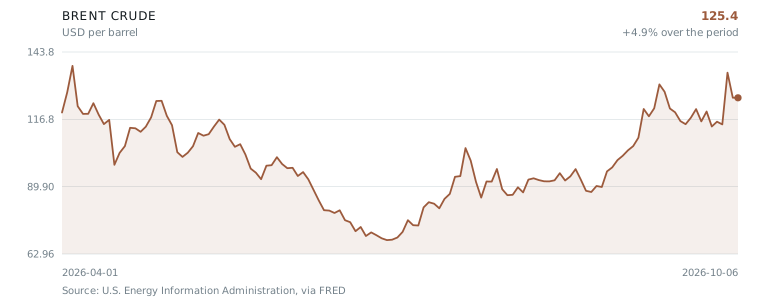
Brent crude at 125.44 dollars a barrel and Henry Hub gas at 3.03 give the only firm anchors in a fast-moving energy-security story. Reported Russian strikes on Ukraine, a statement by Zelenskyy on power cuts and a German Nord Stream trial revive infrastructure risk, but their details remain thin. The key question is whether timing hardens into verified flows and records.
On 6 October, Brent crude stood at 125.44 dollars a barrel, and Henry Hub natural gas stood at 3.03 dollars per million British thermal units. Those two prints are the firm ground in a story that has otherwise arrived as reports, statements and timing. Around them sit Russian strikes on Ukraine reported on 13 and 14 October, a statement from Zelenskyy that the attacks cut power to at least 600,000 people, and a German trial over the Nord Stream blasts said to involve a Ukrainian former officer.
The hard numbers are prices; the connective tissue is still unverified. That matters because energy-security risk is not a mood. It moves through freight, insurance, refinery runs, storage and backup generation, and each of those channels needs a quantity, a duration and a route.
Prices are firm, the sequence is not
Brent is the marker that matters most for diesel, jet fuel and seaborne crude. At 125.44 dollars a barrel, it is the number a procurement desk can put into a cost sheet. Henry Hub at 3.03 is a different animal: it prices gas at a U.S. benchmark and does not directly set European gasoil, but it gives a sense of how tight or loose the broader energy complex is.
The sequence around those prices is thinner. Russian strikes on Ukraine are reported for 13 and 14 October. Zelenskyy said the strikes cut power to at least 600,000 people. The timing reported for the attacks is four days after the Trump administration licensed imports. That is a temporal relationship, not a demonstrated cause. No licensing order, import category or official text accompanies the timing, so the market is being asked to weigh a policy link without the paperwork.
The hard numbers are prices; the connective tissue is still unverified.
For a physical trader, the difference matters. A price can be checked. A sequence needs a source. If the licensing action affected diesel, crude, equipment or something else entirely, the route to European balances would be different in each case.
Outages matter if they last
The clearest mechanism runs through electricity. If at least 600,000 people lost power, the immediate effect is domestic and municipal: water pumping, heating, communications and emergency services. The energy-market effect depends on duration. A short outage is a hardship; a long one can pull in diesel generators, divert fuel deliveries and strain local inventories.
None of the information available here says how long the cuts lasted, where they were concentrated, or whether industrial users were affected. That leaves the diesel impact as a conditional, not a measured flow. The question is not whether an outage can matter; it can. The question is whether it persists long enough to turn lost grid supply into extra fuel demand, or whether it simply shows another vulnerability in infrastructure already stretched by war.
The strikes also raise the familiar spatial problem. If Ukrainian power assets are hit repeatedly, repair crews, spare parts and fuel logistics become part of the same bottleneck. But again, the scale and duration are not established by the information available.
Nord Stream returns as a legal question
The Nord Stream element is separate but politically heavy. A trial in Germany over the blasts is reported to involve a Ukrainian former officer and is expected to run into February. If those details hold, the case would give the blasts a judicial record. But the details themselves are not anchored here by a docket, indictment or hearing record.
For commodity markets, the pipeline story matters less as a near-term supply route than as a marker of infrastructure risk. The legal aftermath can still shape politics, insurance and the perceived safety of subsea energy assets. The trial’s expected run into February means the issue could stay in the background through the winter, even if no physical cargo is directly affected.
The open question is whether the reported pieces harden into verifiable facts. The prices are already on the tape. The strikes, the outage figure, the licensing action and the trial still need records that a reader can check. The next test is whether those records appear.
- 01Brent crude was 125.44 dollars a barrel on 6 October.
- 02Henry Hub natural gas was 3.03 dollars per million British thermal units on 6 October.
- 03Zelenskyy said Russian strikes cut power to at least 600,000 people.
- 04Russian strikes on Ukraine are reported on 13 and 14 October.
- 05A German Nord Stream trial is reported to involve a Ukrainian former officer and to run into February.
Interpretation, not reporting. The facts above carry their tiers; this is one correspondent’s reading of them.
The market is being asked to price a chain that has not been proven. I would separate the Brent print of 125.44 and the Henry Hub print of 3.03 from the reported strikes, the reported Nord Stream trial and the licensing sequence. If Zelenskyy’s figure of at least 600,000 people without power turns into sustained outages, the physical route runs through generators, fuel logistics and industrial demand; if it is brief, the commodity impact should fade. The four-day gap after the Trump administration licensed imports is not evidence of causation. What would change my view is a visible court record, a clear licensing order, or repeated strike data that shows a pattern rather than a single two-day episode. Until then, the safest reading is that oil and gas are already carrying risk premia, while the narrative around them is still being tested.
— Tomás Ferreira
Every claim in this article, and what it rests on
We do not ask you to take our word for it. Each statement below carries its tier and its sources. Where sources disagree, you get both accounts and what would settle it.
The Brent crude price was 125.44 on 2026-10-06.
The Henry Hub natural gas price was 3.03 on 2026-10-06.
A Ukrainian ex-officer went on trial in Germany over the Nord Stream blasts.
The Nord Stream trial in Germany is expected to run into February.
Russian strikes on Ukraine occurred on October 13 and 14, 2026.
Zelenskyy said the Russian strikes cut power to at least 600,000 people in Ukraine.
The strikes occurred four days after the Trump administration licensed imports.
The case against this story
Written by an adversarial reviewer, not the correspondent
The strongest case against this story's overall picture is that it weaves five distinct event-claims— a Ukrainian ex-officer on trial in Germany for the Nord Stream blasts, a trial expected to run into February, Russian strikes on Ukraine on October 13–14 2026, Zelenskyy saying those strikes cut power to at least 600,000 people, and the strikes occurring four days after the Trump administration licensed imports—into an implied causal chain, yet no evidence block was actually supplied for any of them. The temporal framing ('four days after the Trump administration licensed imports') is the most dangerous element: it invites the reader to infer that the Trump policy action caused or enabled the Russian strikes, without stating causation outright and without citing the specific licensing order, its date, or what was being imported. Meanwhile the Nord Stream trial claims carry their own load: putting a Ukrainian ex-officer on trial frames Ukrainian state involvement in the pipeline sabotage as a matter of judicial record, but without a German court docket, indictment, or hearing transcript, the trial's existence, its February end-date, and the defendant's status as an 'ex-officer' are all unverified. The two commodity-price claims at the highest tier compound the problem by lending the whole package a veneer of quantitative precision that the underlying sourcing does not support. A reader who checks any single thread—court records, Ukrainian energy-grid outage reports, the Federal Register for the Trump licensing action, or exchange settlement data—finds no cited anchor for any of it.
Who benefits from this framing: Russian state narratives benefit from framing a Ukrainian ex-officer as the defendant in the Nord Stream case, because it shifts blame for the pipeline sabotage away from Russia and onto Kyiv regardless of the trial's outcome. Domestic US critics of the Trump administration benefit from the temporal juxtaposition of 'Trump licensed imports' with 'Russian strikes four days later,' since it implies his energy policy emboldened or enabled Moscow without requiring proof of a causal link. Fossil-fuel traders and producers benefit from any narrative that ties military escalation to elevated crude prices, because it normalises a higher price floor as a geopolitical rather than a supply-demand phenomenon. Finally, anyone who wants to pressure Germany or Ukraine into a particular settlement on Nord Stream liability benefits from a trial narrative that is already being reported as fact before any verdict.
Report an error in this article
Subscriptions open at launch
Global Materials Review will be a paid publication. Reading is free while we build the archive — leave an address and we will write to you once, when subscriptions open.