
Asian buyers retreat as LNG and coal prices bite
Falling Indian gas demand and Chinese coal imports suggest high prices are starting to ration physical energy purchases.
 Tomás FerreiraEnergy, shipping and chokepoints
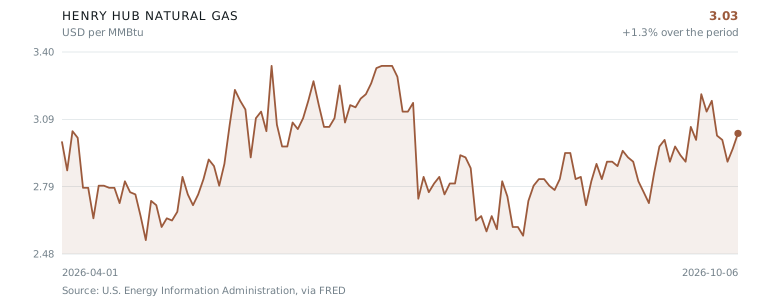
Henry Hub natural gas was priced at 3.03 on 6 October, while reported Asian market readings point to weaker buying. India's natural gas demand has declined by 1.5 million tons so far this year, according to figures being used to describe the market, and China's coal imports fell 6% in September from a year earlier. The open question is whether reported war-linked price gains are a temporary risk premium or the start of lasting demand destruction.
At 3.03 on 6 October, Henry Hub natural gas was not pricing a global emergency. The sharper signal was coming from the buyers who usually set the marginal price: India and China.
India's natural gas demand has declined by 1.5 million tons so far this year, according to figures being used to describe the market. The unit matters. A drop measured in million tons can refer to LNG imports alone, or to a wider gas balance that includes pipeline supply, industrial use and power generation. If the decline is broad, it points to slower economic activity or fuel switching. If it is concentrated in LNG, it points directly to import appetite.
China's coal imports fell 6% in September from a year earlier, according to reported figures, while Chinese coal inventories are described as ample. That is not necessarily a distress signal. When stockpiles are high, imports are the first lever to cut. But coal prices are reported to have hit nearly a three-year high, so the fall in imports is happening despite expensive replacement fuel. That looks less like comfort and more like buyers testing how much price they can bear.
The reported pullback in India and China fits the second version better than the first: buyers are not necessarily running out of fuel; they are refusing the marginal price.
The physical test is missing cargoes, not headlines
For a trader, the question is simple: is a cargo not moving, or is it moving at a price no one wants to pay? The Iran war is being blamed for choking LNG supplies from the Middle East and for lifting spot LNG prices. Those are two different problems. A choke can mean fewer loadings, longer routes, higher insurance, or all three. A price rise can come from risk, weather, outages or simple seasonal demand.
The strongest version of the supply story would show Middle Eastern cargoes failing to arrive and Asian buyers paying up to replace them. The weaker version shows cargoes still moving, but with higher freight, longer voyages and a risk premium that importers reject. The reported pullback in India and China fits the second version better than the first: buyers are not necessarily running out of fuel; they are refusing the marginal price.
Henry Hub complicates the picture. At 3.03, the U.S. benchmark is not confirming a global gas squeeze. It does not by itself set the price of an Asian LNG cargo, but it does show that at least one major gas market is not pricing panic. That gap between a moderate Atlantic benchmark and high Asian spot talk is itself important. It suggests the stress may be regional, logistical and political, rather than a uniform shortage of molecules.
Inventories change the meaning of a price spike
Ample Chinese coal inventories turn a high price into a different signal. If stocks were thin, a near three-year high in coal prices would force urgent imports. With stocks described as ample, utilities can wait. They can let the price rise while they burn stock, or they can switch to whatever fuel is cheaper at the margin. The import fall then becomes a measure of purchasing discipline, not necessarily of lost demand.
India's position is more exposed. A decline of 1.5 million tons in natural gas demand so far this year is large enough to matter to cargo schedules, but the market still needs to know where the cut is landing. Power plants can switch to coal or oil if gas becomes too expensive. Industrial users can curtail. City gas demand can soften. Each channel sends a different message to LNG sellers.
The open question is whether the reported war-driven LNG premium is a temporary risk charge or a lasting physical barrier. If Middle Eastern supply is merely rerouted, the market will eventually clear at a higher freight cost. If buyers stay away even when cargoes are available, the market is telling producers that the price is too high. The next signal will be whether Asian buyers return to the water, or keep living with lower purchases.
- 01Henry Hub natural gas was priced at 3.03 on 6 October.
- 02Reported figures show India's natural gas demand has fallen by 1.5 million tons so far this year.
- 03Reported figures show China's coal imports fell 6% in September from a year earlier.
- 04Chinese coal inventories are described as ample while coal prices are reported near a three-year high.
- 05The Iran war is being blamed for choking Middle East LNG supplies and lifting spot prices.
Interpretation, not reporting. The facts above carry their tiers; this is one correspondent’s reading of them.
The physical evidence points to price rationing before it points to shortage. I would not treat the Iran war as irrelevant, but I would also not treat it as proven cause of every Asian price move. The reported 1.5 million-ton decline in Indian gas demand could reflect LNG import cuts, fuel switching or weaker industry; the reported 6% fall in Chinese coal imports could simply follow ample inventories. Henry Hub at 3.03 also argues against a simple global gas panic. What ties the pieces together is the behaviour of buyers at the margin. If coal is near a three-year high and China still trims imports, and if India lets gas demand fall rather than pay spot prices, the market is testing the seller's number. The watch item is whether Middle Eastern cargoes keep moving and whether Asian utilities return when the risk premium cools. If they stay away, demand destruction is real. If they re-enter quickly, the disruption is mainly a route and insurance problem.
— Tomás Ferreira
Every claim in this article, and what it rests on
We do not ask you to take our word for it. Each statement below carries its tier and its sources. Where sources disagree, you get both accounts and what would settle it.
Henry Hub natural gas was priced at 3.03 on 2026-10-06.
China's coal imports fell 6% in September from a year earlier.
Chinese coal inventories remain robust.
Coal prices hit nearly a three-year high.
India's natural gas demand has declined by 1.5 million tons so far this year.
The Iran war choked LNG supplies from the Middle East.
The Iran war hiked LNG spot prices.
The case against this story
Written by an adversarial reviewer, not the correspondent
The story weaves together separate market developments into a narrative of Iran-war-driven energy disruption, but the causal links are overstated. The claim that the Iran war 'choked' LNG supplies implies severe disruption, but the evidence may only show partial reduction or cargo rerouting. The claim that the Iran war 'hiked' LNG spot prices assumes causation that may not be established—prices could have risen due to seasonal demand, maintenance outages, or other factors. India's natural gas demand decline is reported in unusual units (million tons) that may conflate LNG imports with total gas demand, potentially misrepresenting the underlying data. Meanwhile, China's coal import decline alongside robust inventories suggests adequate supply, not crisis—imports may have fallen precisely because stockpiles are sufficient. And Henry Hub at 3.03 is a moderate price by historical standards, which undercuts the narrative of global gas market disruption. The story appears to stitch together unrelated or loosely related developments into a misleading coherent narrative of energy market crisis driven by the Iran conflict.
Who benefits from this framing: LNG exporters and commodity traders benefit from a narrative of tight supplies and high prices, as it supports higher contract prices and justifies investment in new export capacity. Proponents of military escalation or sanctions against Iran benefit from framing the conflict as having severe economic consequences for global energy markets, building public support for intervention. Coal producers benefit from a story suggesting gas markets are unreliable and vulnerable to geopolitical disruption, supporting fuel-switching back to coal. Energy traders holding long positions in gas and coal benefit from a narrative of market tightness. Natural gas producers benefit from higher spot and contract prices justified by perceived supply disruption from the Middle East.
Report an error in this article
Subscriptions open at launch
Global Materials Review will be a paid publication. Reading is free while we build the archive — leave an address and we will write to you once, when subscriptions open.