
Aramco's squeeze warning meets a $29 WTI-Brent gap
Tight global balances, a large U.S. draw and a steep Alberta discount point to transport and quality bottlenecks rather than one simple shortage.
 Tomás FerreiraEnergy, shipping and chokepoints
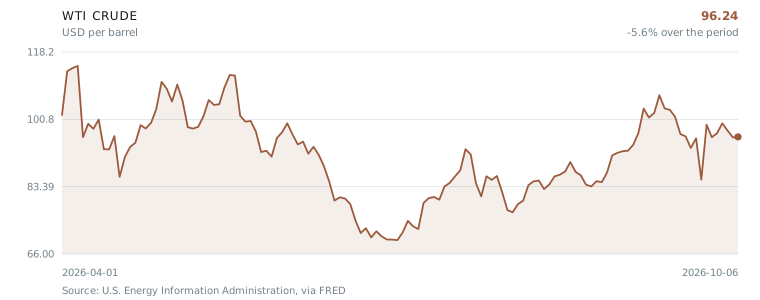
Brent at $125.44 and WTI at $96.24 on 6 October leave a $29.20 gap that sits awkwardly with a reported 8.6 million-barrel U.S. inventory draw. Aramco's chief executive warned that an oil squeeze is serious, while Alberta crude sells at a steep discount. The contradiction points to movement, quality and access rather than a single global shortfall.
A $29 gap against a falling stockpile
On 6 October, Brent was priced at $125.44 and WTI at $96.24. That leaves the U.S. benchmark $29.20 below the seaborne marker. In a simple shortage story, the gap would be narrowing, not sitting wide enough to pay for a long detour.
A reported 8.6 million-barrel fall in U.S. crude inventories in the week ending 9 October adds the usual bullish pressure. A draw of that size removes supply from the system and should, over the following days, make U.S. barrels more valuable relative to the world. Yet the 6 October pricing shows the opposite relationship: WTI is not being pulled toward Brent.
Brent is priced for cargoes that can move by tanker; WTI is priced for barrels that first must gather, store and travel through the U.S. system. When the two diverge, the spread is a map of constraints: pipeline capacity, export demand, refinery runs or quality mismatches.
The tension points to friction rather than pure scarcity. If barrels are falling in U.S. storage but still cannot reach the right refinery, export dock or quality blend at the right time, the price can remain weak at the landlocked point even as the seaborne market stays dear.
Aramco's chief executive has warned that an oil squeeze is serious. The warning comes from a seller, so it needs to be tested against freight, spreads and stock data.
The tension points to friction rather than pure scarcity.
Alberta's discount is a transport problem, not a global thermometer
Alberta oil is selling at a steep discount, according to market reports from the province. That fact can coexist with a tight global market. Canadian heavy crude is landlocked, and its netback depends on pipeline space, rail optionality and the appetite of refineries that can process it.
A steep discount in Alberta does not prove that the world is short of crude. It proves that, at that point, the cost of moving or upgrading the barrel is pressing on the price. If the discount widens while Brent holds high, the message is that the bottleneck is downstream of the wellhead: capacity, quality or access to water.
The discount also changes the signal sent to producers. A high Brent price should encourage output, but a weak local price blunts that incentive.
For refiners, this creates a split market. A complex refinery with coking capacity may see cheap heavy crude as margin support, but only if it can receive the grade. A simple refinery cannot switch into heavy sour crude just because it is cheap. For shipowners, the same dislocation can reward distance: a cargo that can reach tidewater becomes more valuable than one trapped inland.
Nine-day-old marks in a market that moves by the hour
The 6 October prices are nine days old by 15 October. In crude, nine days is not a footnote. A weekly inventory report, weather, a refinery unit returning or a change in cargo availability can move spreads before the next headline. The numbers above are therefore an anchor, not a live quote.
That age matters because the strongest tension is timing. If the U.S. draw is real and persistent, WTI should eventually firm against Brent. If the draw was a one-week event, or if it reflected local flows rather than true consumption, the wide spread may be the better guide. The market is asking whether the missing barrels are gone or merely misplaced.
Traders will likely watch two confirmations: whether the next inventory report repeats the draw, and whether the WTI-Brent gap narrows. One week of data can be noise; two weeks begins to look like a route.
The open question is physical: where would an extra Canadian or U.S. barrel go if the route closed, and how many days would the detour add? Until that question has an answer, the Aramco warning, the U.S. draw and the Alberta discount are not one story. They are three markets, priced differently, waiting for logistics to reconcile them.
- 01Brent was priced at $125.44 on 6 October.
- 02WTI was priced at $96.24 on 6 October, $29.20 below Brent.
- 03Aramco's chief executive warned that an oil squeeze is serious.
- 04U.S. crude inventories were reported down by 8.6 million barrels in the week ending 9 October.
- 05Alberta oil is selling at a steep discount.
Interpretation, not reporting. The facts above carry their tiers; this is one correspondent’s reading of them.
The spread is the tell. If the world were simply short of crude, a large U.S. inventory draw should have pulled WTI toward Brent, not left it $29.20 below. I read that gap as a logistics and quality problem: barrels exist, but they are not in the right place, in the right form, at the right time. Aramco's chief executive has an interest in calling the squeeze serious, yet the warning still matters because it comes from the sell side of the physical market. The Alberta discount reinforces the same point. A landlocked grade can be cheap while seaborne crude is dear, provided movement is constrained. I would watch whether the next U.S. inventory draw coincides with a narrower WTI-Brent spread. If it does, the tightening is becoming deliverable. If the draw repeats while the spread stays wide, the market is paying for friction, not scarcity. What would change my mind is a sustained convergence of the two benchmarks without a visible supply addition.
— Tomás Ferreira
Every claim in this article, and what it rests on
We do not ask you to take our word for it. Each statement below carries its tier and its sources. Where sources disagree, you get both accounts and what would settle it.
Brent crude was priced at 125.44 on 2026-10-06.
WTI crude was priced at 96.24 on 2026-10-06.
Aramco's chief executive warned that an oil squeeze is serious.
U.S. crude inventories fell by 8.6 million barrels in the week ending October 9.
Alberta oil is selling at a steep discount.
The case against this story
Written by an adversarial reviewer, not the correspondent
The story assembles bullish signals that collapse under their own contradictions. If U.S. crude inventories fell by 8.6 million barrels in a single week, the domestic market is tightening and WTI should converge toward Brent—not sit $29 below it. That spread, combined with falling stockpiles, is economically incoherent unless an unmentioned infrastructure disruption (pipeline rupture, refinery outage, export terminal closure) is driving both signals, in which case the story is withholding the actual explanation. Meanwhile, the Aramco CEO's warning that the squeeze is serious comes from a party with direct commercial interest in tight-market narratives: OPEC producers benefit when buyers accept higher prices as inevitable rather than policy-driven. The Alberta discount is a chronic structural condition rooted in pipeline capacity constraints, not evidence of an acute global squeeze. Finally, the price anchors are nine days old on a fifteen-day-old story; in a market that the story itself describes as squeezed and volatile, presenting stale prices as current market reality is misleading. Each component may be individually defensible, but together they form a picture that does not cohere.
Who benefits from this framing: OPEC producers and national oil companies benefit most: an oil-squeeze narrative justifies supply discipline and sustains high prices. Aramco's CEO benefits directly—a public warning about a serious squeeze supports Saudi production-management policy and discourages calls to increase output. Energy-sector investors and commodity speculators benefit from bullish sentiment that drives long positions. Pipeline advocates and Canadian oil sands producers benefit from the Alberta-discount framing, which supports arguments for new export infrastructure and government backing. Consumers and policymakers considering strategic reserve releases or demand-side measures are disadvantaged if they accept the framing uncritically.
Report an error in this article
Subscriptions open at launch
Global Materials Review will be a paid publication. Reading is free while we build the archive — leave an address and we will write to you once, when subscriptions open.