
Alaska LNG’s Taiwan pitch collides with Beijing’s warning
A claimed 20-year offtake from Taiwan could help Alaska gas economics, but Taipei’s hesitation and Beijing’s pressure leave demand unresolved.
 Tomás FerreiraEnergy, shipping and chokepoints
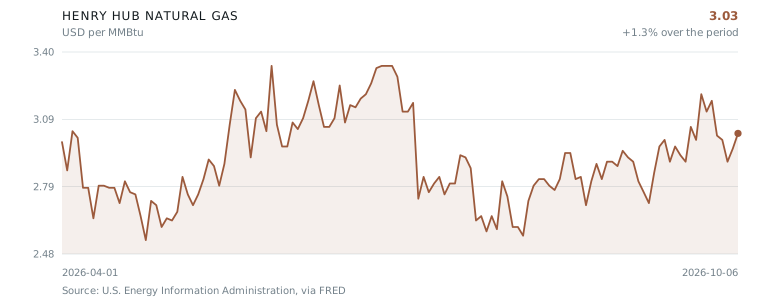
Trump said Taiwan had agreed to take 30% of planned Alaska LNG for 20 years, while Taipei says the purchase is not finalized. Beijing’s warning over Taiwan independence adds political risk to any cross-strait demand. The Henry Hub price at 3.03 on 6 October is a U.S. marker, but it does not settle project economics.
The U.S. Henry Hub natural gas price was 3.03 on 6 October. That number is the quiet part of this story. The loud part is a claimed 20-year commitment from Taiwan to take 30% of liquefied natural gas from a planned Alaska project, and the fact that Taipei says the purchase has not been finalized.
A 20-year claim, an unsigned buyer
President Donald Trump said Taiwan had agreed to buy 30% of the LNG from the planned Alaska project for 20 years. For a project that needs long-dated demand to support financing, construction and eventual loading operations, that is the kind of statement markets notice. A two-decade offtake can turn an undeveloped gas plan into a bankable export chain.
Taipei indicated that the Taiwan-Alaska LNG purchase had not been finalized. That distinction matters. A political declaration is not a cargo schedule, a sale-and-purchase agreement, or a board decision to commit public funds. Until the buyer confirms terms, the volume remains a negotiating posture rather than a physical flow.
In LNG trade, an anchor buyer does more than promise revenue. It allows developers to size equipment, secure transport capacity and contract ships with more confidence. Without that anchor, every later decision becomes heavier: metal, labor, permits and credit.
A claimed 30% allocation is not yet a vessel nomination.
The gap also changes the risk map. If Taiwan does not sign, the project must find other demand or accept a smaller anchor. If it signs late, the financing calendar slips. If it signs under political pressure, the contract carries a cross-strait premium that lenders, insurers and counterparties will price.
Beijing’s warning enters the demand file
Beijing warned Taiwanese people against acting “two-faced” on the issue of Taiwan independence. The warning followed television host Kevin Tsai Kang-yong’s attendance at a DPP rally. Kevin Tsai Kang-yong is a television host, and the sequence places a cultural-political event next to a much harder question: how much demand from Taiwan can be treated as stable when cross-strait rhetoric is this sharp?
The phrase “two-faced” is not a tariff or a shipping restriction. But it signals that Beijing is watching expressions of identity as closely as it watches official policy. In a market where identity and procurement can become entangled, that language is a risk factor.
The warning does not by itself cancel a gas contract. But it raises the cost of assuming that energy procurement can be separated from politics. For an LNG project, demand risk is not only about price spreads and shipping routes. It is also about whether a future government, a frightened utility or a pressured regulator will honor a long-term commitment.
That is why the Alaska pitch cannot be judged only as a commercial headline. The cargo would need to move from Alaska to the buyer over years, through political cycles and insurance reviews. A 20-year buyer is not a single signature; it is a political and legal relationship that must survive repeated stress tests.
The price marker does not settle the project
Henry Hub at 3.03 gives a reference point for U.S. gas, but it does not answer the Alaska question. The project still needs to prove that gas can be produced, moved, liquefied and loaded at a competitive cost. It also needs to show that a buyer will remain committed through the life of the contract.
For physical markets, the unresolved detail is simple. A claimed 30% allocation is not yet a vessel nomination. A warning from Beijing is not yet a blockade, but it is a reminder that cross-strait tension is not only a diplomatic issue; it is a pricing input. The open question is whether Taipei turns the Alaska conversation into a signed offtake, or leaves it as another unanchored pitch.
- 01Trump said Taiwan had agreed to buy 30% of planned Alaska LNG for 20 years.
- 02Taipei indicated the Taiwan-Alaska LNG purchase had not been finalized.
- 03Beijing warned Taiwanese people against acting “two-faced” on Taiwan independence.
- 04The warning followed television host Kevin Tsai Kang-yong’s attendance at a DPP rally.
- 05The U.S. Henry Hub natural gas price was 3.03 on 6 October.
Interpretation, not reporting. The facts above carry their tiers; this is one correspondent’s reading of them.
The Alaska pitch is best read as a financing signal, not a cargo. I would not treat Trump’s 30% statement as demand until Taipei produces a signed agreement. The commercial logic is clear: a 20-year offtake can help underwrite a project, and Henry Hub at 3.03 gives a familiar U.S. price marker. But the political overlay is where the model breaks. Beijing’s “two-faced” warning, arriving after Kevin Tsai Kang-yong’s DPP rally attendance, shows how quickly identity politics can contaminate energy procurement. If Taipei signs, I would watch whether the contract becomes public and whether delivery terms survive cross-strait pressure. If it does not sign, the Alaska project must either shrink, delay or hunt for less exposed demand. What would change my view is a public contract, a confirmed volume and a delivery window. Until then, the story is about optionality under pressure, not cargoes on the water.
— Tomás Ferreira
Every claim in this article, and what it rests on
We do not ask you to take our word for it. Each statement below carries its tier and its sources. Where sources disagree, you get both accounts and what would settle it.
The U.S. Henry Hub natural gas price was 3.03 on 2026-10-06.
President Donald Trump said Taiwan had agreed to buy 30% of the liquefied natural gas from a planned Alaska project for 20 years.
Taipei indicated that the Taiwan-Alaska LNG purchase had not been finalized.
Beijing warned Taiwanese people against acting 'two-faced' on the issue of Taiwan independence.
Beijing's warning followed television host Kevin Tsai Kang-yong's attendance at a DPP rally.
Kevin Tsai Kang-yong is a television host.
The case against this story
Written by an adversarial reviewer, not the correspondent
The story's overall picture is fragile because its two central claims directly contradict each other: Trump says Taiwan 'agreed' to buy 30% of Alaska LNG for 20 years, while Taipei says the deal had not been finalized. If the purchaser itself says nothing is locked in, Trump's assertion of an agreement is at best premature and at worst a misrepresentation of a tentative memorandum. Meanwhile, the story stitches together three only loosely related threads—an unconfirmed US-Taiwan energy deal, Beijing's 'two-faced' warning about Taiwan independence, and a TV host's appearance at a DPP rally—without establishing that they form a single coherent narrative. The claim that Beijing's warning 'followed' Kevin Tsai's rally attendance implies a causal or at least temporal link that may simply be editorial juxtaposition. Appending a Henry Hub price figure lends a false air of market-grounded analysis to what is essentially a political-hearsay story.
Who benefits from this framing: If a reader accepts this framing, Donald Trump benefits from an image of dealmaking prowess even though the counterparty denies finalization. Alaska LNG project backers and associated energy investors benefit from the impression that a major 20-year offtake commitment is secured, potentially attracting capital on a premise Taipei itself undercuts. Hardline voices on cross-strait politics benefit from a narrative that conflates a commercial energy transaction with Taiwan-independence agitation, making any Taiwanese commercial engagement with the US appear provocative to Beijing.
Report an error in this article
Subscriptions open at launch
Global Materials Review will be a paid publication. Reading is free while we build the archive — leave an address and we will write to you once, when subscriptions open.