
AI boom and reported record Los Angeles cargo look strong, but links are thin
Singapore’s advance growth figure and a port-reported record month at Los Angeles may point to stronger freight and materials demand, but the evidence does not yet connect them.
 Tomás FerreiraEnergy, shipping and chokepoints
Singapore’s advance GDP estimate and a port-reported record container month at the Port of Los Angeles both point to firmer activity. The copper figure attached to the story is precise but lacks market context. The bigger question is whether these signals turn into sustained demand for shipping, energy and industrial inputs.
Two strong readings, one weak bridge
Two numbers are doing the heavy lifting. Singapore’s GDP expanded 5.4% in the July-September quarter, according to advance government estimates, and reports describe the expansion as occurring amid an AI boom. The port says it handled 1,042,652 TEUs in September, which it describes as the busiest month in its 118-year history.
Those are solid-sounding anchors. But the bridge between them is thin. Singapore’s growth figure is an early estimate, not a final national accounts release, and the AI link is not broken out in the data. The Los Angeles figure is a container count, not a measure of what those boxes contain, who bought them, or whether they will be replenished next quarter.
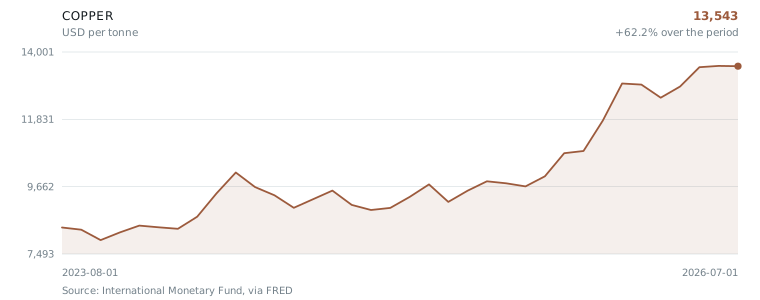
The copper element is even more fragile. The instrument record shows a copper value of 13,542.820869565219 on 1 July. That level of precision is unusual for a commodity quote, and no market context accompanies it. Without a source, unit or contract, the number reads more like an output from a data feed than a price a buyer could act on.
What the port record can and cannot say
The port says imports surged, but no magnitude is given. A surge could mean a sharp monthly jump, a seasonal peak, or a rebound from a weak prior period. The only hard figure available is the September total of 1,042,652 TEUs. That is enough to show scale, not enough to show momentum.
The record is in the box count; the proof is in the follow-through.
For materials demand, the mechanism matters. More containers may mean more goods moving through warehouses, more trucking, more fuel use and more need for handling equipment. But a reported record month at one port does not prove a broad industrial upturn. It may reflect routing choices, inventory timing or a front-loading of shipments. None of those alternatives requires an AI-driven expansion.
The same caution applies to Singapore. A 5.4% quarterly expansion is strong, but the available details do not identify which sectors produced it. If the lift came from activities tied to physical investment, the link to materials demand becomes more plausible. If it came from services or volatile activities, the link weakens. The bullish case asserts the AI connection; it does not demonstrate it.
The copper number is the tell
The copper value is the clearest warning sign. A copper reading can matter for materials demand, but only if it is tied to a market, a unit and a time-bound reference. The available figure has a date, a long decimal tail and nothing else.
Thirteen decimal places do not make a number more real. In commodity markets, they often suggest a calculated index, a conversion or a data-feed artifact rather than a traded price. The value could be meaningful if tied to a known contract or index, but the available details do not say so. Until then, it should be treated as a placeholder, not proof.
That leaves the strongest usable reported points: Singapore’s advance estimate showed quick growth, the port reported a record container month, and the port said imports rose. Those are worth watching. They do not yet add up to a confirmed materials supercycle. The record is in the box count; the proof is in the follow-through.
The next useful checks are whether Los Angeles follows September with another strong month, whether Singapore’s advance estimate survives revision, and whether the copper figure can be tied to a real market. Until those answers arrive, the demand case remains a promising alignment, not a confirmed trend.
- 01Advance government estimates put Singapore’s GDP growth at 5.4% in the July-September quarter.
- 02Reports describe Singapore’s expansion as occurring amid an AI boom.
- 03The port says it handled 1,042,652 TEUs in September and describes the month as its busiest in 118 years.
- 04The port says imports surged, but no magnitude is given.
- 05The instrument record shows a copper value of 13,542.820869565219 on 1 July.
Interpretation, not reporting. The facts above carry their tiers; this is one correspondent’s reading of them.
The useful question is not whether AI exists, but whether these three numbers form a chain. I see two real activity signals: Singapore’s advance 5.4% expansion and the port’s 1,042,652 TEUs. Both are large enough to matter. What is missing is the transmission: which Singapore sectors grew, what cargo moved, and whether the copper figure reflects a physical market. The copper reading bothers me most. Its thirteen decimal places look like a feed output, not a market price, and there is no unit or contract attached. If the port record is followed by another strong month and Singapore’s estimate survives revision, the demand argument becomes more credible. If not, this looks like a set of strong dots that do not yet connect.
— Tomás Ferreira
Every claim in this article, and what it rests on
We do not ask you to take our word for it. Each statement below carries its tier and its sources. Where sources disagree, you get both accounts and what would settle it.
The instrument record shows a copper value of 13,542.820869565219 on 2026-07-01.
Singapore’s GDP expanded 5.4% in the July-September quarter, according to advance government estimates.
Singapore’s economic expansion was reported amid an AI boom.
The Port of Los Angeles handled 1,042,652 TEUs in September.
The September TEU volume was the busiest month in the Port of Los Angeles’s 118-year history.
Imports surged at the Port of Los Angeles.
The case against this story
Written by an adversarial reviewer, not the correspondent
The story assembles a uniformly bullish picture: Singapore GDP up 5.4%, the Port of Los Angeles at an all-time record, imports surging, and a copper instrument reading at a lofty value, all loosely tied together by an 'AI boom' theme. But each load-bearing element is weaker than it appears. The AI connection to Singapore's GDP is asserted, not shown. The Port of Los Angeles 'busiest month in 118-year history' is a superlative that has not been demonstrated against the full historical record, and 'imports surged' gives no magnitude. The copper reading carries thirteen decimal places, which no real commodity quote uses, suggesting it may be a data artifact rather than a market price. Taken together, the story reads as a curated set of positive data points stitched into an optimistic narrative, with the weakest links being the interpretive claims (AI boom, surge, all-time record) and the suspiciously precise copper figure.
Who benefits from this framing: If a reader accepts this framing, the beneficiaries include Port of Los Angeles management and West Coast logistics interests who gain from record-volume publicity; AI industry stakeholders and tech investors who benefit from any narrative tying broad economic growth to an 'AI boom'; the Singapore government, which gains from positive GDP coverage; and commodity traders or analysts who would benefit if the implausibly precise copper reading is treated as a legitimate market data point rather than questioned.
Report an error in this article
Subscriptions open at launch
Global Materials Review will be a paid publication. Reading is free while we build the archive — leave an address and we will write to you once, when subscriptions open.