
A Texas refinery, a dhow strike and a fuel squeeze
The market must decide whether a military incident and a large inventory figure point to real fuel scarcity or noise.
 Tomás FerreiraEnergy, shipping and chokepoints

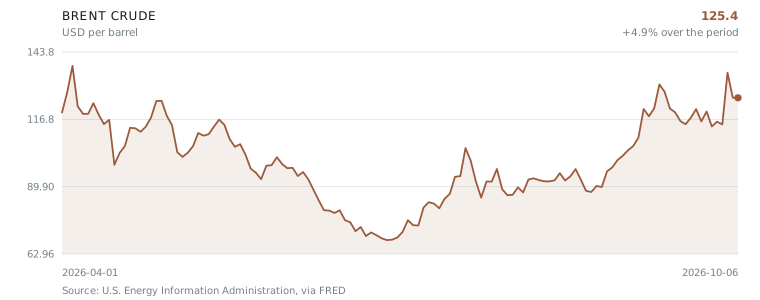
Brent traded above $106 and WTI was $96.24 on 6 October, while reports put US diesel above $6 without naming a benchmark. A reported US strike on an Iranian-affiliated dhow and an American Petroleum Institute figure of an 11.12-million-barrel crude draw add risk, but the causal chain is thin. The key question is whether product tightness becomes visible in inventories and pump prices before the midterm elections.
On 6 October, Brent crude traded above $106 while WTI sat at $96.24, leaving the international marker almost $10 above the US one. On the same day, reports said US forces destroyed an Iranian-affiliated dhow in the Gulf of Oman. The two facts meet in a market already sensitive to any hint of fewer barrels or longer voyages.
Prices are doing the arguing
The price pair is the clearest evidence. Brent above $106 is a global number; WTI at $96.24 is the inland US marker. The gap says the world market is tighter than the domestic one, or that transport, quality or export demand is pulling the seaborne price higher. For fuel users, the exchange rate between crude and products matters more than either headline. Crude is what refineries buy; diesel, gasoline and jet fuel are what fleets, farms and airlines actually consume.
Reports say US diesel prices remained above $6, but they do not name a geography, grade or benchmark. That distinction is load-bearing. A national average above $6 would press directly on household and freight budgets. A regional spike can still matter, but it points to local supply, weather or distribution rather than a nationwide shortage. The same caution applies to reports that US inflation is rising ahead of the midterm elections. Without a measure, period or magnitude, it is a direction, not a trend.
Until a second measure confirms it, the number is a flag, not a verdict.
A small refinery and a big inventory number
Two reported items try to connect the price picture to physical supply. The first is a report that the US invoked a 1950 authority to help boost fuel production at a small Texas refinery. If accurate, that is a political signal more than a volume answer. A small refinery can ease a regional hole, but it cannot by itself replace a large lost cargo or rebuild national stocks. The mechanism would be administrative: priority access to equipment, permits or materials that let a unit run harder or return sooner. The market would need to see that in output, not in the wording of an order.
The second is the American Petroleum Institute figure that US crude oil inventories fell by 11.12 million barrels in the week ending 9 October. That is a large weekly number, and it comes from a single industry source. A draw of that size would reduce the crude available to refineries at a time when product prices are already elevated. But inventory moves can also come from delayed imports, export surges, refinery runs or reporting timing. Until a second measure confirms it, the number is a flag, not a verdict.
The dhow does not close the Gulf
Accounts of the maritime incident are specific but limited. US forces are reported to have destroyed an Iranian-affiliated dhow in the Gulf of Oman on 6 October, and accounts accuse the vessel of conducting surveillance and helping target Navy ships. That places friction on a route that matters for Gulf crude and products. But one small boat does not shut a sea lane. The transmission channel, if there is one, runs through risk premia, tanker routing and the willingness of charterers to load in exposed waters.
That is where physical markets differ from headlines. A naval incident can move prices when it changes the probability of delay, attack or insurance cost. It does not need to sink a tanker to matter; it only needs to make a voyage more expensive or less certain. In the Gulf of Oman, the alternative is not another short route. It is longer waiting, higher cover or a different loading pattern, and those costs can reach the product market within days or weeks.
The open question is whether the pieces fuse. Brent above $106 and WTI at $96.24 are hard numbers. The dhow strike, the Texas refinery action, the $6 diesel figure and the 11.12-million-barrel draw are reported with less confirmation. If the draw is validated and diesel strength spreads beyond a local quote, the inflation story becomes physical. If not, the market may have simply stacked a military headline on top of an already tight price.
- 01Brent crude was above $106 on 6 October.
- 02WTI crude was $96.24 on 6 October.
- 03Reports say US forces destroyed an Iranian-affiliated dhow in the Gulf of Oman on 6 October.
- 04The American Petroleum Institute said US crude inventories fell by 11.12 million barrels in the week ending 9 October.
- 05Reports say US diesel prices remained above $6, without a specified geography or benchmark.
Interpretation, not reporting. The facts above carry their tiers; this is one correspondent’s reading of them.
The market is being asked to connect three separate dots before any of them is fixed. I can see how a trader would lean toward risk: Brent above $106, WTI at $96.24 and a reported dhow strike in the Gulf of Oman all land on the same day. But I would keep the physical test separate from the military one. The Texas refinery action, if real, is political more than volumetric; a small unit does not rebalance a national fuel market. The 11.12-million-barrel inventory figure is the number I would watch, because it is large and comes from the American Petroleum Institute alone. The diesel figure needs a geography before it becomes an inflation story. If the draw is confirmed and the $6 diesel level proves broad, the price move starts to look like physical tightness. If not, I would treat the dhow as a hazard on the map, not the cause of the curve.
— Tomás Ferreira
Every claim in this article, and what it rests on
We do not ask you to take our word for it. Each statement below carries its tier and its sources. Where sources disagree, you get both accounts and what would settle it.
Brent crude was above $106 on 6 October 2026.
WTI crude was $96.24 on 6 October 2026.
US inflation is rising ahead of the US midterm elections.
The US invoked a 1950 authority to help boost fuel production at a small Texas refinery.
US diesel prices remained above $6.
US forces destroyed an Iranian-affiliated dhow in the Gulf of Oman on 6 October 2026.
The destroyed dhow was accused of conducting surveillance and helping target Navy ships.
US crude oil inventories fell by 11.12 million barrels in the week ending 9 October 2026, according to the American Petroleum Institute.
The case against this story
Written by an adversarial reviewer, not the correspondent
The story stitches together loosely worded assertions with specific-sounding data points to manufacture a single crisis arc. 'Inflation is rising' names no measure (CPI, PCE, PPI), no timeframe, and no magnitude—a single month's uptick could be called 'rising' without indicating a trend. 'Diesel prices remained above $6' specifies no geography, no grade, and no benchmark; the U.S. national average retail diesel price has historically sat well below $6 per gallon, so the claim may describe a regional spike rather than a national condition. The crude inventory draw of 11.12 million barrels is extraordinarily large—roughly two to three times a typical weekly change—and is presented at the lowest confidence tier, which undercuts its role as a load-bearing pillar of the narrative. The dhow incident, the oil-price figures, and the inventory data are all dated within days of each other, inviting the reader to infer causation (military confrontation drives prices up, draws down stocks) when only temporal proximity is established. A single small naval engagement in the Gulf of Oman would not by itself move Brent above $106; global crude pricing reflects supply, demand, OPEC policy, macroeconomic conditions, and inventory expectations far more than one localized skirmish. The '1950 authority' invoked for a 'small Texas refinery' is oddly narrow—if the Defense Production Act were genuinely invoked for fuel production, it would more likely apply to broader capacity, and the specificity about refinery size may be a detail added for verisimilitude rather than verified fact. Taken together, the story's power comes from juxtaposition, not demonstrated causation.
Who benefits from this framing: Political challengers to the incumbent administration benefit from a pre-midterm framing that fuses economic pain (inflation, $6 diesel, falling inventories) with national-security failure (Iranian-affiliated forces targeting Navy ships). Oil producers and commodities speculators benefit from any narrative that normalizes Brent above $106 and signals tightening supply, as it supports higher price expectations and long positioning. Defense and national-security hawks benefit from an elevated Iran-threat framing that justifies more aggressive regional posture or funding. Media outlets benefit from crisis-driven engagement and click-through. Each of these actors has an interest in the reader accepting that discrete, possibly unrelated events form one coherent downward spiral.
Report an error in this article
Subscriptions open at launch
Global Materials Review will be a paid publication. Reading is free while we build the archive — leave an address and we will write to you once, when subscriptions open.